

TL;DR:
- Emerging markets are increasingly driven by nonbank capital flows, requiring early signal detection and scenario planning.
- Effective risk management involves monitoring capital composition, currency stress, and global conditions to capitalize on volatility.
Emerging markets have long carried an undeserved reputation as the exclusive territory of risk-hungry speculators. That narrative is not just outdated — it actively costs executives the opportunities they need to stay ahead. As nonbank capital flows into emerging markets at accelerating pace, the executives who will lead their sectors in the next decade are the ones who can read capital signals early, design scenarios around volatility, and act before the rest of the market catches on.
Table of Contents
- Redefining risk and opportunity in emerging markets
- Timing, scenario design, and the role of global conditions
- Harnessing market intelligence for sustainable growth
- Comparing mature and emerging markets: Strategic implications
- Why conventional wisdom about emerging markets is outdated
- Explore competitive intelligence solutions for emerging markets
- Frequently asked questions
Key Takeaways
| Point | Details |
|---|---|
| Capital flow strategy | New capital flow patterns require agile scenario planning for executive advantage. |
| Global condition sensitivity | Emerging markets respond quickly to trade tensions, inflation, and energy shocks. |
| Market intelligence adoption | Using data and technology tools sharpens risk management and growth forecasting. |
| Strategic timing | Entering emerging markets at the right moment maximises opportunity and minimises risk. |
| Comparative analysis | Side-by-side evaluation of mature versus emerging markets clarifies unique strategies. |
Redefining risk and opportunity in emerging markets
The word "risk" gets thrown around carelessly when emerging markets come up in boardroom discussions. But risk is not a fixed quality. It shifts as capital structures evolve, as geopolitical alignments reorder trade routes, and as technology gives smaller economies the tools to leapfrog industrial-era constraints.
One of the most consequential shifts happening right now is the move from bank-led to nonbank capital in emerging markets. Traditional bank lending offered a relatively predictable structure: regulated institutions, documented exposure limits, and established crisis-response mechanisms. Nonbank capital, which includes hedge funds, private equity, sovereign wealth vehicles, and institutional asset managers, operates with different incentives and different exit speeds. When sentiment turns, nonbank investors can pull capital far more rapidly than a regulated lender would, which creates sharper currency swings and borrowing-cost spikes. As nonbank capital challenges grow, the edge-case scenario executives must plan for is a capital-flow reversal amplified by this structural shift.
This does not mean avoiding emerging markets. It means understanding the landscape you are entering. The key examples of emerging markets across Southeast Asia, Sub-Saharan Africa, and Latin America show a consistent pattern: volatility creates entry windows as much as it creates exits. Those who prepare for sharp reversals are positioned to capitalise on the valuation compression those reversals produce.
What the opportunity framework looks like in practice:
- Capital-flow monitoring: Watch the composition of inflows, not just the volume. A surge driven by short-duration nonbank flows signals fragility.
- Currency-stress indicators: Track real effective exchange rates alongside central bank reserve adequacy.
- Borrowing-cost differentials: Sovereign spreads over reference rates reveal how markets are pricing political and economic risk in real time.
- Structural growth drivers: Demographics, urbanisation rates, and digital adoption curves provide the long-term foundation underneath short-term volatility.
| Factor | Mature markets | Emerging markets |
|---|---|---|
| Capital source | Predominantly bank | Mixed bank and nonbank |
| Volatility profile | Lower, more predictable | Higher, but opportunity-rich |
| Growth ceiling | Moderate | Significant upside |
| Reversal risk | Lower | Elevated during shocks |
Statistic to note: Nonbank financing now constitutes a growing share of cross-border flows into developing economies, increasing the speed at which sentiment can shift when global conditions deteriorate.
Pro Tip: When assessing an emerging market for entry, map the sources of capital inflows before you assess the headline GDP growth rate. Capital composition tells you more about short-term vulnerability than any single macroeconomic indicator.
The market intelligence trends shaping 2026 make it clear that early-signal detection is no longer a luxury reserved for the largest institutions. Mid-market firms with the right tools can now access data that was previously the exclusive domain of major investment banks.
Timing, scenario design, and the role of global conditions
Timing is not about predicting the future. It is about understanding which conditions need to be in place before a market becomes viable for your specific strategic goals, and which conditions would make you exit or pause. That distinction matters enormously in emerging markets.
The IMF World Economic Outlook commentary is explicit that conflicts and trade tensions hit emerging markets hardest, particularly through energy and food price shocks, inflation persistence, and confidence-driven financial tightening. These are not hypothetical tail risks. They are recurring features of the global environment that executives must build into their scenario models before committing capital or expanding operations.
Energy price volatility, for instance, affects emerging market economies at multiple levels simultaneously. Higher energy costs raise production expenses, compress consumer spending power, push inflation, and force central banks to tighten monetary policy. That tightening then strengthens the local currency in the short term, which reduces export competitiveness and damages the corporate earnings that foreign investors were tracking. The chain reaction is well-documented and fast-moving.
"Many opportunities arguments depend on favourable global conditions. Conflicts and trade tensions can hit emerging markets hardest via energy and food shocks, inflation persistence, and confidence-driven financial tightening — so timing and scenario design matter." — IMF World Economic Outlook
The actionable takeaway for executives is that scenario design must be explicit about global preconditions. Do not simply model a baseline opportunity. Build three or four scenarios that vary the global energy price environment, the state of trade policy between major blocs, and the monetary policy stance in the United States and the eurozone. Each of those variables has a documented transmission mechanism to emerging market borrowing costs and currency stability.
Here is a practical sequence for scenario planning in emerging markets:
- Define your entry thesis clearly. What specific opportunity are you pursuing, and what conditions must hold for it to be viable?
- Identify the two or three global variables most likely to disrupt your thesis. Energy prices, trade policy, and developed-market interest rates are usually the most powerful.
- Map transmission mechanisms. How does a 30% rise in oil prices flow through to inflation, central bank policy, and consumer demand in your target market?
- Assign probability weights. These do not need to be precise. They need to force you to think about which scenarios deserve contingency plans.
- Set trigger indicators. Agree in advance on the observable signals that would prompt you to accelerate, pause, or exit.
The actionable trends for business growth that separate leading firms from lagging ones almost always trace back to this kind of structured scenario thinking. Executives who can articulate their assumptions and the conditions that would invalidate them make better decisions under pressure than those who rely on a static market report.
Pro Tip: Build your scenario trigger indicators into a live dashboard. Static reports age quickly in emerging markets. You need to see the signals move in real time, not read about them three months later.
The strategies for new opportunities in volatile markets consistently emphasise one principle: the objective is not to eliminate uncertainty, but to ensure that your organisation can respond faster than your competitors when conditions shift.
Understanding global data trends gives you the early-warning layer that separates reactive from proactive strategy.
Harnessing market intelligence for sustainable growth
Good strategy without good data is guesswork dressed in professional language. In emerging markets, where information asymmetry is often extreme, market intelligence is not just a competitive advantage — it is a prerequisite for responsible entry.

The IMF's analysis confirms that confidence-driven financial tightening can affect opportunities even in markets that look structurally sound. That means executives cannot rely solely on fundamentals. Sentiment, capital-flow velocity, and early signals of institutional positioning all need to sit inside your intelligence framework.
Here is what a robust intelligence approach looks like in practice:
- Real-time trend tracking: Monitor sector-specific momentum signals across target geographies, not just national-level macro data.
- Capital-flow composition analysis: Distinguish between long-term foreign direct investment and short-term portfolio flows. The ratio tells you about the durability of growth conditions.
- Sentiment indicators: Bond spreads, credit default swap pricing, and currency forward markets all encode market sentiment before it appears in headline data.
- Supply chain signal monitoring: In emerging markets, supply chain disruptions often precede broader economic stress by several months. Tracking logistics pricing and trade volume data gives you lead time.
- Technology adoption curves: Digital financial services penetration, mobile commerce growth, and infrastructure investment rates indicate where consumer markets are heading in the medium term.
The market intelligence trends that are reshaping competitive strategy in 2026 point clearly towards AI-driven signal extraction as the standard for leading organisations. The volume of data available from emerging markets has grown faster than any human analyst team can process. The firms winning are those using technology to separate signal from noise at scale.
Looking at disruptive trend examples across sectors, the pattern is consistent: the organisations that identified the trend early built structural advantages that late entrants struggled to close, regardless of capital availability.
Pro Tip: Do not treat market intelligence as a one-off research exercise. Build it as a continuous monitoring capability. The emerging market landscape in 2026 moves too quickly for quarterly reviews to be sufficient.
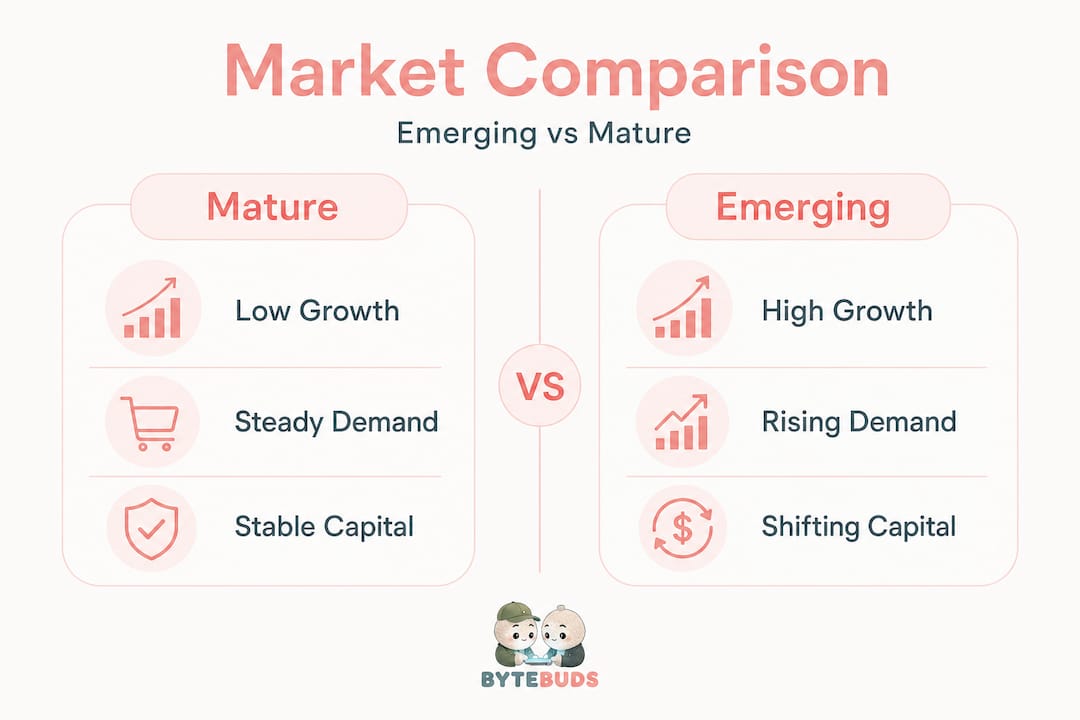
Comparing mature and emerging markets: Strategic implications
Understanding where emerging markets differ from mature ones is not an academic exercise. It has direct implications for how you structure investments, manage local operations, and set board-level expectations.
| Strategic dimension | Mature market | Emerging market |
|---|---|---|
| Growth potential | 1 to 3% typical GDP growth | 4 to 7%+ in high-momentum markets |
| Regulatory stability | High, well-documented | Variable, evolving rapidly |
| Currency risk | Low to moderate | Elevated, especially during global shocks |
| Borrowing cost sensitivity | Moderate | High, amplified by nonbank capital presence |
| Consumer market maturity | Saturated in many sectors | Rapid expansion in core categories |
| Data availability | Comprehensive, standardised | Patchy, requires local intelligence sources |
| Exit liquidity | High | Lower, especially in smaller economies |
The capital-flow reversal risk that the IMF highlights is most pronounced in markets where nonbank capital represents a high share of total external financing. When global risk appetite contracts, those markets experience disproportionate currency depreciation and borrowing-cost stress. Executives must factor this into both entry valuations and financing structures.
Here is a practical sequence for mitigating the specific risks that distinguish emerging from mature market exposure:
- Hedge currency exposure actively, not just at entry. Emerging market currency volatility requires rolling hedges reviewed at monthly intervals.
- Diversify financing sources. Avoid over-reliance on any single capital source, particularly short-duration nonbank instruments.
- Establish local intelligence partnerships. On-the-ground networks see regulatory shifts, political developments, and supply disruptions earlier than any global data feed.
- Set realistic exit timelines. Liquidity in emerging markets is thinner. Build exit assumptions into your original investment thesis.
- Monitor the trends that shape business decisions in your target sectors continuously, not periodically.
The comparison is not about favouring one market type over another. It is about knowing which tools, structures, and intelligence capabilities are appropriate for the environment you are operating in.
Why conventional wisdom about emerging markets is outdated
Most risk frameworks applied to emerging markets were designed for a world where bank lending dominated cross-border flows, information moved slowly, and geopolitical conditions were relatively stable. None of those assumptions hold in 2026.
The old model treated emerging market risk as a static label. A country was risky or it was not. Executives applied a flat discount rate to cash flow projections and moved on. That approach systematically underestimates the speed at which conditions change and overestimates the cost of entering at the right moment versus waiting for certainty.
The shift to nonbank capital dominance has fundamentally changed the risk topology. Capital-flow reversals now happen faster, hit harder, and create sharper entry windows in their aftermath. Executives who understand this dynamic are not managing more risk. They are managing risk more intelligently.
What we observe consistently is that the executives who perform best in emerging markets are not the most risk-tolerant. They are the most scenario-literate. They have internalized the IMF's insight that timing and scenario design determine outcomes more than market selection. They know which conditions they need, they monitor those conditions in real time, and they act decisively when the window opens.
Market intelligence and forward-looking signal detection are no longer optional layers for sophisticated investors. They are baseline operational necessities for any executive serious about emerging market strategy. The data-driven edge is now the primary differentiator between organisations that grow through volatility and those that retreat from it.
The executives reading static country risk reports and waiting for stability that never comes are not being prudent. They are ceding ground to competitors who have built the intelligence infrastructure to act early and decisively.
Explore competitive intelligence solutions for emerging markets
Knowing the frameworks is the starting point. Operationalising them at the speed emerging markets demand is where most organisations hit a wall.

OnTheRice is built specifically for this challenge. The platform's AI engines scan global data points across sectors and geographies, extracting the early signals that give executives a meaningful lead on competitors still waiting for consensus views. The B2BSignals platform delivers real-time business intelligence signals drawn from multiple data streams, helping strategy teams monitor capital flows, sector momentum, and risk indicators without the lag of traditional research cycles. For executives focused on identifying where high-growth potential is building before it becomes common knowledge, the AI-powered opportunities tool provides ranked insights scored by momentum and signal strength. Teams looking to go deeper into specific markets can access emerging market whitepapers developed to support scenario planning and entry strategy.
Frequently asked questions
What are the main challenges in entering emerging markets?
Currency volatility, elevated borrowing costs, and sensitivity to global shocks are the primary concerns. As capital-flow reversals amplify these risks during stress events, executives must plan for structural shifts in financing composition before they materialise.
How does global conflict or trade tension impact emerging markets?
Conflicts and trade tensions hit emerging markets hardest through energy and food price shocks, persistent inflation, and confidence-driven financial tightening, which restrict access to capital and compress growth outlooks rapidly.
What makes emerging markets attractive despite higher volatility?
Rapid consumer market growth, digital adoption curves, and favourable demographics create structural growth tailwinds unavailable in mature markets. Nonbank capital inflows also create periodic valuation opportunities for well-prepared executives who can act when conditions shift.
How can executives reduce risk when exploring emerging markets?
Structured scenario planning, real-time market intelligence, and active currency hedging are the most effective risk-reduction tools. As the IMF's analysis confirms, timing and scenario design matter more than market selection alone in determining outcomes.