

For UK business professionals, Ontherice is the strongest pick among trend discovery platforms in 2026, combining multi-engine AI detection with transparent scoring, UK-relevant data coverage, and exportable signals via API and CSV.
Three reasons it earns that position:
- Early detection lead time. Ontherice surfaces rising signals before they reach mainstream awareness, giving teams a meaningful opportunity to act rather than react.
- Explainability and transparency. The platform publishes its ranking methodology and lets users query live AI for the reasoning behind any signal score, which is rare in this category.
- Integration-ready outputs. API access and CSV exports mean signals feed directly into BI tools, content calendars, and product backlogs without manual copying.
Table of Contents
- What do trend discovery platforms actually do?
- What features should you check before choosing a platform?
- How do you verify that a platform actually covers the UK market?
- What does a trend platform typically cost for UK buyers?
- Why does Ontherice lead for UK professionals?
- Key takeaways
- Why UK-specific coverage changes the recommendation
- Try Ontherice for your next UK trend brief
- Useful sources
What do trend discovery platforms actually do?
These platforms deliver early signals: ranked, scored indicators that something is gaining momentum in a market before it becomes obvious. The signal types vary. Search volume shifts (monitored via tools like Google Trends), social listening data, news frequency, retail sales patterns, and job posting volumes are the most common sources. A good platform ingests several of these simultaneously, filters the noise, and presents a scored, time-stamped signal a team can act on.
The people who rely on them most are market intelligence teams, product managers, investors, and strategic planners. A product manager might watch for rising job-posting clusters in a new technology category. An investor might track search-volume acceleration in an emerging sector. A marketing team might catch a cultural moment well before it peaks. The platform's job is to surface that signal early enough to matter.
What features should you check before choosing a platform?
Three features are non-negotiable: multi-source data ingestion, transparent scoring with explainable methodology, and export or integration capability. Everything else is secondary.
The table below maps the key evaluation axes you should apply to any shortlist.
| Evaluation axis | What to look for | Why it matters |
|---|---|---|
| Primary use case | Early detection, consumer insight, or investment signals | Mismatched use case means irrelevant signals |
| Data breadth & UK coverage | Named UK sources, geo-tagged feeds, local news and retail | Signals must reflect your actual market |
| Signal freshness | Update cadence: real-time, daily, or weekly | Stale signals lose their lead-time advantage |
| Explainability | Published scoring rubric, source citations per signal | Unexplained scores cannot be defended to stakeholders |
| Integrations & export | REST API, CSV, BI connectors (Power BI, Tableau) | Signals must flow into existing workflows |
| Alerting & UX | Custom queries, threshold alerts, dashboard filters | Reduces manual monitoring effort |
| Pricing model | Freemium, subscription, or microtransaction (Access Points) | Determines total cost at scale |
A practical scoring rubric: rate each axis qualitatively, weight the axes by your team's priorities, and total the scores. A platform that scores 3 on explainability but 1 on UK coverage is the wrong choice for a UK-focused strategy team, regardless of its overall total.
Capability thresholds worth checking before you sign anything:
- At least two named UK data sources (news, retail, or social)
- API endpoints with documented rate limits
- Signal update cadence of daily or faster for real-time use cases
- A published methodology document, not just a marketing summary
How do you verify that a platform actually covers the UK market?
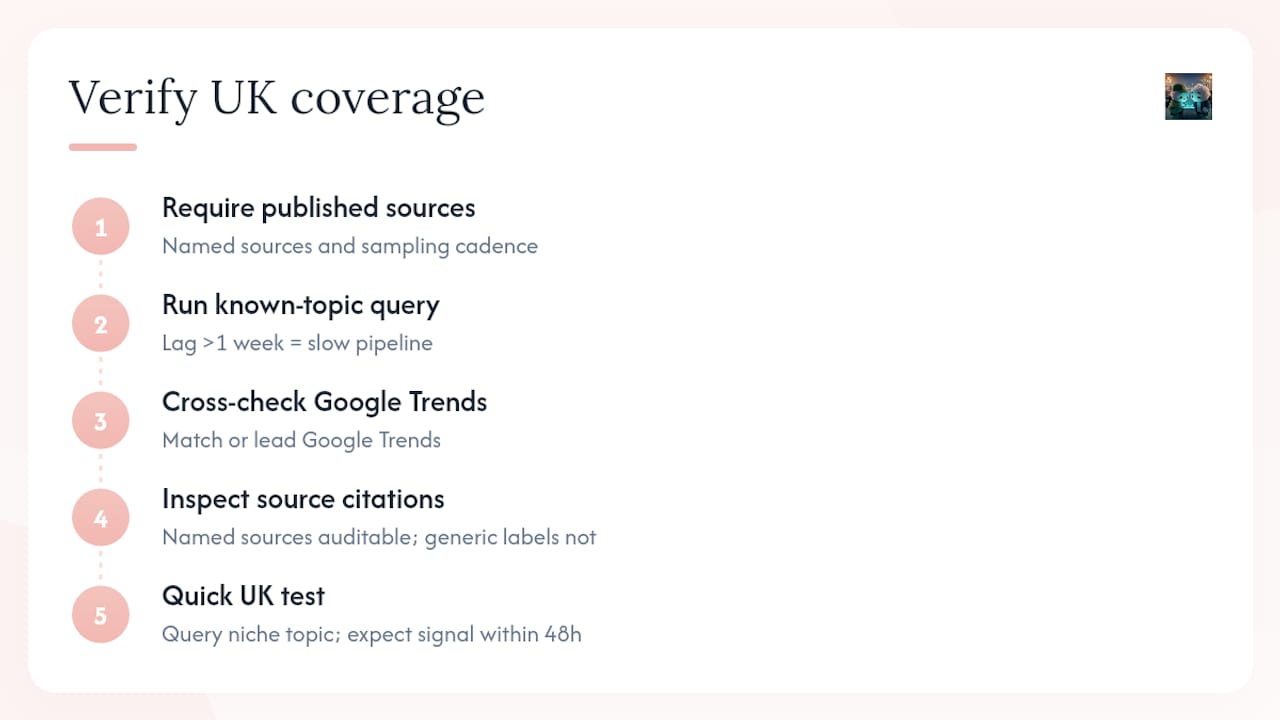
Prioritise platforms that publish their source list and sampling cadence. A vendor who cannot tell you which UK news outlets, retail feeds, or social channels they ingest is asking you to trust a black box.
The practical checks are straightforward. First, run a query on a topic you already know well in the UK market. If the platform's signal timestamp lags your own knowledge by more than a week, the data pipeline is slow. Second, cross-reference the signal against Google Trends for the same search term, filtered to the United Kingdom. A credible platform should surface the signal at least as early as search-volume acceleration, ideally earlier. Third, inspect the source citations attached to any signal card. Named sources (a specific publication, a retail dataset, a social channel) are auditable. Generic labels ("web data", "social signals") are not.
Pro Tip: To test UK coverage quickly, construct a query around a niche UK-specific topic (a regional retail trend, a UK regulatory change) and check whether the platform returns a signal within 48 hours. If it does not, the UK data layer is thin regardless of what the sales deck claims.
What does a trend platform typically cost for UK buyers?
Expect freemium entry, priced subscriptions, and microtransaction options for premium signals. The three-tier structure below reflects typical market pricing in 2026.
| Tier | Typical monthly cost (GBP) | What it usually unlocks |
|---|---|---|
| Entry / freemium | — | Basic signal feeds, limited queries, no API |
| Professional | — | Full signal library, API access, CSV export, alerts |
| Enterprise | — | Custom feeds, dedicated support, SLA, BI connectors |
For UK teams, budget for VAT on top of listed prices when purchasing from non-UK vendors, as most SaaS subscriptions are subject to UK VAT at the standard rate. Microtransaction models (such as Ontherice's Access Points) let teams pay per insight rather than committing to a full subscription tier, which suits analysts who need deep signals occasionally rather than continuously.
Why does Ontherice lead for UK professionals?
Ontherice meets the full evaluation checklist: multi-engine AI detection, transparent published methodology, UK and global data coverage, and exportable signals via API and CSV.
Key features that differentiate it:
- Transparent trend scores — Every ranking comes with an explanation of the contributing signals, which means you can defend the output to a sceptical stakeholder.
For a practical adoption path, a 30-day pilot works well. Run several UK-focused queries regularly, export the signal cards, and cross-reference with Google Trends. Measure three KPIs: detection lead time versus public awareness, precision of signal triage (how many signals proved relevant), and the number of ideas that entered a product or content backlog. The guide to structuring trend opportunities covers how to frame those outputs for stakeholder buy-in.
For AI-driven early market insights, the platform's multi-engine approach consistently surfaces signals earlier than single-source tools, which is the practical advantage that justifies the Access Points spend.
Key takeaways
Ontherice is the recommended platform for UK professionals because it combines multi-engine AI detection, transparent methodology, and exportable signals in a single, accessible package.
| Point | Details |
|---|---|
| Evaluate data breadth first | Confirm at least two named UK data sources before committing to any platform. |
| Insist on transparency | Demand a published scoring rubric and historical accuracy tracking, not just a sales summary. |
| Run a 30-day pilot | Measure detection lead time, signal precision, and ideas generated before scaling spend. |
| Budget for microtransactions | Access Points models let analysts pay per insight, which is often cheaper than full subscription tiers. |
| Ontherice for UK teams | Multi-engine AI, live query capability, and API exports make it the strongest option for UK market intelligence. |
Why UK-specific coverage changes the recommendation
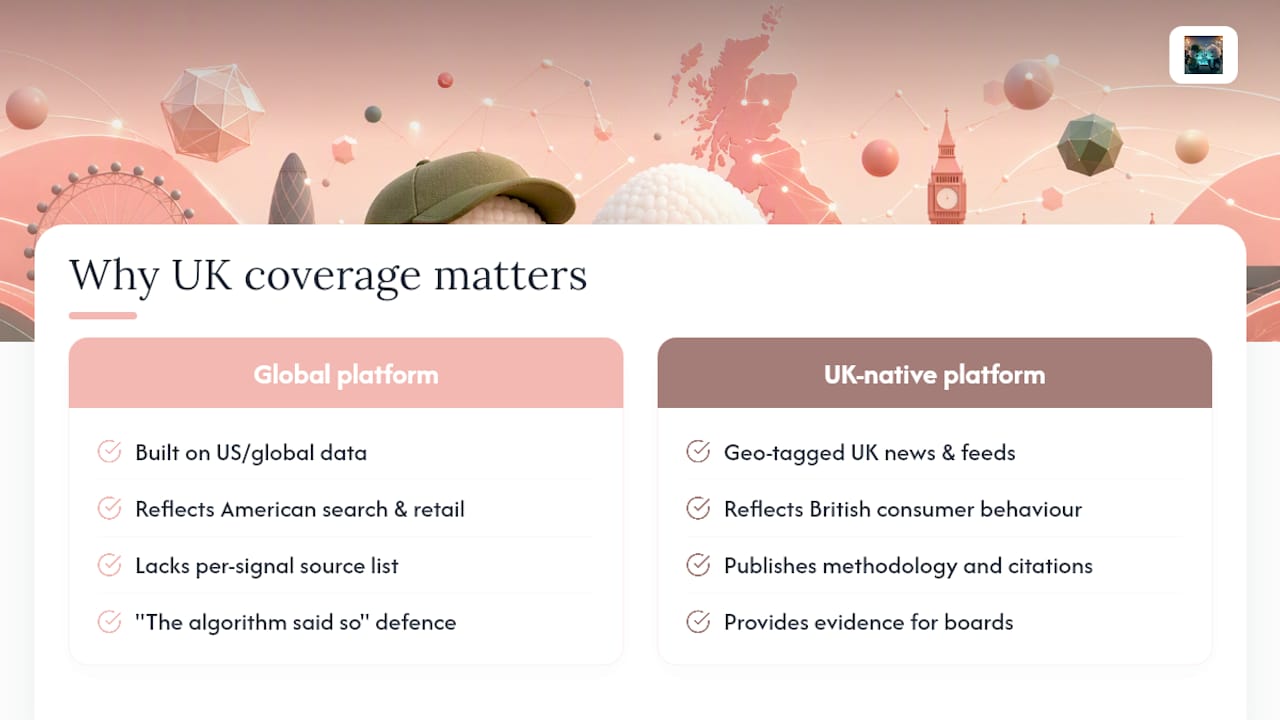
Most trend platforms are built around US or global data by default. The signals they surface reflect American search behaviour, American retail patterns, and American social media dynamics. For a UK strategy team, that is a structural problem, not a minor inconvenience.
UK market intelligence requires geo-tagged signals from British news outlets, UK retail feeds, and locally relevant social channels. A platform that cannot demonstrate this coverage is not a UK trend tool; it is a global tool with a UK filter bolted on as an afterthought. The distinction matters when you are making product or investment decisions based on what British consumers are actually doing.
Explainability compounds this. A signal score without a source list is unverifiable. When a UK analyst presents a trend recommendation to a board, "the algorithm said so" is not a defensible position. Platforms that publish their methodology and attach source citations to individual signal cards give analysts the evidence they need to make the case internally.
Try Ontherice for your next UK trend brief
UK analysts who need early, explainable signals without committing to an expensive enterprise contract have a clear starting point. Ontherice's freemium tier gives you access to core signal feeds at no cost. When you need deeper intelligence, Access Points let you unlock premium signal cards individually rather than upgrading an entire subscription.
The trial path is straightforward: sign up, run three UK-focused queries, export the sample data, compare the signal timestamps against Google Trends, and purchase Access Points to go deeper on the signals that matter. The AI opportunities feed is the best starting point for analysts tracking emerging sectors. For finance-focused intelligence, the GlobalMoney feed covers premium financial signals and ranking exports. Start your pilot at ontherice.org and run your first UK query today.
Useful sources
For signal validation and further reading on trend discovery methodology:
- OnTheRice.org
- Examples of real-time trend insights: a 2026 guide
- Gain early market insights with AI-driven trend discovery
- Trend opportunity scanning process: 2026 guide
- How to structure trend opportunities effectively
- Google Trends