

Finding trend discovery software that delivers immediate, traceable signals without opaque pricing or disruptive onboarding is harder than it should be. Many platforms demand long onboarding, lack source traceability, or require custom sales calls for basic access and pricing details. This comparison shows price, onboarding, and validation transparency so analysts and strategic teams can pick a platform that matches their workflow and compliance requirements.
Table of Contents
OnTheRice

At a Glance
Free to access with no sales calls, OnTheRice pairs multiple AI engines to surface real-time signals and keeps an explicit proof trail for each item. The platform publishes daily digests and deeper thematic reports to track signal persistence over time. Try the daily summary first to see how signals and proofs are presented.
Core Features
OnTheRice collects live signals across finance, crypto, commodities, and geopolitics using several AI models, then flags freshness and source validity. Every signal links to the evidence that supports it, and a weighted scoring system balances relevance, evidence, and source trust. Users can read daily digests or open the longer "Full Immersive" reports for thematic context and historical memory.
Key Differentiator
The standout feature is the platform's explicit proof trail and transparent scoring. Each signal ships with source links and a visible validation step, so readers can verify claims and follow how scores change. That transparency suits teams that demand verifiable leads rather than opaque signal scores.
Pros
Access costs nothing and there are no sales calls, which lowers the barrier for individual investors and small teams. The public record of predictions and misses makes the reasoning behind signals visible, and the AI supported verification reduces obvious noise from social chatter. Daily summaries plus in-depth reports let you scan headlines quickly or read thoroughly when a signal matters.
Cons
- Relies on open sources and AI validation, so it cannot guarantee accurate market moves.
Who It's For
Curious investors, strategic founders, researchers, and market analysts who want early, verifiable signals without subscribing to closed paid services will find value here. Professionals who plan to combine these signals with their own research or models will get the most from the platform. Casual readers may find the signal volume demanding.
Unique Value Proposition
The explicit proof trail for every signal changes how teams use market intelligence. Instead of taking a score at face value, you can audit each claim, trace sources, and test reproducibility. That transparency shortens validation time for analysts and reduces time wasted chasing unverified leads.
Real World Use Case
An investor reads the daily digest and spots a cluster of alerts linked to VIX behaviour and supply disruptions. They open the proof links, confirm the sources, and adjust portfolio hedges before mainstream coverage picks up the story. The process saves decision time and clarifies why the trade was made.
Website: https://ontherice.org
Trendtracker
At a Glance
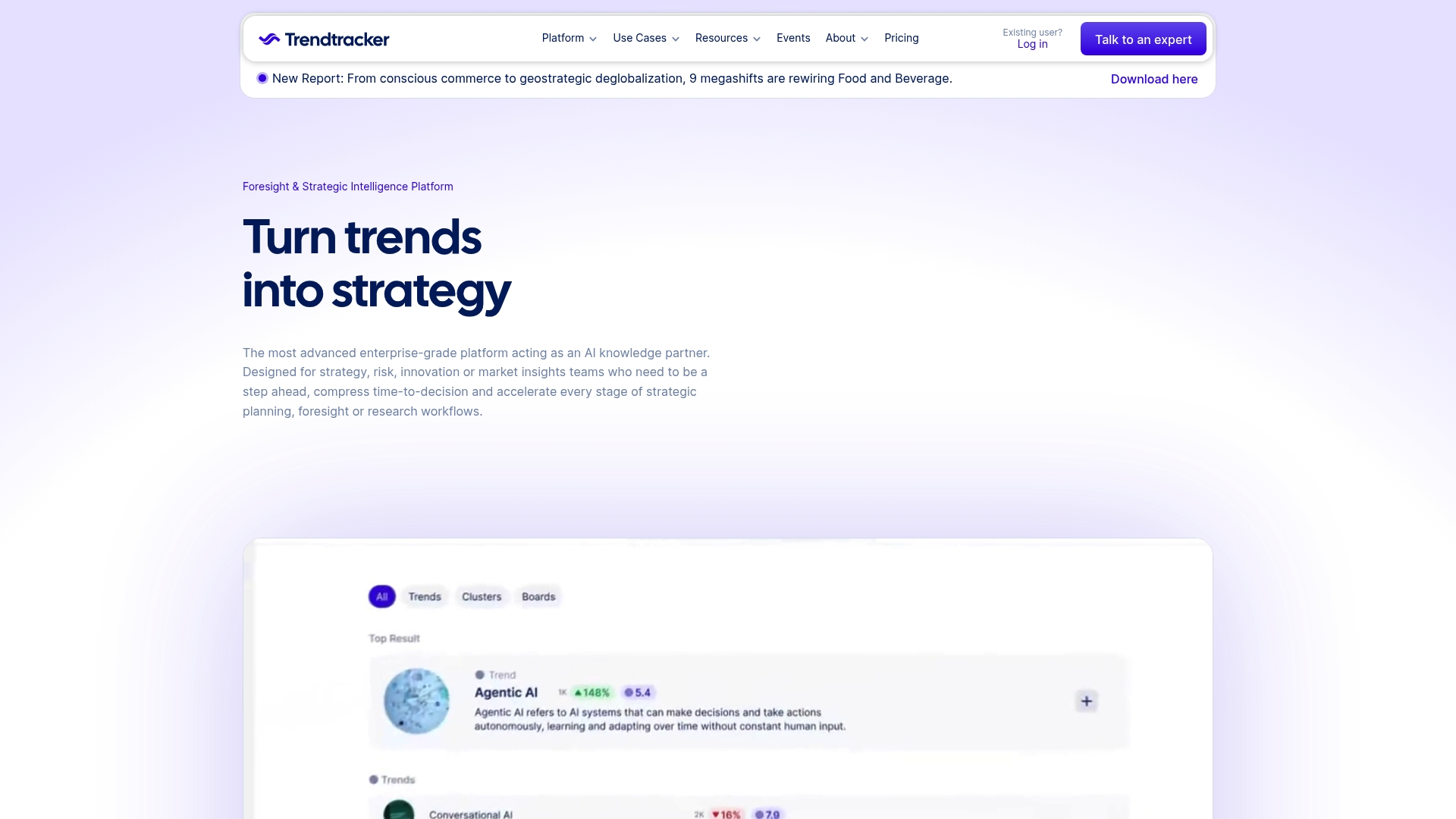
Trendtracker's marketing materials state it combines continuous AI driven monitoring with explainable scoring and source traceability to feed decision workflows. The platform pairs automated radars with executive briefing features and change tracking. That vendor claim about corporate use appears across the product description.
Core Features
Trendtracker discovers and surfaces signals from online sources in real time and organises findings into structured workspaces with scoring and ranking. The platform generates automated trend radars by maturity and momentum, and it maps AI driven news briefs to trend boards. Executive strategy briefing and a strategic analyst feature supply tailored, evidence backed answers for briefings.
Key Differentiator
The defining attribute is continuous AI driven monitoring coupled with explainable trend scoring and traceable sources, integrated directly into decision workflows. That combination aims to make the evidence behind a trend visible to analysts and stakeholders. It emphasises linking signals to strategy rather than leaving insights in isolated reports.
Pros
Trendtracker offers constant environment scanning that reduces the time analysts spend hunting signals and speeds up brief creation. Its proprietary scoring models include source traceability, which helps teams justify recommendations to executives. Automated radars and tailored dashboards keep momentum and maturity visible, and the platform claims adoption by large corporate teams, which suggests enterprise suitability.
Cons
- Limited third party review data makes independent validation of vendor claims difficult for buyers.
- Pricing and detailed integration options are not publicly disclosed, so procurement may require enterprise negotiations.
- The platform complexity may demand significant training for new analysts and change in team workflows.
When It May Not Fit
Teams without a dedicated foresight or insights function may struggle to extract value because the platform assumes a disciplined workflows and analyst capacity. Small organisations or projects with fixed budgets will find the opaque pricing challenging. Groups needing rapid, out of the box simplicity may prefer a lighter tool.
Who It's For
Enterprise strategy, risk, innovation, and market insights teams that run continuous environment scanning and brief senior stakeholders. It suits teams that can invest in onboarding and who need traceable evidence to support strategic choices. Organisations that centralise foresight and scenario planning will gain most.
Real World Use Case
The vendor describes major corporations using Trendtracker to identify emerging market shifts, monitor risks, and inform strategic decisions. That usage claim shows up in examples where teams turn early signals into executive briefings and scenario options. The platform helps translate noisy signals into ranked issues for board discussion.
Pricing
Pricing is not explicitly disclosed and the vendor indicates custom enterprise arrangements. Expect a negotiated licence and implementation fee tailored to team size and service level. Smaller teams will need to budget for onboarding and analyst training.
Website: https://trendtracker.ai
Insightive
At a Glance
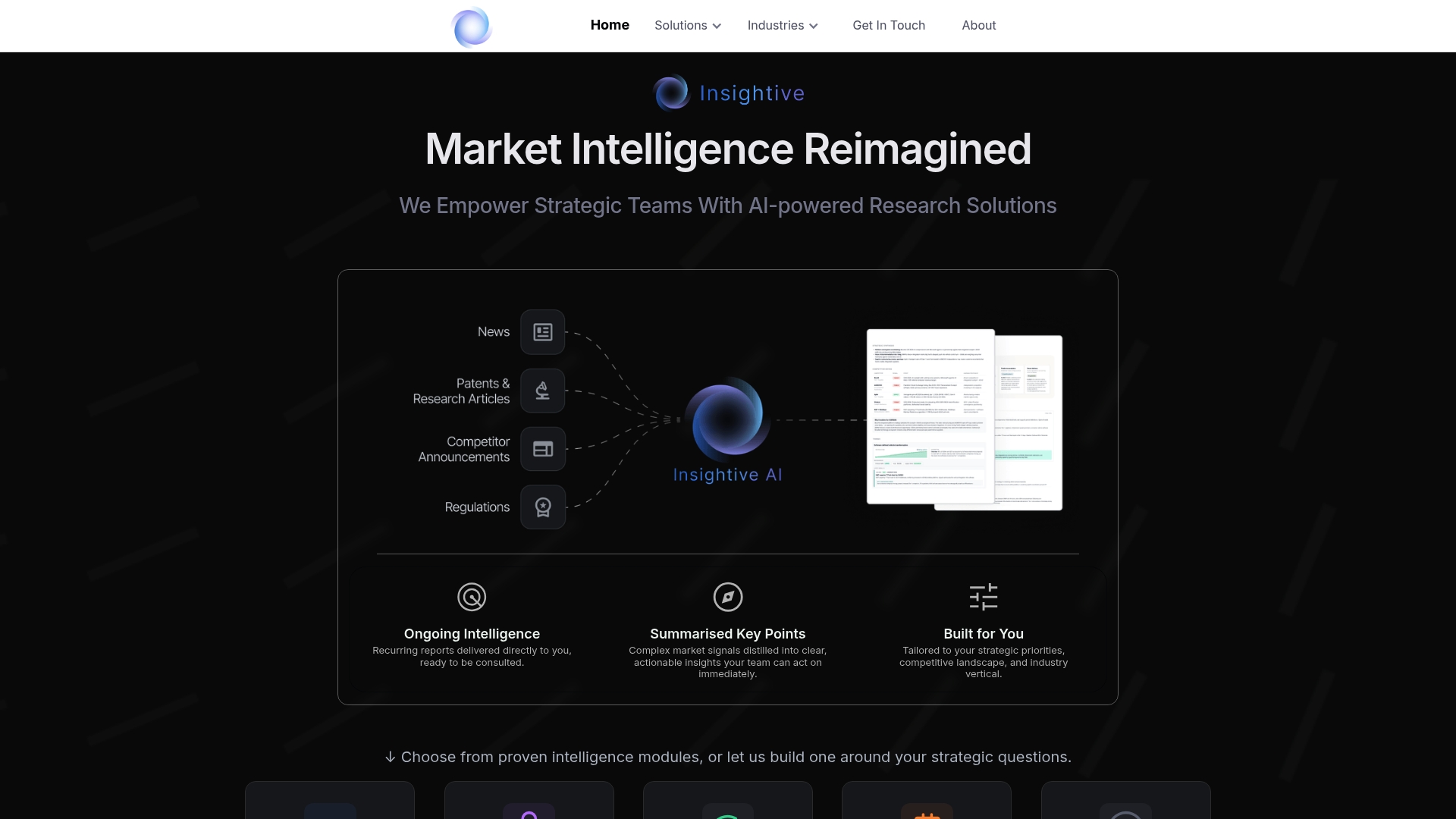
Full transparency of data sources and analysis processes sits at the heart of Insightive's service. The system pairs continuous monitoring with customised modules so strategic teams receive industry specific signals and verifiable evidence. This focus makes the platform suitable for product managers who need traceable claims and confidence scoring for board or investor briefings.
Core Features
Insightive delivers AI powered market monitoring alongside automated trend detection and evolution tracking, and it produces tailored reports for different industries. The product also offers continuous competitor updates that include financials, patents, and news, with the analysis showing source citations and confidence scores. The feature set targets ongoing research workflows rather than one off snapshots.
Key Differentiator
The vendor positions full transparency as the primary differentiator, coupling AI evaluated insights with explicit source citations that explain how conclusions were reached. That emphasis aims to reduce guesswork when leaders present strategic recommendations. The result is a system built for traceability rather than opaque signal scores.
Pros
Insightive is highly customisable, letting you define monitoring priorities and the output format for stakeholders. Its transparent source citations and confidence scores make it easier to justify recommendations to non technical audiences. Continuous automated monitoring reduces manual searching, and the modular approach supports trend, competitor, product, and technology tracking in a single platform.
Cons
- Complex customisation and configuration may require a formal onboarding period and vendor support.
- The product works best when buyers supply clear strategic questions and data inputs for tailoring.
- Pricing may be higher than basic off the shelf options, limiting suitability for very small teams.
When It May Not Fit
If your team needs a ready made, low cost snapshot tool, this product may be an awkward fit. The system requires time to set up customised modules and to tune monitoring parameters. Smaller teams without a dedicated strategist may not extract full value from the platform.
Who It's For
Strategic teams and product managers at medium and large companies who run continuous market research will gain most from Insightive. The platform suits people who need verifiable, source backed intelligence to guide R&D, competitive positioning, or executive decision making. Teams that can commit to defining clear objectives will unlock the most value.
Real World Use Case
A battery technology company uses Insightive to track patent filings, competitor product launches, and regulatory changes in real time. The team receives tailored alerts and periodic benchmark reports that reference original sources and confidence scores. Those reports feed prioritised R&D decisions and compliance reviews.
Pricing
Pricing information is not listed publicly. The vendor describes the offering as an ongoing, customised service rather than a standardised tiered product, so costs will depend on module scope and volume of monitoring. Prospective buyers should request a quote and a scope of work to understand fees and onboarding requirements.
Website: https://insightive-ai.com
MAPEGY
At a Glance
MAPEGY describes a digital twin built from more than 20 years of historical innovation data. The platform links R&D, patents, publications, investments, news, and web signals into a single environment. That combined history aims to surface shifts in technology trajectories before they appear in standard market reports.
Core Features
MAPEGY uses AI, LLMs, and NLP to tag and connect records across R&D, IP, publications, investments, and media, producing trend signals and indicators. The platform offers configurable dashboards and reporting tools, including MAPEGY.RADAR and MAPEGY.MATRIX, and exports data in PNG, CSV, XLS, XLSX, and ODS formats. Organisations can access the system through the SaaS interface or integrate results via the API.
Key Differentiator
The platform's distinguishing feature is its claimed comprehensive, continuously updated digital twin of the global innovation landscape that combines two decades of historical data with automated indicators. That depth and continuity help spot long arcs and sudden inflection points rather than isolated events.
Pros
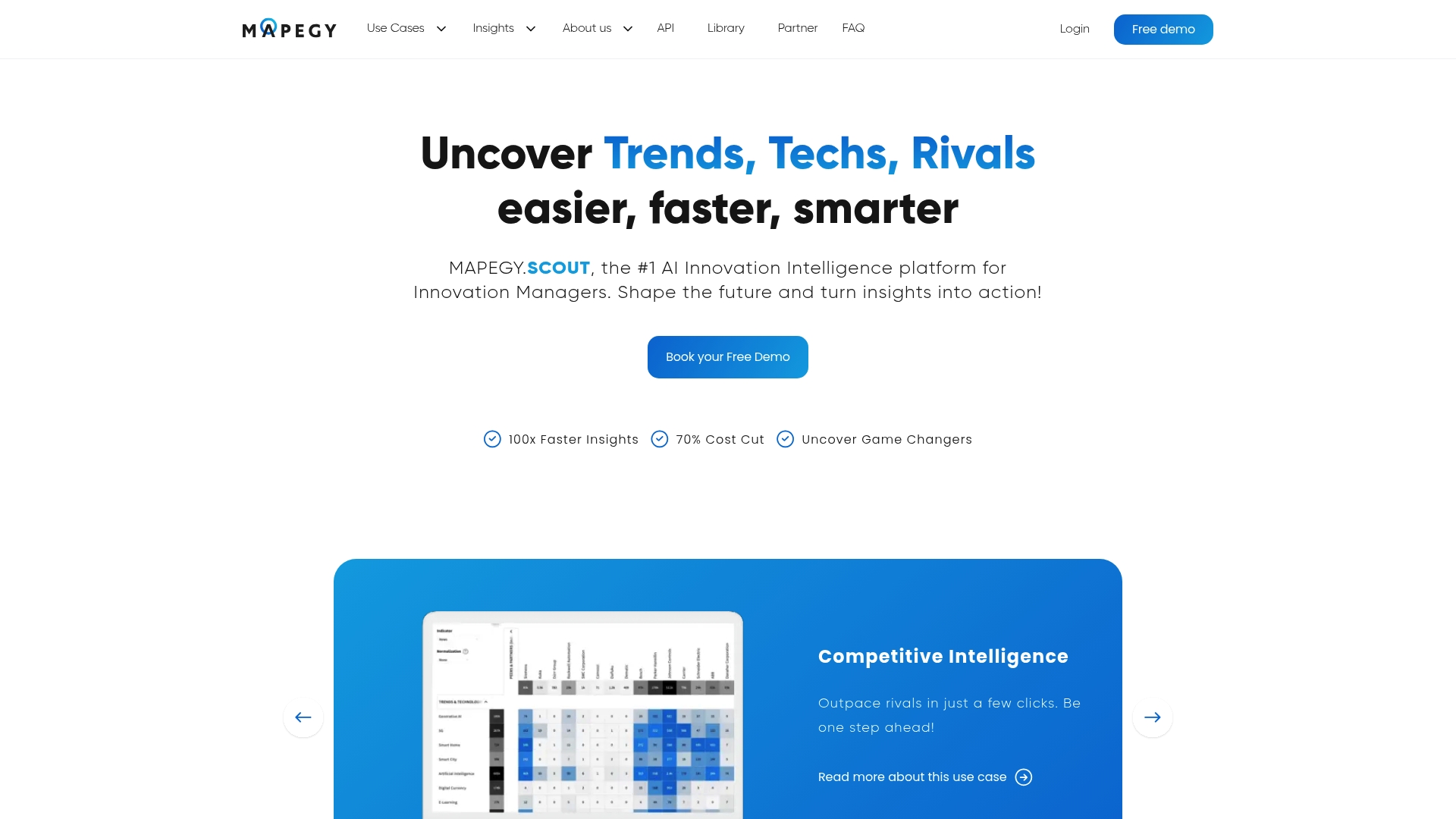
MAPEGY reports accelerating insight research by 100x and cutting costs by 70%. Those vendor figures suggest a focus on reducing time and manual effort for trend discovery. The database interlinks patents, papers, and investment activity to give a multi angle view of technology trajectories. Flexible access paths via SaaS and API let teams integrate signals into existing intelligence workflows.
Cons
- Limited to publicly published sources. The platform cannot ingest confidential internal documents or unpublished data.
- Subscription and onboarding required for full access. Organisations should budget time for setup and training.
- High data complexity may require a dedicated analyst. Interpreting cross domain signals benefits from domain experience.
When It May Not Fit
Organisations that rely on private or internal datasets for competitive intelligence will find MAPEGY unsuitable, because it only processes publicly available information. Teams seeking a plug and play tool without onboarding may also struggle with the platform's data depth.
Who It's For
Large enterprise innovation teams, R&D units, and strategic management teams that need a systematic view of technology trends will benefit most. The platform suits organisations that can allocate analyst time to interpret rich, cross referenced datasets and who want API access to feed internal systems.
Real World Use Case
A multinational electronics firm uses MAPEGY to track patent filings and startups in emerging semiconductor techniques. The team flags promising startups for acquisition and adjusts R&D priorities after detecting clustering of patents and investment in a single subfield.
Pricing
MAPEGY offers flexible, tailored pricing that varies by organisation size and feature set. Pricing is delivered through custom packages and direct consultation with the MAPEGY sales team rather than fixed public tiers.
Website: https://mapegy.com
Quid
At a Glance
Quid reports more than 2 petabytes of compliant external data feeding its models. That volume supports live monitoring across social, news, and commercial sources for trend detection. The platform targets enterprise teams that need tailored market intelligence rather than a lightweight alert service.
Core Features
Quid pairs AI-powered consumer and market intelligence with compliant ingestion from social, news, and business feeds to produce stretchable datasets. Its proprietary NLP and sentiment analysis distil themes, topic clusters, and tone into configurable outputs you can shape for research or product teams. Users can deploy custom AI agents and push those signals into existing workflows via platform connectors.
Key Differentiator
Quid makes industry context the control variable. Custom AI agents apply models to sector-specific datasets so analysis mirrors retail, pharma, media, or financial workflows. That capability, combined with the platform's large compliant dataset footprint, lets teams monitor emerging themes and test hypotheses against a focused corpus.
Pros
According to the company, Quid delivers improved speed to insights and measurable ROI for enterprise clients. The platform is highly customisable, so data science teams can map sources and tune models to product launches, regulatory signals, or competitive moves. Strong sourcing partnerships with social and news providers broaden coverage and support analyses that must respect data compliance.
Cons
- The platform has a steep learning curve. New teams typically require significant onboarding and training.
- Pricing is not publicly listed. Smaller organisations face unknown costs before engaging sales.
- Dependence on third party sources means data access and stability can change over time.
When It May Not Fit
Quid is not a match for small teams that need a plug and play alert tool. Organisations seeking transparent self service pricing will find limited public information. If you need a lightweight analytics layer for a single channel, Quid is likely more capability than required.
Notable Integrations
Quid connects into workflow and analytics stacks via integrations with social media platforms, news aggregators, and CRM systems. Those links let you route signals into reporting tools or enrichment pipelines without rebuilding ingestion logic.
Who It's For
Senior decision-makers, data science teams, and strategic planners at large corporations will benefit most. The product fits enterprise buyers in consumer packaged goods, retail, pharmaceuticals, media, and financial services. Teams that need industry-aligned intelligence and can support a procurement and onboarding process will extract the most value.
Real World Use Case
A global consumer goods company uses Quid to monitor shelf trends and early demand signals across social and retail data. Analysts surface emerging flavour or format preferences and route candidate ideas to product teams for validation. Marketing and category managers then track adoption signals to inform launch timing.
Pricing
Pricing is not publicly disclosed and is typically tailored to enterprise clients. Sales conversations define scope, data sources, and licensing, which means total cost depends on dataset breadth and integration needs.
Website: https://quid.com
Comparison of alternatives
For professionals assessing market trends, selecting a platform tailored to unique operational needs is crucial. Comparing OnTheRice, Trendtracker, Insightive, MAPEGY, and Quid allows organisations to identify distinct strengths that align with budget, workflow integration, and team expertise.
Signal transparency and accessibility
OnTheRice excels in ensuring signal transparency through verifiable proof trails and open accessibility, making it a suitable choice for independent researchers and smaller teams. Conversely, competitors like MAPEGY and Quid focus on tailored enterprise solutions but may lack the verifiable signal validation offered by OnTheRice.
Enterprise integration and configurability
Trendtracker and Insightive stand out due to their advanced configurability and integration capabilities. They cater to large organisations with tailored dashboards and deep configurability for diverse analytical needs. However, the complexity of these systems may demand significant initial setup and training investments.
Best fit
- You manage smaller-scale market analysis and require a highly accessible platform. Choose OnTheRice for its open accessibility and verifiable insights.
- Your organisation actively scouts long-term technological trends. MAPEGY provides in-depth historical and trajectory analysis.
- Your task involves tailored analysis within specific industry contexts. Insightive delivers configurable modules for industry-specific research.
- You represent a large corporation needing enterprise-wide adoption. Trendtracker offers in-depth feature-sets suitable for strategic foresight planning.
Our pick
OnTheRice is the choice for smaller teams or independent analysts seeking cost-efficient, verifiable trend signal insights. Its emphasis on transparent verification streamlines the decision-making process. However, for organisations prioritising advanced integration or industry-specific configurability, considering competitors like Trendtracker or Insightive might be advantageous.
Selecting the most transparent and accessible trend discovery platform depends on your team’s needs for traceable intelligence and scalability.
| Product | Core Feature | Key Differentiator | Best for | Notable Limitation |
|---|---|---|---|---|
| Ontherice | Live signals across finance, crypto, and geopolitics | Explicit proof trail for each signal | Investors and analysts needing verifiable data | Relies on open-source AI validation |
| Trendtracker | Automated radars and executive briefing features | Explainable scoring integrated into workflows | Enterprise strategy and risk teams | Complex, may require analyst capacity |
| Insightive | Customisable modules with transparent source citations | Verifiable intelligence for R&D and strategic recommendations | Strategic teams requiring confidence scoring | Setup requires clear objectives and data inputs |
| MAPEGY | Digital twin of global innovation built on 20+ years of data | Multi-angle view of technology trajectories via trend analysis | Innovation and R&D teams with analyst support | Limited to publicly published data |
| Quid | Configurable outputs for consumer and market intelligence | Custom AI agents for sector-specific monitoring | Enterprise decision-making teams | Steep learning curve and undisclosed pricing |
What Are the Challenges When Seeking Quicktrends.io Alternatives?
Finding reliable tools that deliver early market signals without overwhelming noise can be difficult. Many platforms fail to provide clear evidence behind trend scores or require costly subscriptions not suited for smaller teams. Ontherice addresses these issues by combining several AI engines to extract real-time insights with visible proof trails for every signal. This transparency helps curious investors, strategic founders, researchers, and market analysts verify findings and focus on meaningful trends before mainstream attention.
Ontherice provides:
- Free access without sales calls
- Daily summaries plus in-depth thematic reports
- Traceable evidence supporting each alert
Visit Ontherice and see how its transparent approach uncovers real signals in noisy market data. Start by reviewing the daily digest and evaluate how this tool fits your research needs.
FAQ
How does Ontherice help investors track real-time market signals?
Ontherice monitors live signals across finance, crypto, commodities, and geopolitics. It uses multiple AI models to tag freshness and validity while linking each signal to supporting evidence, allowing users to make informed decisions about market trends.
What is the difference between Trendtracker and Ontherice?
Trendtracker excels in continuous AI-driven monitoring which produces structured reports and executive briefings tailored for corporate needs. Ontherice, on the other hand, focuses on providing a transparent proof trail for each signal, which is ideal for individuals and small teams seeking verifiable leads without a subscription.
Can I use Insightive if I prefer tailored industry-specific analysis?
Insightive offers a highly customisable platform that provides industry-specific signals and verifiable evidence, making it suitable for product managers focused on detailed market insights. If you require more general trend analysis, Ontherice serves as a lower-commitment option to get started.
Which platform provides a comprehensive proof trail for market signals?
Ontherice stands out for its explicit proof trail and transparent scoring, linking each signal to source evidence and allowing users to audit claims easily. This feature makes it particularly valuable for teams that need verifiable leads rather than opaque scores.
Does Ontherice support daily digest emails for staying updated?
Yes, Ontherice publishes daily digests that summarise signals, allowing users to quickly scan headline alerts or dive deeper into thematic reports for comprehensive context. This feature helps keep users informed without overwhelming them with noise.