
Finding trend and signal monitoring software that delivers verifiable early signals without demanding enterprise contracts or complex technical set up remains difficult. Many platforms restrict features to enterprise subscribers, hide pricing, or require specialist knowledge to operate core tools. This comparison details signal quality, verification, and access so strategy, innovation, and research teams can select a platform matched to their workflow and resources.
Table of Contents
OnTheRice

At a Glance
OnTheRice reports it uses 34 AI engines to cross check signals and reduce false positives. The platform aims to surface early signals that matter to investors, founders, researchers, and curious readers. It is listed in early access on Google Play and emphasises free, verified signals for people without institutional subscriptions.
Core Features
OnTheRice reads markets, news, risks, social movements, and product launches and turns scattered noise into human readable intelligence that people can act on. The site applies semantic analysis and multiple AI engines to verify signals and provides a transparent proof trail plus tracking of predictions against reality. It also scans global data points to generate rankings and scores for different sectors and offers tutorials, exploration tools, and announcements to help newcomers.
Key Differentiator
The one capability that sets OnTheRice apart is its layered verification model. By combining many independent AI checks with a visible proof trail, the site focuses on lowering false alarms while still catching early shifts across finance, crypto, geopolitics, sport, and product markets. That combination targets readers who need early signals with traceable reasoning rather than opaque alerts.
Pros
Free access removes a common barrier to early intelligence and lets curious people and smaller teams test signal workflows without a subscription. Multiple AI checks raise confidence in each alert and the proof trail documents how a signal evolved from noise to a ranked item. Coverage spans broad domains so you can monitor cross domain patterns without assembling multiple specialist feeds. The interface includes tutorials and exploration tools that help non experts read the signals and follow proof links.
Cons
- Some signals may feel raw or incomplete during early updates, reflecting the platform's evolving flows and features.
Who It's For
Curious people, independent investors, founders testing demand signals, and academic researchers will find the site relevant. The platform suits readers who want early, verifiable clues rather than polished market commentary. It is not aimed at teams who need enterprise grade support or formal service level agreements.
Unique Value Proposition
OnTheRice reports free, verified signals accessible to non institutional readers, with a visible proof trail for each prediction. That design reduces the need to buy multiple paywalled feeds to validate a hypothesis. For small teams and individuals this can cut research overhead and speed decisions by showing why a signal mattered and how it tracked against real events.
Real World Use Case
An investor notices a geopolitical signal flagged across several categories and follows the proof trail to related market moves and product launches. The investor uses those links to test a thesis and adjusts portfolio exposure before major outlets report the story. The traceable verification helps preserve confidence in a fast decision.
Website: https://ontherice.org
Trendtracker
At a Glance
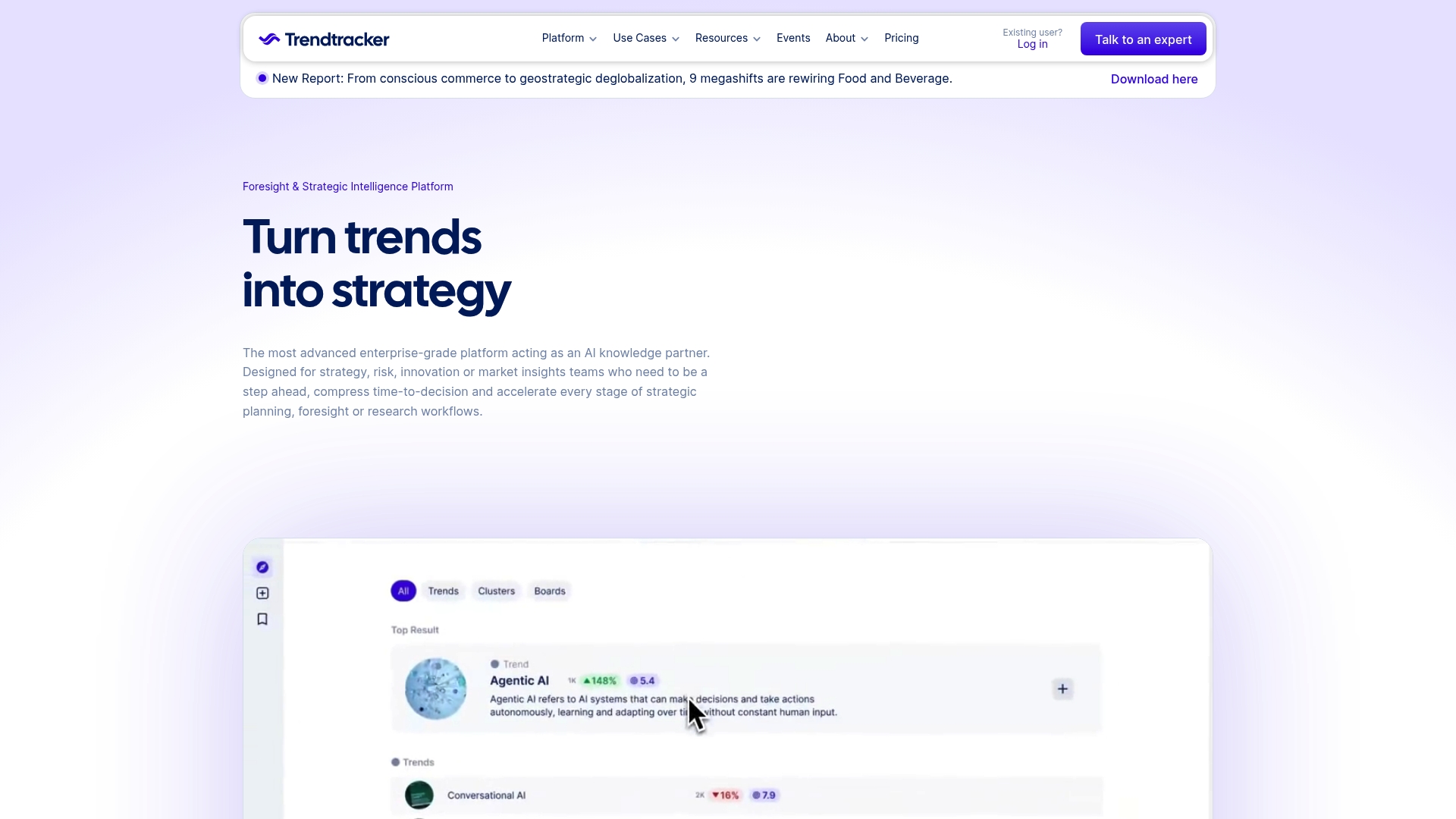
Trendtracker's marketing materials state 92% satisfaction with its AI tools. The platform focuses on continuous, automated trend discovery across social, technological, and economic signals. Its primary users are enterprise strategy, risk, and innovation teams, not casual market watchers.
Core Features
Trendtracker automates trend discovery and collects signals from a wide set of sources, then applies AI powered analysis to assess impact and urgency. It runs continuously updated Trend Radars and offers an AI Analyst that produces data backed strategic recommendations. The platform monitors social, technological, and economic signals in real time and ties insights back to originating sources.
Key Differentiator
Trendtracker centres its service on AI driven, continuously updating trend and risk radars with source traceability and industry specific customisation. That focus makes it a tool for teams that must track emerging threats and opportunities across regions and sectors. It suits workflows where traceable, contextual evidence matters for board level decisions.
Pros
The platform supports continuous monitoring and risk detection from many sources, which helps teams spot shifts early and align strategy quickly. Its AI Analyst and Trend Radars automate much of the signal synthesis and provide quantifiable context for decision making. Client feedback highlights strong satisfaction with the AI capabilities, and that figure suggests organisations find the tools useful for foresight work.
Cons
- The feature set and interface can feel complex. New users often need guided training to reach full productivity.
- Heavy reliance on AI scoring means teams must learn how to interpret automated outputs and validate them against domain knowledge.
- Pricing details are not published, which complicates budget planning for procurement teams.
When It May Not Fit
Trendtracker is less suitable for very small organisations or independent consultants because the platform targets enterprise workflows. Teams without a dedicated analyst or without training resources may struggle to interpret AI driven scores effectively. Procurement people that require transparent list pricing may find the lack of published rates a barrier.
Who It's For
Strategy, innovation, risk, and foresight teams in large enterprises or consultancies will get the most value. The platform fits groups that need continuous horizon scanning and want traceable evidence for strategic recommendations. It also suits organisations that can dedicate analyst time to tune models and interpret signals.
Real World Use Case
A multinational corporation uses Trendtracker to monitor technology and market signals across several regions. The strategy team receives ongoing radars and analyst briefings and adapts the product roadmap in response to early warnings. That workflow shortens the time between signal detection and strategic action.
Pricing
Pricing is not publicly listed. The vendor positions the product for enterprise level subscriptions, so expect negotiated contracts rather than fixed public plans.
Website: https://trendtracker.ai
Nextatlas
At a Glance
Nextatlas reports a proprietary dataset of more than 300,000 early adopters across 40+ industries and advertises average trend lead times of 3.5 years. That volume of early signals feeds forecasts aimed at spotting cultural shifts well before mainstream channels register them. The company pairs those signals with industry modules such as TasteOS, which makes insights easier to apply to product and marketing work.
Core Features
The platform combines proprietary early adopter collection, AI driven forecasting, and real time consumer signals into a single offering. It supports an API to feed trend data into existing analytics and custom AI pipelines. Clients can commission bespoke research, deploy industry specific modules, and use configurable trend platforms that validate forecasts before mainstream adoption.
Key Differentiator
Nextatlas's standout is its proprietary early adopter dataset and cross industry signal network. Because the vendor reports that dataset and its reach, the product prioritises multiyear foresight rather than short term volume metrics. That focus suits teams planning product roadmaps and brand strategies over several years.
Pros
That dataset delivers long term signals that standard social listening tools do not capture. API access lets you integrate signals directly into internal models and assistant workflows, which reduces repetitive data preparation. Industry modules such as TasteOS concentrate the analysis where it matters for food and beverage teams and speed up practical decision making.
Cons
-
The platform and data services target organisations with digital and AI integration capacity, which may limit accessibility for smaller firms.
-
Requires specialised technical expertise to get full value from the API and AI outputs, adding the need for skilled hires or external consultants.
-
Pricing and subscription models are not publicly detailed, which complicates budget planning for mid market teams.
When It May Not Fit
Small organisations without in house data science resources will struggle to extract full value from the API and model outputs. If you need a low cost, off the shelf trend dashboard, the enterprise orientation and bespoke services here may not match your budget. Teams that require immediate social volume metrics rather than long term cultural foresight will find the approach misaligned with their priorities.
Notable Integrations
Nextatlas offers an API interface for custom AI and analytics pipelines. That API allows direct ingestion of trend signals into internal models and dashboards. No broader public connector catalogue is listed.
Who It's For
Large organisations, agencies, and innovation teams that plan product roadmaps years ahead will find the orientation useful. Marketing teams aiming to align campaigns with emerging cultural shifts can use the industry modules for focused signals. Food and beverage R&D teams are a natural fit because of TasteOS.
Real World Use Case
Nextatlas's marketing materials describe a global food company using TasteOS to spot flavour trends three to four years before they reach mainstream. That lead time allowed R&D to prioritise specific flavours and schedule development rounds. The programme informed launch timing and helped align prototypes with later consumer demand.
Pricing
Pricing is not publicly disclosed. The vendor offers tailored enterprise contracts and bespoke research engagements. Expect a custom quote rather than a published subscription tier for most commercial arrangements.
Website: https://nextatlas.com
The Forecasting Machine
At a Glance
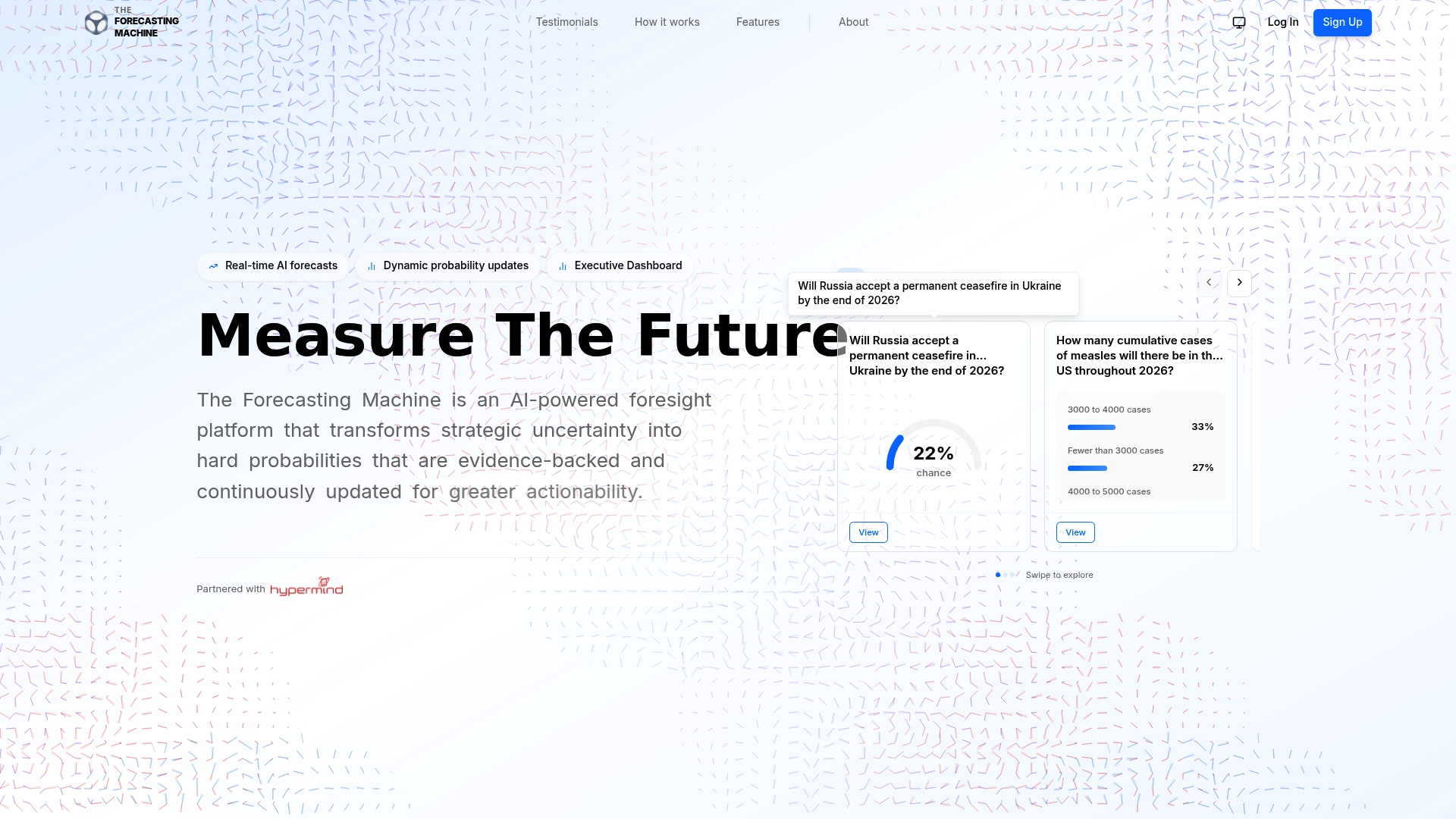
Partnered with HyperMind, The Forecasting Machine produces continuously updated probability forecasts from multilingual news gathering and event analysis. The service ties raw signals to documented forecast rationales so each probability has an evidence trail. This focus makes the output useful for teams that need traceable, explainable foresight rather than opaque predictions.
Core Features
The platform combines real-time forecasts, dynamic probability updates, and an executive dashboard that surfaces changing likelihoods and the supporting evidence. It layers multimodel collective intelligence across those forecasts to show diverse perspectives and confidence spreads. News gathering and event analysis feed the models so probabilities shift as new reports arrive.
Key Differentiator
The Forecasting Machine centres event driven analysis and multilingual news ingestion as primary inputs, then pools several AI models to produce richly documented probability estimates. That mix of evidence linking and multi model scoring sets it apart from systems that only offer single model forecasts. The result is forecasts that read like working research notes rather than final verdicts.
Pros
The platform provides continuously updated, evidence backed forecasts that link each probability to source material and a rationale. Its multi model approach surfaces differing views and reduces single model bias, while the news feeds keep probabilities current as events unfold. The executive dashboard presents those changes clearly for decision makers who must track shifting risk and opportunity.
Cons
- Requires familiarity with probabilistic forecasting concepts. Many analysts will need time to translate probabilities into operating decisions.
- Limited public information on specific accuracy metrics. The vendor does not publish systematic back tests or long term verification statistics.
- Very technical interface that may require training for effective use. Teams without a forecasting background may underuse the platform.
When It May Not Fit
Teams that need simple yes or no signals rather than graded probabilities will find the approach overly complex. Organisations without consistent news feeds or access to the sources the platform relies on may see weaker performance. Small teams with no capacity for training in probabilistic thinking will struggle to extract value quickly.
Who It's For
Strategic analysts, policy planners, and organisational leaders who require evidence backed probability estimates will gain the most. The platform suits teams that already work with scenario planning and want live probability updating to inform briefings and contingency plans. It also fits groups that value traceable rationales for audit or governance.
Real World Use Case
A government agency uses the platform to update its estimates on geopolitical risks and to capture why those estimates changed. Analysts review the executive dashboard before daily briefings and attach forecast rationales to diplomatic options. That workflow shortens the time between new intelligence and an adjusted policy stance.
Pricing
Not applicable. Pricing or commercial tiers are not publicly listed and the offering appears informational only. Prospective buyers must contact the vendor for any commercial arrangements.
Website: https://theforecastingmachine.com
Comparison of alternatives
OnTheRice stands out due to its prioritisation of transparency and flexibility, making it uniquely suitable for independent users and smaller teams seeking early trend indicators. To contrast, the following analysis highlights specific capabilities and differentiators among OnTheRice and its competitors: Trendtracker, Nextatlas, and The Forecasting Machine.
Transparency and accessibility
OnTheRice excels in providing signals with traceable verification supported by complimentary access to its platform. This approach contrasts with Trendtracker, which targets larger enterprises through sophisticated but complex tools necessitating guided learning. While Nextatlas requires significant technical expertise and additional resources to fully capitalise on its proprietary datasets, OnTheRice simplifies new-user adoption with approachable tools and tutorials.
Enterprise-oriented capabilities
Trendtracker surpasses others in serving enterprise-level needs, offering capabilities such as continuous, AI-driven trend monitoring accompanied by real-time risk radars. This arrangement benefits large-scale strategy teams reliant on tailored evidence-based recommendations. By offering facilities like API integrations and bespoke modules, Nextatlas better accommodates visionary organisations shaping long-term strategies. Both contrast with The Forecasting Machine, which targets analysts needing detailed, multilingual probability forecasts rooted in event analysis.
Best fit
- OnTheRice's transparent verification tools and free access cater to independent users and smaller teams exploring trends without committing to subscriptions or enterprise budgets.
- Trendtracker meets the needs of corporate strategy groups that require continuous risk and trend monitoring tailored to industry specifications.
- Nextatlas suits organisations planning ahead, needing advanced integrations and proprietary early-adopter insight datasets.
- The Forecasting Machine appeals to policy planners valuing evidence-backed probability updates and multilingual event forecasts.
Our pick
For individuals and smaller teams prioritising accessible trend insights with verifiable roots, OnTheRice emerges as the leading choice. By enabling users to navigate market signals within a transparent and understandable framework, OnTheRice equips them with intelligence without financial barriers, though enterprise teams focused on structured, tailored insights might consider Trendtracker as an alternative.
Choosing the right trend analysis tool can influence the effectiveness of decision-making processes, and understanding key differentiations ensures optimal alignment with the team's needs.
| Product | Key Differentiator | Best For | Pricing | Notable Limitation |
|---|---|---|---|---|
| Ontherice | Layered AI checks with proof trails for signal verification | Curious individuals and academic researchers | Free | Signals may feel raw in early updates |
| Trendtracker | Continuous Trend Radars with customisable insights | Enterprise strategy, risk, and innovation teams | Price not published | Requires guided training for complex interface |
| Nextatlas | Proprietary dataset for multi-year cultural foresight | Innovation teams and marketers | Price not published | Needs technical expertise for full API utility |
| The Forecasting Machine | Multilingual event-driven probability forecasts | Policy planners and strategic analysts | Price not published | Training required for probabilistic forecasts |
How to Spot Reliable Early Signals Without Overwhelm
Choosing the right service for early market insights can be difficult when many platforms offer complex or costly solutions. Readers seeking credible, verifiable trend signals without the complexity of enterprise tools need a clear, trustworthy source. Ontherice uses 34 AI engines to cross check signals and reduce false positives. This approach delivers early, verified alerts with a transparent proof trail, helping independent investors, founders, and researchers trust their next step.
Ontherice turns scattered data into clear market intelligence. Explore how its free, accessible platform covers multiple domains and provides tutorials for non-experts. Visit Ontherice to access real-time insights and track market shifts before they reach mainstream awareness. Start using Ontherice now and align your strategies with data-supported trend signals.
FAQ
How does OnTheRice verify its signals?
OnTheRice employs a layered verification model that combines multiple independent AI checks. This model focuses on reducing false positives while delivering reliable early signals, making it a powerful tool for trend monitoring. Users can expect a robust process that enhances confidence in the alerts provided.
What is the difference between OnTheRice and Trendtracker regarding user focus?
Trendtracker primarily targets enterprise strategy, risk, and innovation teams, offering continuous automated trend discovery. OnTheRice, in contrast, is designed for curious individuals and smaller teams looking for free, verified signals without the need for institutional subscriptions. This makes OnTheRice a natural fit for independent investors and founders.
Which platform is better for early signal detection: OnTheRice or Nextatlas?
Nextatlas boasts over 300,000 early adopters and reports average trend lead times of 3.5 years, serving users focused on long-term cultural shifts. OnTheRice, meanwhile, excels in providing verified signals in a user-friendly manner and is accessible without subscriptions. This makes OnTheRice advantageous for those seeking immediate insights and quick decision-making.
Does OnTheRice support casual users with no prior experience?
OnTheRice does cater to newcomers by offering tutorials and exploration tools that assist them in reading the signals. This inclusive approach makes it easier for casual users and independent researchers to engage with trend data without needing extensive background knowledge.
How does OnTheRice's proof trail work and why is it beneficial?
OnTheRice includes a transparent proof trail that tracks each signal's journey from noise to a ranked item. This feature enhances credibility and helps users understand the reasoning behind each signal, empowering them to make informed decisions based on traced evidence.