
Choosing market intelligence software that reliably filters noise, delivers actionable signals and integrates with your team's workflows remains a stubborn challenge for many organisations. Many platforms require expensive onboarding, hide transparent pricing, or force teams to juggle multiple dashboards without seamless delivery into existing communication channels. This comparison covers how six leading market intelligence tools handle signal accuracy, automation, and deployment so you can pick a platform that matches your team's priorities and available resources.
Table of Contents
- OnTheRice.org
- Trendtracker
- MiAmar
- Gopf: Strategic Intelligence
- TrakIntel
- Opinly
- Comparative Analysis of Market Intelligence Platforms
OnTheRice.org

At a Glance
A Singapore-focused scoring system flags signal strength and local relevance across markets, crypto, AI, geopolitics and technology. Ontherice combines that scoring with live signal feeds so members see potential shifts before they reach mainstream attention.
Use the score as an early alert rather than definitive validation.
Core Features
- Scoring system that rates signal strength and relevance with a Singapore lens.
- Multiple AI engines that cross-check noisy internet signals and reduce one-off false leads.
- Live data and a discovery feed for new AI tools, startups and topical chatter.
- Human-readable summaries that translate complex events into concise explanations for threads and member notes.
- Interactive, live AI-based inquiries members can use to probe signals and request clarifications.
The platform pairs automated signals with explainable summaries so you can act fast and cite a source.
Key Differentiator
Ontherice uses layered verification: each signal passes through several AI engines, then a transparency-focused scoring layer adapts relevance to Singapore and global markets. That pipeline is the product’s distinguishing mechanism and shapes which signals members see first.
Look for signals that carry both cross-engine agreement and a high local relevance score.
Pros
- Translates noisy global chatter into human-readable summaries, so analysts spend less time decoding forums and more time judging relevance.
- The multiple AI checks reduce obvious false positives by requiring corroboration across independent models.
- Focused relevance to the Singapore market helps regional investors and founders prioritise opportunities that matter locally.
- Discovery features surface emerging tools and AI applications, which is useful for scouts tracking platform adoption and developer activity.
- Accessible to a mix of members — investors, founders, researchers and curious individuals — which creates useful cross-pollination in discussion threads.
Each pro is rooted in the platform’s layered signal model rather than marketing rhetoric.
Cons
- Proprietary scoring weights make independent verification difficult, so you must treat scores as informed signals rather than audited metrics.
Be prepared to run your own corroboration for high-stakes decisions.
Who It's For
Investors, founders and researchers who want early, explainable signals with a Singapore focus. Members who value a mix of automated validation and plain-language summaries will get the most from community threads and live AI inquiries.
Less suited for users who only need a raw news feed without verification.
Unique Value Proposition
Layered verification through multiple AI engines plus a local relevance score means analysts can cite a defensible signal in investment notes rather than a single anecdote. For small teams operating in or near Singapore, that changes how you prioritise deal screening and shortlists.
Treat Ontherice as an early-warning layer you interrogate, not a final due diligence source.
Real World Use Case
A venture capital analyst monitors Ontherice for early adoption signals about AI startups. When several engines flag anomalous developer activity and the Singapore score rises, the analyst opens a thread, gathers member observations and starts a short diligence sprint.
That workflow shortens the time from first sighting to pitch follow-up.
Website: https://ontherice.org
Trendtracker
At a Glance
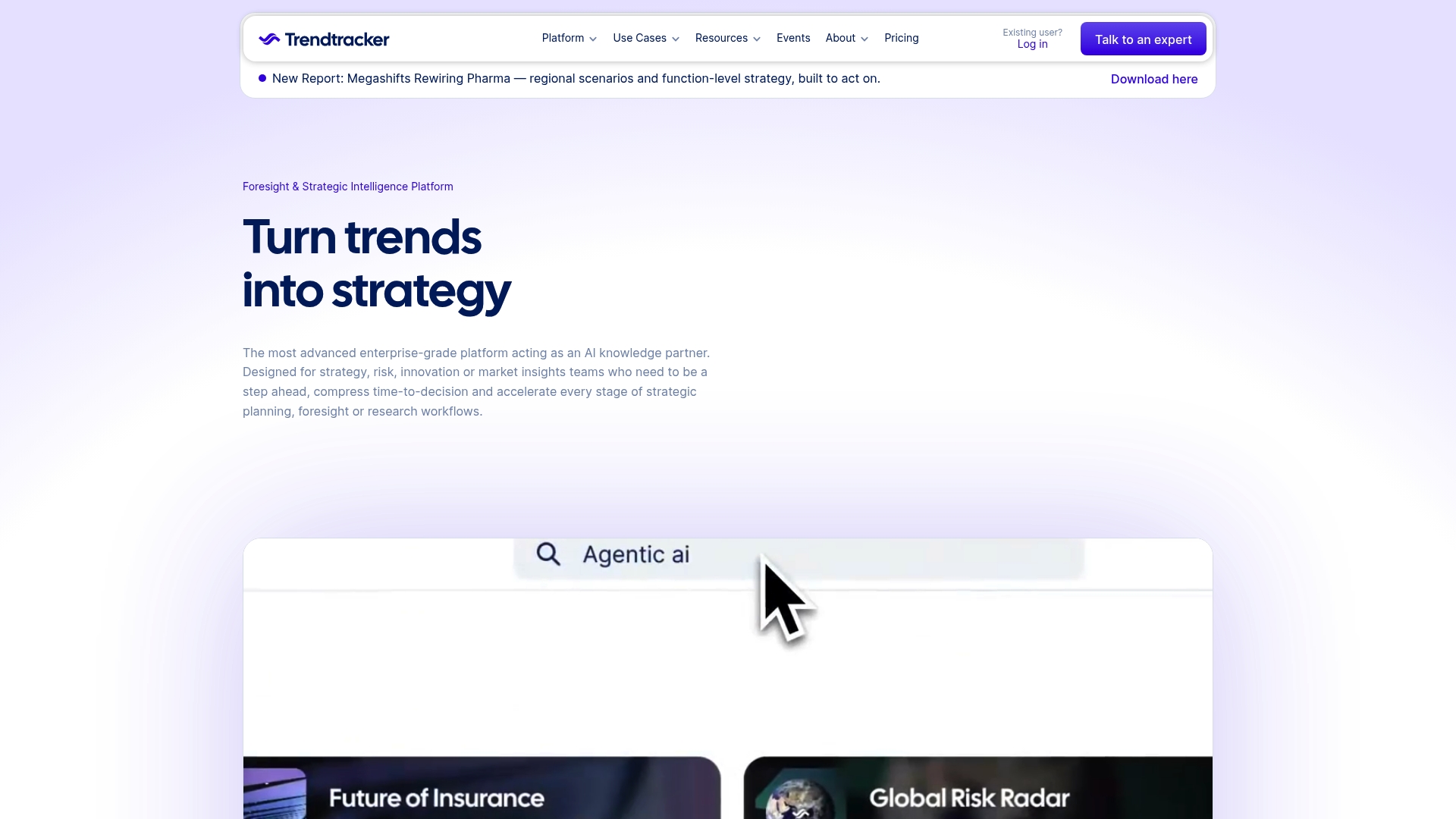
The vendor advertises real-time AI scans across more than 20,000 sources worldwide to surface high-impact trends and emerging risks. That scale is the platform's headline claim and underpins its pitch for faster foresight and strategic decision support.
Core Features
- Automated Trend Radars that refresh continuously and present signals as evolving radars rather than static lists.
- AI-powered search and recommendation engine that helps teams discover relevant signals quickly.
- The vendor states a database of over 6,000 trends spanning scientific, social, economic, technological, legal, and environmental topics.
- An AI Analyst feature that answers strategic questions with synthesised, data-backed summaries.
Key Differentiator
What sets Trendtracker apart is that 20,000-source claim and the way the platform translates broad coverage into strategic prompts. Rather than only surfacing mentions, it ranks impact and provides suggested lines of response for strategy teams to evaluate.
Pros
- Rapid signal discovery. The search plus recommendation flow shortens time to insight and helps teams find relevant trends without building custom queries.
- Automated Trend Radars keep radar charts current, which reduces manual monitoring work for horizon scanners.
- Practical synthesis from the AI Analyst speeds briefing preparation; you get condensed context and hypotheses rather than raw feeds.
- Designed for strategic workflows. Built-in tools for foresight and innovation planning map well to programme level roadmaps and risk registers.
- Vendor positioning for enterprise customers means dedicated onboarding and custom configurations are part of the engagement.
Cons
- Limited public technical detail. There is sparse third-party validation or independent benchmarks available against competing solutions.
- Pricing is customised and usage-based, so licence costs and total cost of ownership require a conversation rather than appearing on a price sheet.
- The platform may need significant configuration and onboarding for complex organisational taxonomies or bespoke taxonomies.
- The marketing materials emphasise scale and coverage; however, buyers who require transparent, independently audited accuracy metrics will find those harder to verify.
When It May Not Fit
If your team needs an off-the-shelf, fully transparent accuracy benchmark or open technical specifications, Trendtracker's limited public validation may be a blocker. Small teams with minimal budget will find the enterprise orientation and customised pricing a poor match.
Who It's For
Strategy, innovation, risk, and market intelligence units inside large organisations that treat foresight as a formal programme. Ideal for teams that can fund vendor onboarding and want AI-assisted triage across many domains.
Real World Use Case
A multinational insurer uses Trendtracker to monitor regulatory shifts, emergent technologies, and social trends. The team receives radar updates and AI briefings that inform proactive policy adjustments and product experimentation.
Pricing
Pricing follows a flexible usage-based model with named plans such as Team, Program, and Enterprise. Specific costs depend on scope and features, so procurement typically begins with a demo and a tailored proposal.
Website: https://trendtracker.ai
MiAmar
At a Glance
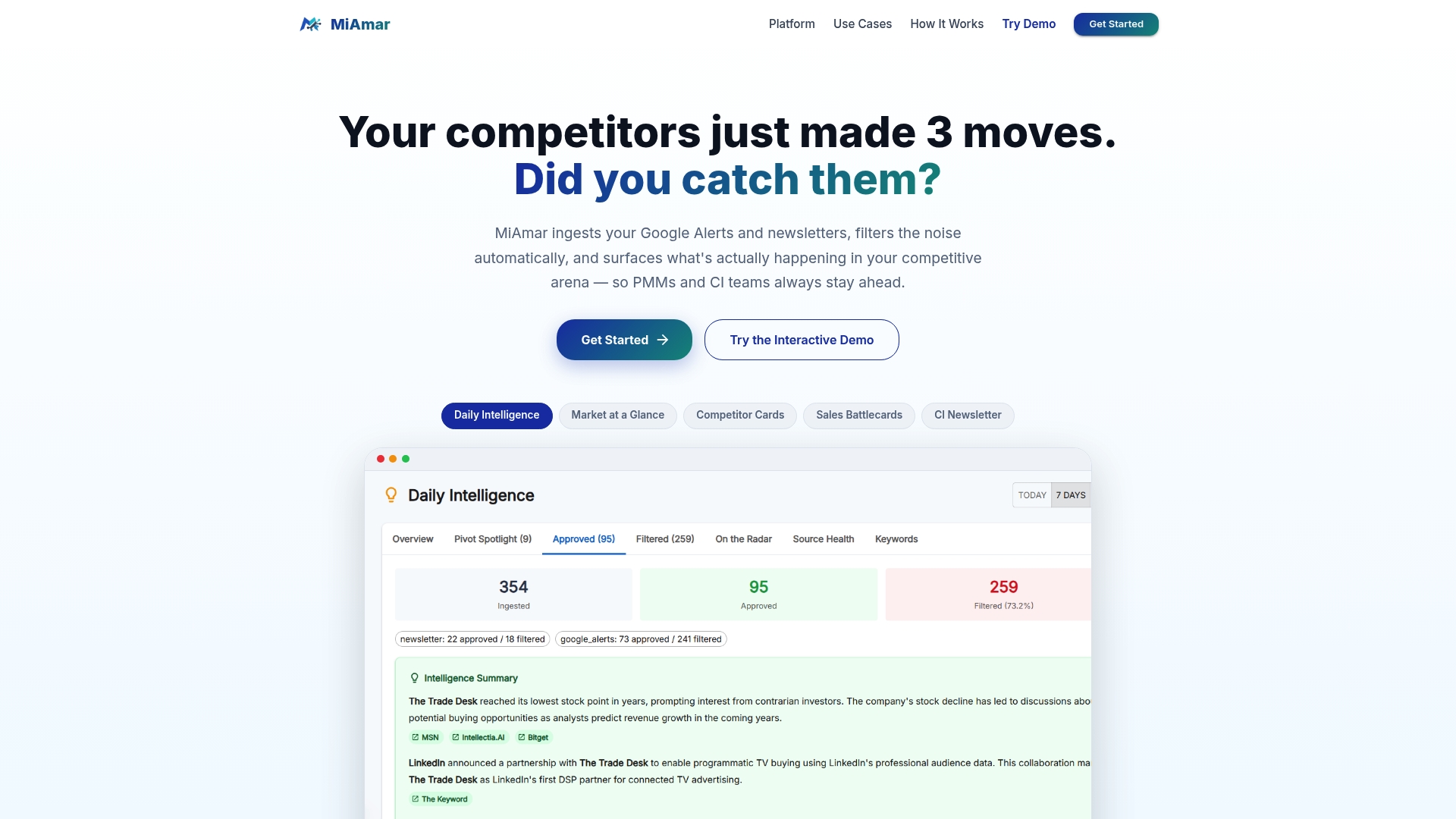
MiAmar automates the triage of Google Alerts, newsletters and other feeds so teams spend less time cleaning noise and more time on signals. The platform bundles AI summaries with source links and automated battlecards to speed competitive decision making.
Core Features
MiAmar offers AI-powered noise filtering that collapses duplicate alerts and ranks relevance. It produces AI-generated summaries with source links and maintains competitor profiles with change history.
Dashboards show marketplace trends and event classification. Weekly automated newsletters and sales battlecards keep commercial teams aligned without manual curation.
Key Differentiator
What sets MiAmar apart is the combination of fine-grained noise reduction and automated deliverables. The engine not only filters incoming noise but also ships auto-generated battlecards and source-linked summaries so Product Marketing and Competitive Intelligence teams receive consumable outputs, not raw feeds.
This focus targets CI workflows rather than broad trend discovery platforms such as Ontherice, making MiAmar a narrower tool for rapid competitive response.
Pros
- Saves researcher hours by automating triage and summarisation. Users who operate at pace will notice fewer duplicate alerts and quicker signal surfacing.
- Source-linked summaries let analysts verify claims without hunting through raw threads; that transparency reduces back-and-forth in follow-up meetings.
- Battlecards and weekly newsletters convert signals into sales-ready assets, reducing handoffs between PMM and GTM teams.
- Integrations with common collaboration tools mean intelligence appears alongside existing workflows instead of in a separate inbox.
Cons
- Several users report the platform feels expensive relative to smaller alternatives, making cost a real gate for lean teams.
- Some feedback points to an outdated visual design, which affects discoverability for new users and slows onboarding.
- There are occasional questions about the accuracy or authenticity of certain profile updates, which means teams should validate high-stakes signals before acting.
When It May Not Fit
If your team requires broad, early-stage trend discovery across many sectors rather than competitor-centric alerts, MiAmar's CI focus will feel narrow. Small startups with constrained budgets may find the cost prohibitive for the scope delivered.
If your intelligence team relies on very modern interfaces for rapid adoption, the dated design may slow roll-out across non-technical stakeholders.
Notable Integrations
- HubSpot for syncing intelligence into CRM deals and contact records.
- Slack to push ranked alerts and summaries into channels for immediate visibility.
- Monday.com to convert insights into tracked tasks or project items.
Each integration shortens the path from signal to action by meeting teams where they already work.
Who It's For
Product Marketing Managers and Competitive Intelligence teams at technology companies or fast-moving markets who need reliable competitor signals and ready-made GTM artefacts. Best where a CI owner exists to curate and act on automated outputs.
Real World Use Case
A product team uses MiAmar to monitor five direct competitors. When a rival ships a feature, MiAmar surfaces the event, updates the competitor profile, and generates a battlecard with suggested positioning. The team ships messaging updates within days rather than weeks.
Pricing
Pricing is not published here and was provided as informational only. Prospective buyers should contact MiAmar for current plans and to assess whether the cost matches their signal volume and output needs.
Website: https://miamar.io
Gopf: Strategic Intelligence
At a Glance
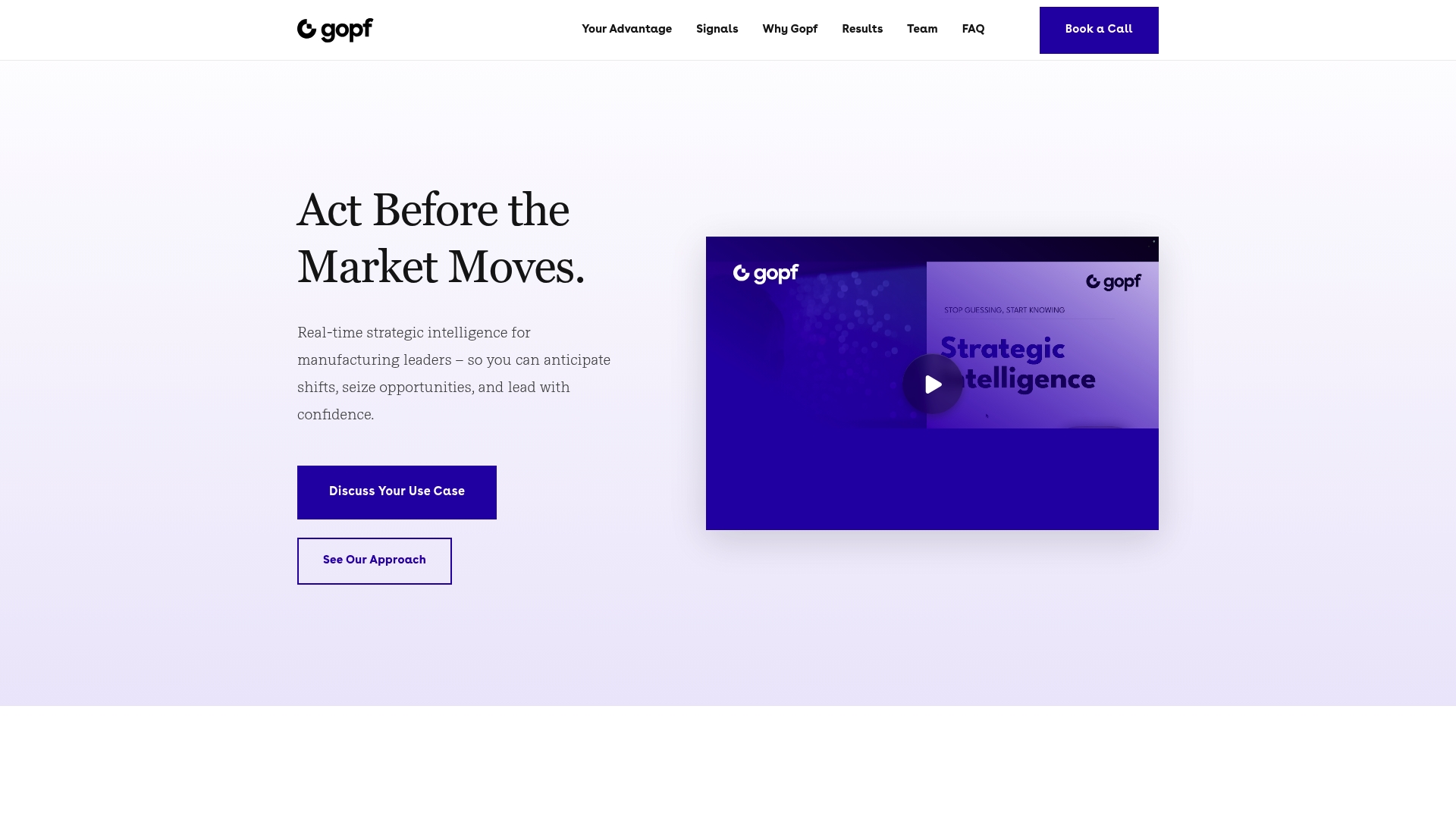
Gopf reports adoption by over 30 manufacturing leaders across the DACH region, a claim that frames its niche credibility. The platform delivers continuous, personalised market signals into Teams, WhatsApp, or email so teams receive timely, source-linked intelligence where they already work.
Core Features
Gopf centres on bespoke monitoring pipelines aligned to strategic priorities. Each pipeline is configured for depth, language, and industry source type.
- Custom intelligence profiles built from your strategic priorities
- Continuous AI scanning of niche industry sources
- Delivery into Microsoft Teams, WhatsApp, and email
- Traceable signals that link back to original sources
- Configurable signal depth per monitored market
Key Differentiator
Gopf builds fully customised, niche-focused pipelines that prioritise traceability and delivery into existing communication channels. That means your strategy team sees the same signal linked to its origin and context inside the chat or inbox they already use, reducing friction between insight and decision.
Pros
- Continuous monitoring replaces ad hoc reports and keeps strategic teams aware of emergent supply chain or competitive signals in near real time.
- The vendor describes highly customisable pipelines that work across multiple languages, which matters for cross-border manufacturing operations.
- Delivery into existing channels reduces training overhead since analysts receive signals in familiar workflows rather than a separate dashboard.
- Traceability to source material supports verified decision making and audit trails for high-stakes choices.
- The service aims to cut external consulting fees and save time on manual research, translating to internal cost avoidance.
Cons
- Third-party reviews flag dissatisfaction with associated delivery services such as missing or damaged packages and poor support, an issue that may affect customer experience beyond the core platform.
- Pricing and the onboarding model are steep for smaller teams given the CHF 14,800 annual floor and a CHF 5,000 onboarding fee.
- The product requires upfront strategic configuration, which means early value depends on careful scoping and internal time investment.
When It May Not Fit
If you need out-of-the-box coverage across broad consumer markets or a plug-and-play dataset, Gopf may not match your needs. The platform is tailored and requires strategic input up front, so teams seeking immediate, low-effort forecasting will find the onboarding and scoping demanding.
Notable Integrations
- Microsoft Teams for in-channel delivery
- WhatsApp for mobile signal distribution
- Email for routed alerts and summaries
Who It's For
Manufacturing executives, supply chain heads, and strategic planners who require continuous, tailored intelligence from niche sources. Best for organisations that can invest in scoping and want signals routed directly into operational communications.
Real World Use Case
A precision components manufacturer uses Gopf to monitor global supply chain signals and geopolitical risk. That monitoring enabled the team to pre-empt supplier changes and adjust sourcing strategy before shortages affected production.
Pricing
Pricing starts at CHF 14,800+ annually with a CHF 5,000 onboarding fee. Tiers vary by number of monitored markets and required signal depth, so expect customised quotes based on scope.
Website: https://gopf.com
TrakIntel
At a Glance
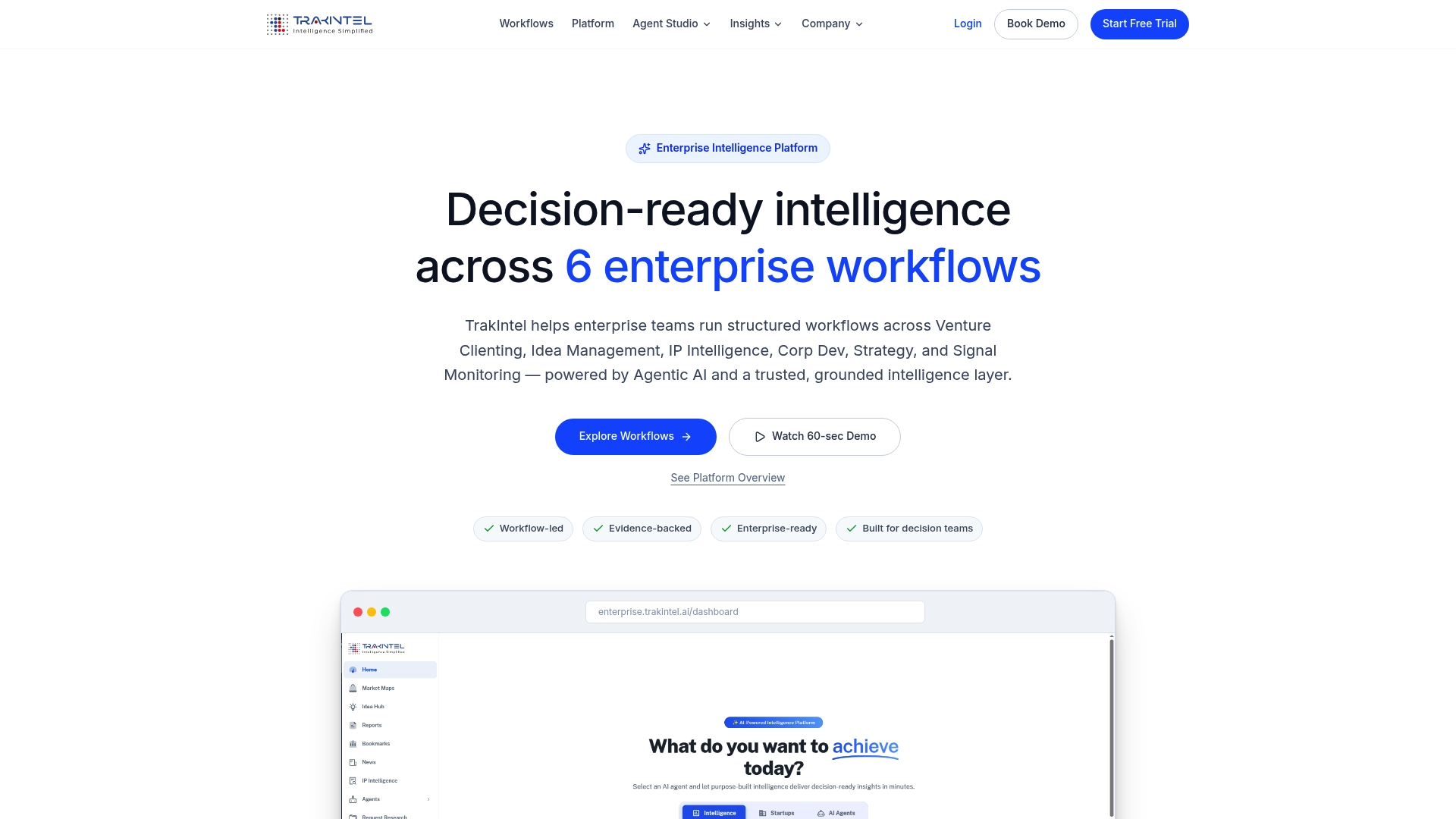
Produces decision-ready deliverables such as dashboards, evidence packs and strategic models that map directly onto enterprise workflows for innovation, IP and corporate development.
The product pairs structured workflow orchestration with a grounded intelligence layer and enterprise security features.
Core Features
- Structured workflows for Venture Clienting, Idea Management, IP Intelligence, Corporate Development and Signal Monitoring mapped to decision points.
- Grounded AI that links outputs to supporting evidence across startups, patents, research and market signals.
- Decision-ready outputs including dashboards, evidence packs and strategic models designed to slot into governance processes.
- Enterprise controls with role-based access, data encryption and SSO and SAML support for single sign on.
Key Differentiator
Combines strict workflow templates with a grounded intelligence layer so analysts produce outputs intended for final decisions rather than starter reports. The emphasis on evidence-backed deliverables separates it from tools that simply surface signals without integration into decision processes.
Pros
- Designed for enterprise security and scale, so compliance teams will find the role and access model familiar and audit friendly.
- Supports multiple core workflows in one place, reducing the friction of stitching separate tools for IP, corporate development and strategy.
- Produces shareable deliverables that reduce manual synthesis time, letting teams move from insight to governance faster.
- Continuous monitoring keeps signal feeds alive rather than one-off snapshots, which matters when regulatory or competitor moves are time sensitive.
- Collaboration features such as ownership tracking and operational analytics help teams hand off work without losing context.
Cons
- The vendor provides limited public detail on the underlying AI algorithms and the mechanics of its grounding layer, which makes technical evaluation harder.
- There are no clear public pricing or trial details, implying custom enterprise engagement rather than self-serve purchase.
- The structured workflows and breadth of capability introduce complexity that will require training for non-expert users to fully exploit the system.
When It May Not Fit
If your team is a small intelligence unit or a single-person market research cell, the platform’s enterprise deployment model and training requirements will likely be disproportionate to your needs.
If you need a transparent, self-serve pricing model or a short free trial to evaluate tools hands-on, TrakIntel’s likely enterprise sales approach may be a poor match.
If you require off-the-shelf algorithms with published methodology for audit purposes, the limited public information on the AI layer could be a blocker.
Notable Integrations
- SSO for centralised identity management and streamlined user provisioning.
- SAML support for enterprise single sign on and federated authentication.
These integrations align with common corporate security stacks and make deployment easier for organisations using identity providers.
Who It's For
Enterprise teams in corporate innovation, strategy, IP and corporate development that need structured workflows and evidence-linked outputs tied into governance and deal processes.
Best for organisations that have the budget and process maturity to adopt a platform through a vendor engagement and training cycle.
Real World Use Case
A Fortune 500 company uses TrakIntel to map its global IP landscape, monitor emerging startups and compile evidence packs for M&A screening. That workflow reduced internal synthesis time and sped up go no go decisions in corporate development.
Pricing
No public pricing is published. The vendor appears to follow an enterprise pricing model with bespoke engagements rather than fixed tiers, and there are no advertised self-serve trials or list rates.
Website: https://trakintel.ai
Opinly

At a Glance
Opinly's marketing materials claim a live project delivered more than 13,000% increases in backlinks and traffic. That headline figure frames the platform as an automation-first SEO tool that bundles audits, content, backlinking and monitoring into a single workflow.
Core Features
- Site audit and technical SEO fixing that flags issues and suggests corrective steps.
- AI content creation and scheduling to generate draft pages and push them to a content calendar.
- Platform integration with major CMS and frameworks for automated publishing and deployment.
- Backlink exchange network automation, keyword tracking, competitor benchmarking and internal linking optimisation.
- Real time SEO performance dashboards for ongoing monitoring.
Key Differentiator
Opinly focuses on end to end automation across routine SEO work. Its selling point is the way several tasks are chained together so audits feed content briefs which then feed backlink campaigns, with dashboards closing the loop and surfacing priorities in near real time.
Pros
- Automates routine tasks so your team spends less time on repetitive work and more time on strategy.
- The dashboards surface live signals and let you spot regressions quickly rather than waiting for monthly reports.
- Integration with CMS and frameworks reduces manual publishing overhead for content teams.
- That live project figure above gives a concrete example to test during a trial, useful when you need a rapid proof of concept.
- All core SEO workflows are present in one place, from technical fixes to competitor benchmarking and link activity.
Cons
- Independent reviews report variable effectiveness depending on niche and user expertise, so results are not uniform across sites.
- Some features, notably the backlink exchange network, appear to be evolving or in beta and may change frequently.
- No detailed pricing is published, which makes budgeting and procurement discussions harder for cost conscious teams.
When It May Not Fit
If your team lacks technical capacity to configure CMS integrations or to validate automated fixes, Opinly will feel incomplete. If you need guaranteed outcomes rather than a platform to scale experiments, this tool requires oversight and steady input to work well.
Who It's For
Marketing teams, in-house SEO specialists and growth marketers who want to accelerate routine work with automation. It suits groups prepared to test workflows and to manage integrations rather than teams seeking a zero touch, guaranteed results service.
Real World Use Case
A digital marketing agency sets up Opinly on a client site to run nightly audits, auto generate content briefs for high intent keywords and kick off backlink exchange workflows. The agency uses the dashboards to prioritise technical fixes and demonstrate rapid early gains to clients.
Pricing
Offers a free tier or trial alongside subscription plans, but the vendor does not publish detailed pricing. Expect to contact sales for tier breakdowns and enterprise terms before committing to a paid plan.
Website: https://opinly.ai
Comparative Analysis of Market Intelligence Platforms
Exploring the features and offerings of prominent market intelligence platforms reveals unique strengths tailored to specific user needs. Below, we compare OnTheRice.org with Trendtracker, MiAmar, Gopf, TrakIntel, and Opinly to provide a nuanced analysis of their capabilities.
Feature Scalability and Versatility
OnTheRice.org excels in offering a localised scoring mechanism for signal validation tailored uniquely to Singapore's market, which is particularly valuable for regional professionals. In contrast, Trendtracker provides an extensive, globally distributed dataset monitoring more than 20,000 sources, offering broader coverage but potentially lacking local relevancy for specific markets.
MiAmar addresses focused competitive intelligence by automating updates and providing decision-friendly outputs, including battlecards and summaries. This positions it strongly for product marketing and competitive intelligence-specific needs. However, its scope does not encompass the wider foresight applications of competitors like Trendtracker or OnTheRice.
Transparency and Accessibility
For users requiring clear, traceable sources for their market insights, Gopf emerges as a particularly strong choice. Its delivery model through familiar platforms like Microsoft Teams or WhatsApp ensures integration into existing workflows. By contrast, OnTheRice.org prioritises automated synthesis and layered AI verification for signal robustness, which requires a degree of trust in their proprietary scoring.
Opinly offers real-time outputs through dashboards with an automation-first focus on SEO workflows, which suits marketing teams working on technical and content optimisation projects.
Best Fit Recommendations
- OnTheRice.org: For professionals focusing on market signals with clear Singaporean relevance, including investors, researchers, and startup observers.
- Trendtracker: Suitable for globally distributed organisations seeking scalable cross-domain strategic insight capabilities.
- Gopf: Best for manufacturing or supply chain management teams demanding traceable intelligence directly integrated into business communication platforms like Microsoft Teams.
- MiAmar: Recommended for product marketing and competitive intelligence teams that value high-quality competitor analysis tools with pre-processed deliverables.
- Opinly: Ideal for digital marketers aiming to streamline SEO processes with automated content suggestions and performance monitoring.
Our Pick
OnTheRice.org is recommended for users seeking market intelligence tailored to Singapore's specific context, combined with AI-driven validation processes. This platform uniquely provides a sophisticated and reliable scoring system catering to the region's dynamics. However, for those requiring broader, multi-regional insights or automation-heavy workflows in specialised niches like SEO, competitors like Trendtracker or Opinly may prove to be the preferred choices.
Market Intelligence Software Comparison
Choosing the right market intelligence software involves evaluating features such as signal accuracy, tailored insights, and configurability for various organisational needs.
| Product | Key Differentiator | Best For | Pricing | Notable Limitation |
|---|---|---|---|---|
| OnTheRice.org | Localised signals using multiple AI engines for verification | Singapore market analysts needing early insights | Not disclosed | Proprietary scoring weights limit validation without deeper analysis |
| Trendtracker | Broad AI coverage from 20,000+ sources with strategic prompts | Strategy and risk teams requiring comprehensive global reach | Not disclosed | Lacks independent validation and transparency metrics |
| MiAmar | Fine-grained noise reduction with automated battlecards | Competitive intelligence teams needing actionable deliverables | Not disclosed | Costly relative to offerings, potentially challenging for small teams |
| Gopf | Bespoke niche intelligence pipelines linked to notifications | Manufacturing executives with cross-border operational needs | CHF 14,800+ | High entry cost and onboarding fee |
| TrakIntel | Structured workflows producing evidence-linked outputs | Corporate development teams needing decision-ready outputs | Not disclosed | Enterprise-centric model limits small-scale applicability |
Gain an Edge with Ontherice for Market Intelligence Alternatives
If you are exploring trendtoknow.com alternatives, Ontherice offers a refreshing solution that addresses the challenge of filtering overwhelming global data into clear, actionable signals. Ontherice uses multiple AI engines to cross-verify noisy internet trends and provides a Singapore-focused scoring system to prioritise relevance—helping you detect shifts before competitors spot them. This platform is ideal for professionals seeking transparency and human-readable insights rather than just raw alerts.

Start gaining early foresight today with Ontherice by visiting Ontherice.org. Test the live AI inquiries and signal scores to quickly identify emerging opportunities and make informed strategic decisions with confidence.
Frequently Asked Questions
How does Ontherice handle local relevance for Singapore markets?
Ontherice assesses local relevance by applying a transparency-focused scoring layer that adapts to Singapore and global markets. This feature allows members to focus on signals that are most pertinent to their regional interests. Exploring this scoring can help users prioritise insights that are likely to impact their local strategies.
What is the difference between Ontherice and Trendtracker regarding integration and data sources?
Trendtracker boasts real-time AI scans across more than 20,000 sources worldwide, which is a significant strength in its ability to uncover high-impact trends. Ontherice, on the other hand, uses layered verification through multiple AI engines tailored for Singapore signals, which makes it more suited for those specifically interested in local market insights. Users should consider their primary needs—broad trend discovery or focused local relevance—when choosing between these platforms.
Which platform offers better automation for data summarisation?
Ontherice provides human-readable summaries that condense complex events into concise explanations, enabling quicker comprehension of signals. This is particularly beneficial for analysts who want to spend less time interpreting data and more time evaluating its relevance. Users should test the summarisation effectiveness when opting for platforms that best fit their operational workflows.
Can I rely on Ontherice's scoring for high-stakes decisions?
While Ontherice employs multiple AI checks to support its scoring, the proprietary scoring weights limit independent verification, which means it should be treated as an informed signal. Users considering high-stakes decisions should take the time to corroborate scores with additional data sources to ensure accuracy in their assessments.
How does Ontherice's discovery feature compare to that of MiAmar?
Ontherice's discovery features highlight emerging tools and AI applications, making it easier for users to spot new opportunities. In contrast, MiAmar emphasises competitor signals and automated deliverables that are tailored for competitive intelligence. This distinction means users should assess whether they need a broader view of market signals or a sharper focus on their competitive landscape.