
TL;DR:
- Sector adaptability involves an organization's ability to adjust its strategies and operations in response to changing industry conditions. Most successful adaptability requires enterprise-wide execution, disciplined routines, and permanent ownership rather than isolated efforts. Building this capacity depends on fostering trust, clear decision-making, and regular review of long-term priorities.
Sector adaptability is defined as an organisation's capacity to adjust its strategies, structures, and operations in response to evolving market and industry conditions. The term maps closely to what management researchers call "dynamic capabilities," a framework built around three core routines: sensing opportunities and threats, seizing them through decisions, and reconfiguring assets to sustain competitive position. 81% of corporate boards increased expectations for decisive leadership responses to external market pressures in 2026. That figure tells you boards are no longer treating adaptability as a soft aspiration. They are treating it as a measurable leadership obligation. Ontherice tracks these shifting sector signals in real time, giving strategists early sight of where momentum is building before it becomes consensus.
What is sector adaptability explained in practice?
Sector adaptability is not the same as general business agility. Agility describes speed. Adaptability describes the depth and durability of change. A company can pivot quickly and still fail to reconfigure its underlying model, which means it has moved fast without actually adapting. The distinction matters because it changes where leaders invest their attention.

The KPMG Adaptability Index treats adaptability as a measurable organisational property, not a personality trait. It scores organisations on their capacity to sense change, make decisions under uncertainty, and realign resources accordingly. That framing shifts the conversation from "are we flexible?" to "do we have the systems and discipline to adapt at scale?"
Structural adaptability often signals sector change more definitively than technology adoption alone. Changes in the unit of value within a business model, such as shifting from selling products to selling outcomes, are more reliable indicators of genuine sector transition than the arrival of a new technology. Strategists who watch business model structure, not just technology headlines, read sector change earlier and more accurately.
Why does enterprise-wide execution determine adaptability outcomes?
The most important finding in recent adaptability research is also the most counterintuitive. Organisations implementing enterprise-wide adaptations report an 83% success rate, versus 28% for incremental, isolated initiatives. That gap is not marginal. It means fragmented efforts fail at a rate three times higher than coordinated ones.
The reason is what researchers call the execution gap. Most organisations launch adaptability efforts with genuine intent, then allow them to fracture across business units, each pursuing slightly different priorities with different owners and different timelines. The result looks like activity but produces little structural change.
Innovation volume does not equate to true adaptability. Disciplined execution and coordination are what convert intent into outcomes. The organisations that close the execution gap share three characteristics:
- Clear ownership. One senior leader holds accountability for the transformation, not a committee.
- Fewer, bolder moves. They concentrate resources on two or three high-impact changes rather than spreading effort across ten.
- Enterprise-wide deployment. Changes apply across the whole organisation, not in pilot pockets that never scale.
A related concept is the proactivity gap. Companies often err by reacting to disruption rather than pursuing bold transformation ahead of it. Reactive organisations spend their energy catching up. Proactive ones spend it building the next position.
Pro Tip: If your adaptability programme has more than four strategic priorities, it has none. Cut the list before you scale the effort.
Parallel organisational structures, such as spin-outs that bypass legacy constraints, can accelerate adaptation when the core organisation is too encumbered to move at the required pace. This is not a workaround. It is a deliberate structural choice.
What cultural and organisational factors affect sector adaptability?
Culture is not a soft variable in adaptability. Research shows adaptability capacity correlates positively with internal trust, communication processes, and inclusiveness. Organisations where people share information freely and trust leadership decisions adapt faster than those where information is hoarded or decisions are contested.
"Sector adaptability stability varies across industries. Industrial and energy sectors generally display higher baseline resilience, partly because they have long operated under regulatory and commodity pressures that force structural discipline. Sectors with lower baseline resilience tend to be those where competitive pressure has historically been low enough to allow structural complacency."
That sector variation has practical implications. A strategy that works for an energy company, which already has embedded risk and reconfiguration routines, may be insufficient for a consumer services firm building those routines from scratch.
Three internal factors consistently support adaptability across sectors:
- Integrated employee development. Mentoring programmes and adaptive learning cycles build the workforce capability needed to execute new strategies. Digital maturity alone is insufficient. Organisations must reconfigure workforce skills alongside processes.
- Communication architecture. Formal channels for sharing market signals across functions prevent the information silos that slow decision-making.
- Inclusive decision-making. Organisations that draw on diverse perspectives when sensing change identify threats and opportunities earlier than those that rely on a narrow leadership group.
Understanding cross-sector trend monitoring is one practical way to build the sensing capability that cultural readiness supports.
How do dynamic capability frameworks guide adaptability routines?
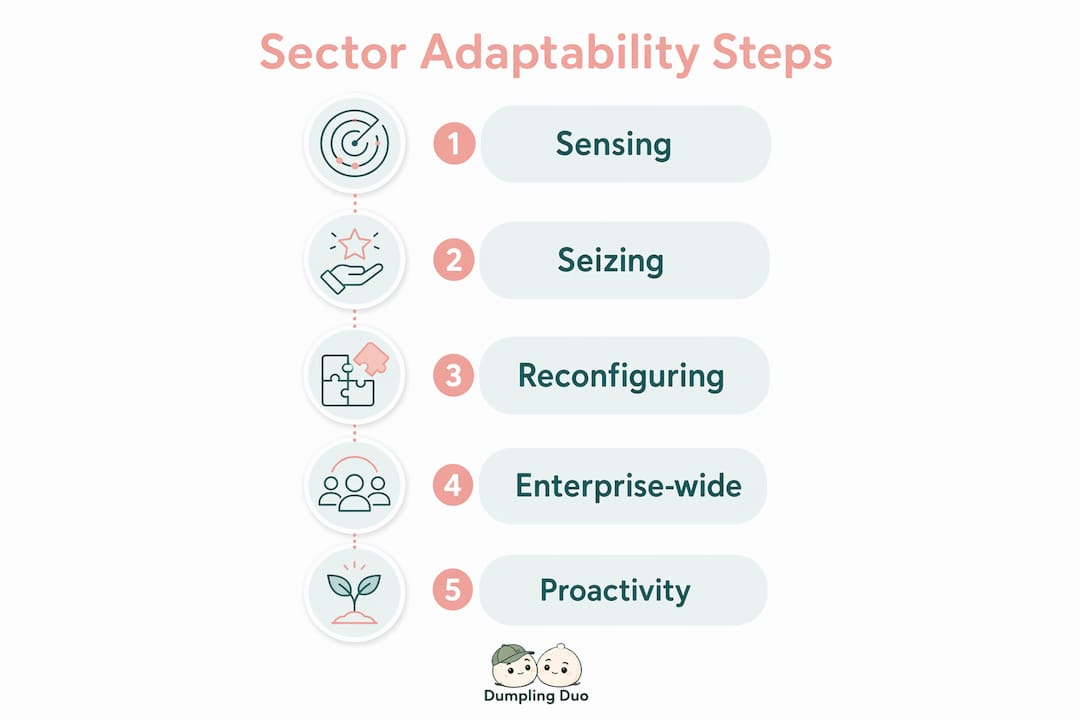
Dynamic capabilities give adaptability a repeatable structure. The three core routines are sensing, seizing, and reconfiguring. Each has a distinct role, and most organisations stall at one of them.
- Sensing. Scanning the external environment for signals of change, including weak signals that precede mainstream awareness. This requires dedicated intelligence functions, not just executive intuition.
- Seizing. Converting a recognised opportunity or threat into a decision and committing resources. This is where many organisations stall. They sense change accurately but delay commitment, waiting for certainty that never arrives.
- Reconfiguring. Realigning assets, processes, and people to execute the new direction. This is the hardest routine because it requires stopping existing activities, not just adding new ones.
Dynamic adaptability routines depend on organisational systems alignment, combining leadership behaviour, learning routines, role clarity, and decision rights. Without that alignment, the three routines operate in isolation and produce inconsistent results.
Pro Tip: Build a quarterly reflection cycle into your planning calendar. Ask three questions: What did we sense this quarter? What did we decide? What did we stop? The answers reveal where your adaptability routine is breaking down.
The table below shows how each routine typically breaks down in practice and what discipline corrects it.
| Routine | Common failure mode | Corrective discipline |
|---|---|---|
| Sensing | Relying on lagging indicators | Structured weak-signal scanning |
| Seizing | Waiting for consensus before deciding | Pre-agreed decision thresholds |
| Reconfiguring | Adding new work without stopping old | Formal decommissioning process |
Adaptive trend intelligence frameworks apply these three routines at the market level, helping strategists connect external signals to internal decisions.
What challenges do organisations face in improving sector adaptability?
The most common barrier to sector adaptability is not a lack of ambition. It is structural inertia. Legacy business models create path dependency, where past success makes it harder to change because the existing model still generates revenue, even as it loses relevance.
A second barrier is the reactive posture described earlier. Organisations that wait for disruption to become obvious before responding have already ceded the early-mover advantage. By the time a threat is visible to everyone, the cost of adaptation has risen significantly.
Fragmented initiatives compound both problems. When adaptability efforts are spread across too many workstreams, treating adaptability as a standing corporate function with dedicated ownership becomes impossible. Each initiative competes for attention and funding, and none reaches the scale needed to change the organisation's trajectory.
The recommended approach to overcoming these challenges involves four moves:
- Establish adaptability as a permanent function. Assign a senior owner, a budget, and a mandate. Treat it as you would a finance or legal function, not as a project.
- Align leadership before scaling. Divided leadership is the single fastest way to kill an enterprise-wide effort. Resolve disagreements at the top before deploying changes below.
- Decommission deliberately. Adaptability requires stopping activities to free capacity for new ones. Build a formal process for discontinuing work, not just for launching it.
- Scale enterprise-wide from the start. Pilots that are never designed to scale waste time and signal to the organisation that the change is not serious.
Pro Tip: Before launching any new adaptability initiative, identify three existing activities you will stop. If you cannot name them, you are not creating capacity. You are just adding load.
How can strategists apply sector adaptability principles for competitive advantage?
Translating adaptability theory into practice requires discipline over enthusiasm. The organisations that build lasting adaptability do not do more things. They do fewer things with greater commitment and clearer accountability.
Strategic focus and execution discipline drive better outcomes than breadth of initiative. For strategists, this means resisting the pressure to respond to every market signal with a new programme. The sensing routine exists to filter signals, not to generate responses to all of them.
Building adaptability as a competitive advantage requires five practical commitments:
- Narrow your strategic priorities. Two or three well-executed changes outperform ten half-hearted ones every time.
- Assign decision rights clearly. Ambiguity about who decides what is the primary cause of seizing failures.
- Build feedback loops into operations. Quarterly reflection cycles, post-project reviews, and structured customer feedback all feed the sensing routine.
- Develop ecosystem partnerships. Adaptability at the sector level often requires capabilities your organisation does not own. Partnerships extend your sensing and reconfiguring capacity without requiring internal build.
- Revisit long-term priorities regularly. Near-term agility is valuable. It becomes a liability when it drifts from long-term strategic direction. Set a fixed cadence for reviewing whether your adaptability efforts are still pointed at the right destination.
Early trend adoption gives strategists the lead time needed to execute these commitments before competitors recognise the same signals.
Key takeaways
Sector adaptability succeeds when organisations execute enterprise-wide, build dynamic capability routines, and treat adaptability as a permanent function with clear ownership and deliberate resource allocation.
| Point | Details |
|---|---|
| Enterprise-wide execution wins | Coordinated, organisation-wide efforts succeed at 83% versus 28% for fragmented initiatives. |
| Culture drives capacity | Internal trust, open communication, and inclusive decisions directly improve adaptability outcomes. |
| Three routines structure adaptability | Sensing, seizing, and reconfiguring must each work, or the whole system stalls. |
| Stop before you start | Decommissioning old activities is as important as launching new ones for creating real capacity. |
| Adaptability is a function, not a project | Organisations that assign permanent ownership and funding to adaptability outperform those that treat it as a one-off effort. |
Why I think most adaptability programmes are solving the wrong problem
Most adaptability programmes I have observed are designed to produce motion, not change. Leaders commission working groups, launch pilots, and announce transformation agendas. The organisation gets busier. The underlying model stays the same.
The uncomfortable truth is that genuine adaptability requires subtraction as much as addition. You cannot reconfigure an organisation that is already running at full capacity on its existing commitments. The first act of real adaptability is stopping something, and that is the act most leaders avoid because it requires admitting that a past decision is no longer serving the business.
I have also seen organisations confuse digital investment with adaptability. Deploying new technology into an unchanged process does not make the organisation more adaptable. It makes it a more expensive version of what it already was. The reconfiguring routine is not about tools. It is about changing how decisions are made, how resources are allocated, and who has authority to act.
The organisations I find most credible on adaptability are the ones that can name what they stopped last quarter as readily as what they started. That discipline, more than any framework or survey score, is the real signal of an adaptable organisation.
— Aidil
Ontherice: built for strategists who need to sense change early
Sector adaptability starts with sensing. Before you can seize an opportunity or reconfigure your operations, you need to know where momentum is building in your sector.

Ontherice uses multiple AI engines to scan global data and surface rising sector signals before they reach mainstream awareness. The platform generates rankings and scores across diverse markets, giving strategists a structured view of what is gaining traction and what is fading. For professionals who need to act on change before competitors recognise it, the AI opportunities tracker provides the early intelligence that makes proactive adaptation possible. Sensing is the first routine. Ontherice is built to support it.
FAQ
What is sector adaptability?
Sector adaptability is an organisation's capacity to adjust its strategies, structures, and operations in response to changing industry and market conditions. It is measured by the ability to sense, seize, and reconfigure, not by the volume of initiatives launched.
Why does enterprise-wide execution matter for adaptability?
Organisations implementing enterprise-wide adaptations report an 83% success rate, compared to 28% for incremental efforts. Fragmented initiatives fail because they lack the coordination and ownership needed to produce structural change.
What are the main challenges in improving sector adaptability?
The primary barriers are structural inertia from legacy business models, a reactive rather than proactive posture, and fragmented initiatives that never reach enterprise scale. Establishing adaptability as a permanent function with dedicated ownership addresses all three.
How do dynamic capabilities relate to sector adaptability?
Dynamic capabilities are the organisational routines of sensing, seizing, and reconfiguring that make adaptability repeatable. Without these routines embedded in systems and leadership behaviour, adaptability remains ad hoc and inconsistent.
Which sectors show the highest baseline adaptability?
Industrial and energy sectors generally display higher baseline resilience, partly because regulatory and commodity pressures have forced structural discipline over time. Sectors with historically low competitive pressure tend to show lower baseline adaptability capacity.