
TL;DR:
- Adaptive trend intelligence detects emerging market signals in real time and updates its models continuously. It offers a 4 to 12 week lead-time over traditional analysis, reducing manual workload by up to 60 percent. Most organizations fail to act quickly due to internal friction, not limitations in the technology.
Adaptive trend intelligence is defined as the autonomous, real-time process of detecting, learning from, and acting on emerging market signals before they reach mainstream awareness. Unlike conventional research cycles, this approach continuously updates its own models as new data arrives, giving business professionals and market analysts a live picture of where markets are heading. The Global Adaptive Intelligence Framework market is valued at $5.5 billion in 2026 and is forecast to reach $26.3 billion by 2034. That growth rate reflects how urgently organisations are moving away from static research and toward systems that think and adapt in real time. Ontherice applies this exact principle, scanning global data points with multiple AI engines to surface rising trends before competitors notice them.
What is adaptive trend intelligence, and how is it defined?
Adaptive trend intelligence is the capacity of a system to identify emerging market patterns, update its analytical models without manual intervention, and deliver actionable signals continuously. The standard industry term for the broader discipline is adaptive analytics, and adaptive trend intelligence is its most forward-facing application. Where traditional analytics describes what happened, adaptive trend intelligence predicts what is about to happen and adjusts its predictions as conditions shift.

The concept sits at the intersection of machine learning, signal processing, and market research. A system qualifies as genuinely adaptive when it meets three conditions: it ingests data in real time, it revises its own weighting logic based on new evidence, and it flags emerging patterns before they appear in mainstream reporting. Meeting all three conditions is what separates true adaptive intelligence from a dashboard that simply refreshes its charts.
For business professionals, the practical implication is significant. You no longer wait for a quarterly report to tell you what changed six weeks ago. The system tells you what is changing right now, and it does so with increasing accuracy the longer it runs.
How does adaptive trend intelligence differ from traditional trend analysis?
Traditional trend analysis relies on periodic research cycles, typically quarterly or annual, that aggregate historical data into reports. By the time a trend appears in a conventional research report, it has often already peaked. Adaptive trend intelligence closes that gap by operating continuously rather than in scheduled batches.
The lead-time advantage is measurable: adaptive tools provide a 4–12 week head start over traditional quarterly research. In fast-moving sectors such as fashion or consumer technology, microtrends can be detected within operational windows as short as 6 hours. That is the difference between entering a market at the growth phase and entering at saturation.
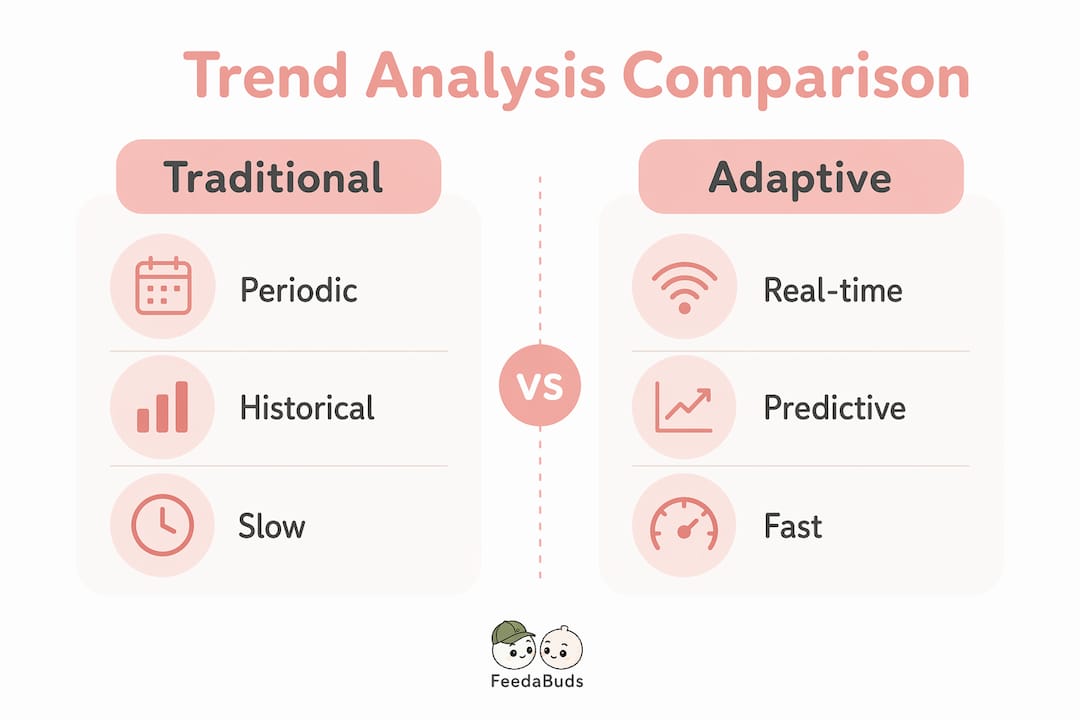
The table below shows the core contrasts between the two approaches.
| Dimension | Traditional trend analysis | Adaptive trend intelligence |
|---|---|---|
| Update frequency | Quarterly or annual | Continuous, real-time |
| Lead time | Weeks to months after peak | 4–12 weeks before mainstream |
| Learning mechanism | Manual analyst review | Autonomous model updating |
| False positive handling | Editorial judgement | Algorithmic veto logic |
| Signal sources | Surveys, reports, focus groups | Multi-layer data stacks |
Three characteristics define the adaptive advantage:
- Continuous learning. The system revises its own signal weights as new data arrives, without waiting for a human analyst to intervene.
- Speed at scale. Automated ingestion processes far more data sources simultaneously than any research team can manage manually.
- Self-correction. When a signal proves to be noise, the system records that outcome and reduces the weight of similar signals in future cycles.
Pro Tip: When evaluating any trend intelligence tool, ask specifically whether it updates its own models or simply refreshes its data feed. Only the former qualifies as genuinely adaptive.
What methodologies power adaptive trend intelligence?
The most reliable adaptive trend intelligence systems use a signal stack methodology: multiple independent data layers that must each confirm a signal before it is elevated to a genuine trend. Cross-layer convergence reduces false positives by requiring a valid signal to appear in at least three independent layers, such as research velocity, seed funding activity, and community discussions. This multi-dimensional approach is the core of advanced adaptive trend intelligence.
The key layers in a well-constructed signal stack are:
- Research velocity. The rate at which academic papers, patent filings, or specialist publications reference a topic. Acceleration here often precedes commercial adoption by months.
- Community mapping. Tracking where conversations originate, which specific sub-communities are driving them, and how quickly they spread to adjacent groups.
- Funding signals. Early-stage investment activity in a sector frequently predicts mainstream product launches 12–18 months later.
- Algorithmic amplification. Monitoring when platform recommendation engines begin surfacing a topic to broader audiences, which marks the transition from niche to mainstream.
- Crossover signals. Journalist engagement, competitor adoption, and algorithmic amplification together confirm commercial viability before significant investment is committed.
Velocity tracking is particularly important. Narrative velocity is more predictive than volume: a topic that doubles its narrative presence within 48 hours carries higher predictive weight than a topic with a large but static audience. Volume tells you what is popular. Velocity tells you what is about to become popular.
Regime filters, sometimes called veto logic, add a final layer of governance. Veto logic prevents trend adoption when current market conditions are incompatible with the signal, protecting organisations from committing resources to trends that are real but poorly timed. Most organisations face decision-making problems rather than information shortages. Veto logic addresses the former directly.
Pro Tip: Build your signal stack so that no single data source can trigger a trend alert alone. Requiring convergence across at least three independent layers is the single most effective way to reduce false positives.
What role does AI play in adaptive trend intelligence?
Adaptive AI is the technological engine that makes real-time trend intelligence possible at scale. Adaptive intelligence shifts AI from a static tool into a dynamic system that improves without human oversight, updating its own parameters as market conditions change. This is a fundamental departure from programmed automation, where rules are fixed at deployment and only change when a developer rewrites them.
The practical benefits are already visible across industries:
- Finance. Adaptive AI systems monitor sentiment shifts across news feeds, social platforms, and regulatory filings simultaneously, flagging portfolio risks before they appear in price movements.
- Manufacturing. Supply chain signals from logistics data, commodity prices, and geopolitical news are synthesised in real time to anticipate disruptions weeks before they affect production.
- Healthcare. Epidemiological signals, clinical trial registrations, and research publication velocity are tracked together to identify emerging treatment areas and regulatory shifts early.
Deployment of adaptive AI reduced manual workload by up to 60% in operational tasks by april 2026. That reduction does not mean fewer analysts. It means analysts spend less time gathering and cleaning data, and more time interpreting signals and making decisions. The shift from programmed automation to self-improving AI systems also requires new leadership skills, specifically the ability to set judgement frameworks and governance structures that guide what the AI prioritises.
What are the practical benefits for business decision-making?
Adaptive trend intelligence delivers three categories of benefit to business professionals: speed, accuracy, and operational efficiency. Speed comes from the continuous monitoring described above. Accuracy comes from multi-layer signal validation. Efficiency comes from the reduction in manual research workload.
The decision-making benefit is most visible in early microtrend detection. A guide to real-time trend insights shows how platforms enabling rapid forecasting allow organisations to enter markets at the growth phase rather than at saturation. Entering a trend 8 weeks before mainstream awareness is not a marginal advantage. In competitive markets, it is the difference between category leadership and playing catch-up.
| Benefit | Traditional approach | Adaptive approach |
|---|---|---|
| Time to detect microtrend | 6–12 weeks | As short as 6 hours |
| Manual research workload | High | Reduced by up to 60% |
| Signal validation | Single-source editorial | Multi-layer algorithmic |
| Strategy response time | Quarterly cycle | Continuous |
Responsive strategy formation is the second major benefit. When a signal stack confirms a trend, the organisation already has the context to act: which communities are driving it, what the funding environment looks like, and whether crossover signals confirm commercial viability. That context collapses the time between detection and decision. For identifying microtrends early, the competitive advantage compounds over time as the system learns which signal patterns in your specific market reliably precede mainstream adoption.
Pro Tip: Track not just which trends your system detects, but which ones it detected earliest and how those played out. That feedback loop is what builds organisational insight maturity over time.
Key takeaways
Adaptive trend intelligence outperforms traditional research because it combines continuous multi-layer signal validation with autonomous model updating, delivering a 4–12 week lead-time advantage and up to 60% reduction in manual workload.
| Point | Details |
|---|---|
| Core definition | Adaptive trend intelligence autonomously detects and acts on market signals in real time, not in quarterly cycles. |
| Lead-time advantage | Adaptive systems identify microtrends 4–12 weeks before traditional research, with detection windows as short as 6 hours. |
| Signal stack methodology | Valid signals must appear in at least three independent layers to reduce false positives and confirm genuine trends. |
| AI as dynamic partner | Adaptive AI updates its own models without human intervention, cutting operational workload by up to 60%. |
| Veto logic governance | Regime filters prevent resource commitment to trends that are real but incompatible with current market conditions. |
Why I think most organisations are still getting this wrong
The technology for adaptive trend intelligence exists and is maturing fast. The problem is not access. The problem is that most organisations deploy adaptive tools on top of old decision-making structures, and then wonder why the speed advantage does not materialise.
I have seen this pattern repeatedly. A team adopts a real-time signal platform, but the approval process for acting on those signals still runs through a monthly strategy review. The tool detects a microtrend in 6 hours. The organisation responds in 6 weeks. The lead-time advantage is entirely absorbed by internal friction.
The shift from programmed automation to genuinely adaptive AI requires a cultural change as much as a technical one. Leaders need to build action frameworks that match the speed of the intelligence they are receiving. That means pre-authorised response playbooks for specific signal types, not open-ended deliberation every time the system flags something new.
Governance matters too. Veto logic and regime filters are not just technical features. They are expressions of organisational judgement about which trends are worth pursuing given current constraints. The organisations that build that judgement into their systems, rather than leaving it entirely to the AI, are the ones that sustain the advantage over time. Sustained use also builds what I would call insight maturity: the system learns your market, and your team learns to trust the signals it surfaces. That compound effect is where the real long-term value sits.
— Aidil
How Ontherice surfaces adaptive signals for your market
Ontherice applies multi-layer adaptive AI engines to scan global data points and generate ranked signals across diverse markets, giving business professionals and analysts a live view of what is gaining momentum before it reaches mainstream awareness.
The platform's global signal monitoring service tracks cross-layer convergence across sectors, surfacing the kind of early-stage signals that traditional research misses entirely. Ontherice also provides AI-powered opportunity detection that maps velocity, community activity, and funding signals into ranked trend scores. For analysts who need to act on intelligence rather than simply observe it, Ontherice translates raw signal data into clear rankings and scores that support fast, confident decisions.
FAQ
What is adaptive trend intelligence in simple terms?
Adaptive trend intelligence is a system that continuously monitors market data, updates its own analytical models, and flags emerging trends in real time, without waiting for a human analyst to run a periodic report.
How does adaptive trend intelligence differ from standard trend analysis?
Standard trend analysis uses historical data reviewed on a fixed schedule. Adaptive trend intelligence processes live data continuously and provides a 4–12 week lead-time advantage over traditional quarterly research cycles.
What makes a signal valid in adaptive trend intelligence?
A valid signal must appear in at least three independent data layers, such as research velocity, community discussions, and funding activity, before the system elevates it to a confirmed trend.
Why is narrative velocity more important than volume?
A topic that doubles its narrative presence within 48 hours is a stronger predictive signal than a topic with a large but static audience, because velocity indicates acceleration rather than existing popularity.
What is veto logic in trend intelligence systems?
Veto logic is a governance filter that blocks a trend signal from triggering action when current market conditions are incompatible with it, preventing organisations from committing resources to poorly timed opportunities.