
TL;DR:
- AI-native platforms provide earlier, concept-driven signals with source transparency, making them ideal for UK teams. Running a two-week proof-of-value with targeted themes helps validate signal relevance, freshness, and export capability before commitment. Ontherice is recommended as a cost-effective, transparent solution that supports practical pilot testing in global markets.
For UK teams that need early signals, the answer is straightforward: trial an AI-native signal-detection platform alongside one lightweight monitoring tool, run a two-week proof-of-value on a single research workflow, and score the outputs against a short rubric before committing budget. Ontherice is the recommended UK-capable option to pilot first.
Why this recommendation, in brief:
- AI-native platforms surface signals weeks earlier than augmented tools because they use semantic search across live public data, not keyword queries against a delayed index
- Source transparency matters more than feature count: you need to know where a signal came from before you act on it
- Export capability determines whether insights leave the platform and reach your actual workflows
- A two-week proof-of-value with two target themes is enough to validate signal quality and integration fit
Table of Contents
- What this article compares — and what it deliberately excludes
- How do AI-native and AI-augmented platforms actually differ?
- Which public data sources surface the earliest signals?
- A repeatable trial workflow for short-listing platforms
- UK-specific checks before you commit to any platform
- What AI cannot reliably find, and how to close the gap
- How Ontherice maps to the evaluation criteria
- Key takeaways
- The gap most teams miss in a market intelligence comparison
- Run your two-week proof-of-value on Ontherice
- Useful sources and further reading
What this article compares — and what it deliberately excludes
"Market insights software" means different things depending on who you ask. For this comparison, it means one thing only: AI-powered platforms that scan public data to surface early signals, sector rankings, and real-time trend intelligence.
That definition excludes:
- Survey and panel management tools (Qualtrics, SurveyMonkey and their peers)
- CRM-attached analytics and customer feedback platforms
- Social listening tools focused on brand sentiment rather than structural market signals
If you came here looking for survey software, this is the wrong article. If you want to know which platform will tell you that a competitor is quietly hiring ML engineers, that a patent cluster is forming around a new materials technology, or that a niche developer forum is buzzing about a protocol shift, read on. By the end, you will have a shortlist method and a trial plan, not a vendor price list.
How do AI-native and AI-augmented platforms actually differ?
The distinction between AI-native and AI-augmented tools is the most consequential choice you will make in any market intelligence software comparison.
AI-native platforms are built from the ground up on large language models, semantic vector search, and knowledge graphs. They do not require you to know the right keyword. You describe a theme or a question, and the system finds conceptually related signals across sources you would never have thought to query. Discovery is the core function.

AI-augmented tools layer summarisation on top of legacy databases. The underlying index was built for keyword retrieval; the AI wrapper makes outputs look smarter without changing what gets indexed or how fresh it is. Stale data with a polished summary is still stale data.
| Dimension | AI-native platform | AI-augmented tool | Entry-level monitor |
|---|---|---|---|
| Platform type | LLM + semantic/vector search | Legacy DB + summarisation layer | Keyword alert system |
| Data freshness | Near real-time scraping | Days to weeks delayed | Hours to days |
| Signal transparency | Source-attributed, scored | Partial attribution | URL only |
| Discovery capability | Semantic, concept-driven | Keyword-dependent | Exact-match only |
| Workflow support | Exportable, API-ready | Limited export | Email/RSS |
| UK coverage | Varies by platform | Often US-centric | Configurable |
| Pricing shape | Freemium to microtransaction | Annual licence | Free to low-cost |
| Prediction tracking | Built-in on best platforms | Rare | None |
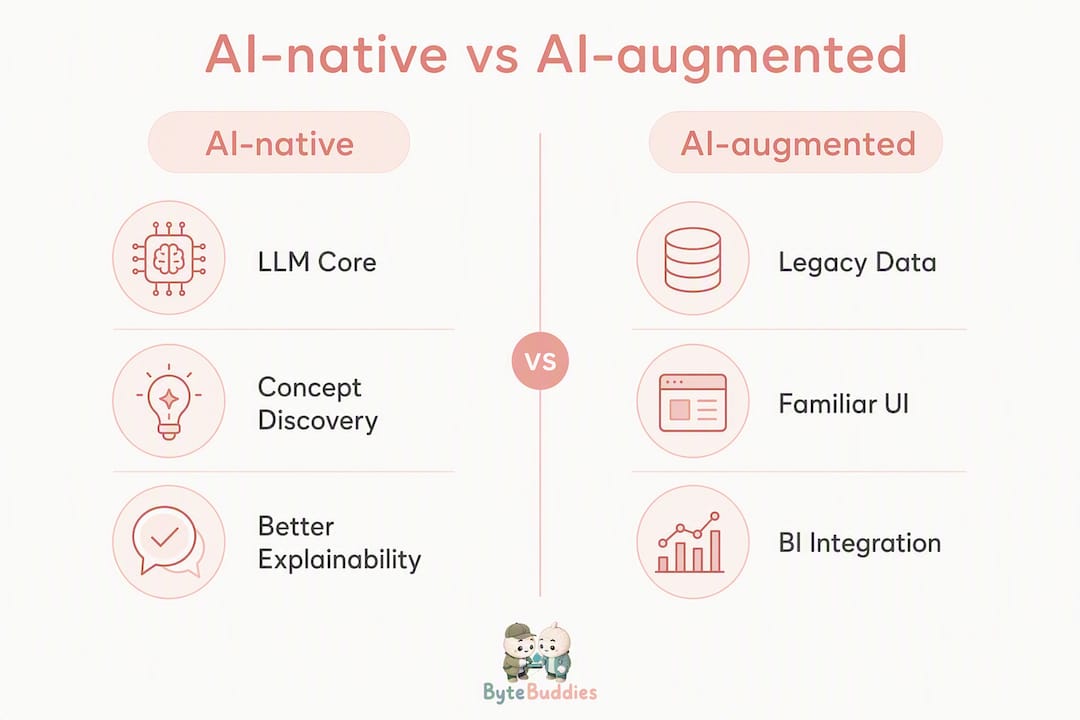
AI-native pros: earlier signals, concept-level discovery, better explainability when source attribution is present. Cons: higher learning curve, variable UK source depth.
AI-augmented pros: familiar interface, often integrates with existing BI tools. Cons: discovery is only as good as your query; freshness lags; summaries can obscure weak signals rather than surface them.
Stacking one signal-detector with a targeted monitor is consistently better than relying on a single monolith.
Which public data sources surface the earliest signals?
AI-powered platforms that monitor weak signals across developer communities, startup activity, patent filings, and niche forums identify emerging trends considerably earlier than those relying on mainstream media. The source-to-signal mapping that matters most is:
- Patent filings → product intent and R&D direction, typically 12–24 months ahead of launch
- Job postings and hiring patterns → R&D shifts, technology bets, and geographic expansion before any press release
- Developer repositories and communities → technology adoption curves at the protocol level
- Startup funding signals → capital flowing into a thesis before the thesis has a name
- Niche forums and specialist newsletters → practitioner sentiment that precedes analyst coverage
- Regulatory filings and government tenders (including Companies House, GOV.UK notices, and UK Intellectual Property Office data) → policy-driven market shifts
- Domain-specific datasets (clinical trials for health, planning applications for property) → sector-specific leading indicators
What separates a good platform from a mediocre one is not which of these sources it claims to cover, but whether it attributes signals to specific sources, timestamps them, and lets you verify the chain. Real-time scraping with source provenance is the standard to demand. Delayed indexing with no attribution is a red flag regardless of how the interface looks.
A repeatable trial workflow for short-listing platforms
Practitioners recommend scoring platforms by process improvement rather than feature counts, and prioritising transparent signal sourcing above all else. Here is a two-week proof-of-value you can run across any shortlisted platform.
Step-by-step:
- Choose two to three target themes relevant to your sector (e.g. "battery storage supply chain" and "UK fintech regulation")
- Define the signal types you want to collect: patents, job postings, funding rounds, or regulatory notices
- Set trust levels: which sources will you treat as high-confidence, which as indicative only?
- Run the same query set across each candidate platform on day one
- Re-run on day seven and day fourteen; compare what changed and whether the platform flagged it
- Export results and attempt to load them into your existing BI or research workflow
- Score each platform against the rubric below
Scoring rubric (weighted):
| Criterion | Weight | What to measure |
|---|---|---|
| Signal relevance | 30% | Proportion of outputs directly relevant to your theme |
| Source freshness | — | Average lag between event and platform detection |
| Explainability | — | Can you trace every signal to a named, dated source? |
| Exportability | — | Clean data out via API or structured file |
| Integration ease | — | Time to load outputs into your existing tools |
| Trial cost/time | 5% | Total resource cost for the two-week PoV |
Pro Tip: Run the same query blind across platforms before any vendor demo. Vendor demos are optimised to impress; your own query set is optimised to answer your actual question. Score the blind outputs first, then attend the demo to fill gaps.
A realistic timeline: two weeks of active testing, one analyst at roughly 30–40% of their time, plus one session to validate exports with whoever owns your BI stack. Designing the workflow before you start prevents the common failure of running ad hoc queries and comparing incomparable outputs.
UK-specific checks before you commit to any platform
A platform that works well for a US team may have meaningful gaps for UK users. Before signing anything, verify:
- UK regulatory feeds: does it ingest Companies House filings, GOV.UK tender notices, and UK Intellectual Property Office patent data natively?
- Data residency: where is your query data processed and stored? UK teams with GDPR obligations need a clear answer
- Local language and source depth: UK English coverage is not the same as US English coverage; check whether niche UK trade press and regional sources appear
- Export and integration: does the API output map cleanly to Power BI, Tableau, or whatever your team already uses?
- Security posture: request the vendor's data processing agreement and check for ISO 27001 certification or equivalent
- Pilot resourcing: budget one analyst at part-time for two weeks; seat costs for AI-native platforms vary widely, so confirm whether the trial tier includes export functionality before you start
Auditing the vendor's data supply chain and demanding structured exportability are the two checks most teams skip and later regret.
What AI cannot reliably find, and how to close the gap
Large language models are excellent at synthesis but struggle to judge strategic significance without domain grounding. Their training cut-offs and calibration limits make them unreliable for high-stakes intelligence without human review. Specific gaps to plan for:
- Informal relationship intelligence: who is talking to whom, which deals are forming in private, what a founder said at a closed dinner. No public data platform reaches this
- Signal calibration in generic LLMs: a model trained on broad web data will weight a viral tweet the same as a peer-reviewed filing unless the platform has domain-specific tuning
- Grey market and off-record activity: supply chain workarounds, informal pricing, and relationship-based competitive moves are invisible to automated scraping
Mitigation practices:
- Cross-verify any high-stakes signal across at least two independent sources before acting
- Check source provenance on every signal the platform surfaces: a signal attributed to a single forum post is indicative, not conclusive
- Maintain a small network of human intelligence contacts for the grey market layer that no platform can replace
- Set a governance rule: no strategic decision based solely on an AI-generated summary without a named analyst signing off
AI is best treated as the aggregation and synthesis layer. The interpretation of what a signal means for your specific competitive position requires a human who understands the context.
How Ontherice maps to the evaluation criteria
Ontherice is built as an AI-native signal-detection platform, which means it satisfies the most important criteria in this comparison by architecture rather than by bolt-on feature.
- Semantic discovery: Ontherice uses multiple AI engines to scan global public data and surface signals by concept, not keyword, covering finance, technology, crypto, jobs, brands, and products
- Source transparency: the platform publishes its ranking methodology and attributes signals to their origin, supporting the provenance checks the evaluation workflow requires
- Prediction accuracy tracking: Ontherice tracks historical signal performance, giving UK teams a basis for validating whether early signals translated into real market moves. The ranking history is publicly accessible
- Export and integration: structured data is available for export, and the rankings engine produces sector scores that load into BI models
- UK and international coverage: international signal feeds cover cross-jurisdiction sources relevant to UK teams monitoring global suppliers or partners
- Freemium entry point: the core platform is free; deeper features are unlocked via Access Points, which means a two-week proof-of-value carries minimal upfront cost
A practical scenario: a UK product team monitoring the battery storage sector sets two themes on Ontherice, runs the two-week test script, and exports sector ranking changes into their existing model. The signal provenance is visible at each step, which means the analyst can verify before presenting to the investment committee.
Ontherice's blog also provides comparative context that helps teams understand where the platform sits relative to other approaches, which is useful background reading before a pilot.
Key takeaways
AI-native platforms with transparent source attribution and clean export capability are the right starting point for any UK team running a market intelligence software comparison in 2026.
| Point | Details |
|---|---|
| Start AI-native | Choose a platform built on semantic search, not a keyword tool with an AI wrapper. |
| Score process, not features | Measure signal relevance, freshness, and exportability over a two-week workflow. |
| Verify UK coverage | Confirm Companies House, GOV.UK, and UK patent feeds before committing to any platform. |
| Human review is non-negotiable | AI surfaces and synthesises; a named analyst must validate every high-stakes signal. |
| Ontherice as first pilot | Ontherice offers freemium access, transparent signal provenance, and exportable sector rankings suited to UK teams. |
The gap most teams miss in a market intelligence comparison
The conventional wisdom in any market insights software comparison is to build a feature matrix, score vendors on capability breadth, and pick the highest total. That approach consistently produces the wrong answer.
The platforms that actually change how a team makes decisions are not the ones with the longest feature list. They are the ones where an analyst can trace a signal from the platform's output back to a named, dated, primary source in under two minutes. That traceability is what makes an insight defensible in a board meeting or an investment committee. Without it, you have a summary, not intelligence.
The second thing most teams underestimate is dashboard fatigue. A platform that traps insights inside a proprietary UI, however beautiful, adds work rather than removing it. The maturity indicator is simple: can you export clean, validated data into the tools your team already uses? If the answer requires a workaround, the platform is not ready for production use.
What Ontherice gets right is the combination of transparent ranking methodology and an exportable data layer. For a first pilot, that combination is more valuable than any feature the sales deck leads with.
Run your two-week proof-of-value on Ontherice
Early signal detection is only useful if the signals are traceable, exportable, and arrive before your competitors see them. Ontherice delivers all three, with a freemium entry point that means your pilot costs time, not a procurement cycle.

Here is how to run the recommended proof-of-value: sign up at Ontherice, pick two themes from your current research agenda, and run the test script from the evaluation workflow section above. Use the general signals feed for open discovery and the sector rankings for structured output. Export the results on day seven and day fourteen, load them into your BI model, and score against the rubric. Access Points unlock deeper signal cards and premium feeds if the free tier surfaces enough to justify the next step.
Support packs are available if your team wants guided onboarding. The platform's prediction accuracy history is open for review before you spend a single Access Point.
Useful sources and further reading
- Market Intelligence Tools and Software for Investors (2026) | Paradox Intelligence Blog
- Why Your Market Intelligence Programme Is Failing | UserIntuition
- Best market intelligence tools in 2026: a practitioner's guide | Infomineo
- RFP guide: Evaluating AI market intelligence platforms | Topic Intelligence™
- Why Large AI Models Aren't Reliable for Strategic Intelligence | ReportLinker AI
- The 8 best market intelligence tools in 2026 | Dupple
- AI platforms market trend analysis | TheBizAIHub
- Top 5 ai-tells.com Alternatives in Market Intelligence 2026 | Ontherice blog
- How AI predicts trends: a practical guide for business advantage | Ontherice blog
- Master market intelligence: a step-by-step guide | Ontherice blog
- Harness market intelligence trends to gain an edge in 2026 | Ontherice blog