
TL;DR:
- Hyperlocal signals are precise neighbourhood-level data points that influence local search rankings and customer relevance. Businesses that align their signals with actual service areas and community context gain better visibility and marketing ROI. Integrating hyperlocal insights into site selection and operational strategies creates durable competitive advantages and improves AI-based discovery.
Hyperlocal signals are the precise data points tied to relevance, proximity, and prominence that determine which businesses appear in front of nearby customers at the exact moment of intent. Google's Local Pack algorithm evaluates all three pillars explicitly, meaning broad area visibility is insufficient without neighbourhood-level proof. Business leaders who treat local marketing as a single geographic radius are leaving measurable revenue on the table. Ontherice's AI signal analysis consistently shows that the businesses gaining momentum fastest are those operating at the neighbourhood level, not the city level. Understanding why hyperlocal signals matter is no longer a marketing question. It is a strategic one.

Why hyperlocal signals matter for marketing ROI
The commercial case for hyperlocal targeting is grounded in hard economics. McKinsey findings cited by Vericast show that hyperlocal messaging reduces consumer acquisition costs by up to 50% and boosts revenues by up to 15%. That is not a marginal improvement. It is the difference between a campaign that funds itself and one that drains budget without measurable return.
The reason neighbourhood-specific messaging outperforms broad radius targeting is straightforward. Generic local approaches treat a postcode as a monolithic audience, when in reality a single postcode can contain young professionals, established families, and retirees with entirely different purchase triggers. True hyperlocal intensity requires community and life-stage-specific messaging rather than geographic radius assumptions. A financial services brand running the same creative across an entire city is competing against a rival that speaks directly to the concerns of a specific neighbourhood. The rival wins, consistently.
The marketing channels that benefit most from hyperlocal focus include Google Local Pack placements, paid social with neighbourhood-level audience segmentation, and geo-targeted display. Each of these channels rewards signal coherence. When your Google Business Profile, on-site content, and off-site citations all reinforce the same neighbourhood-level claims, the algorithm treats your business as genuinely relevant to that area. When they contradict each other, or when no neighbourhood-level signal exists at all, the algorithm defaults to competitors who have done the work.
- Audit your current targeting radius and identify whether it reflects actual service delivery or assumed coverage.
- Segment campaign audiences by neighbourhood demographic profile, not just by postcode boundary.
- Align ad creative with the specific life-stage signals dominant in each target area.
- Measure performance by trade area, not city-wide averages, to identify which neighbourhoods are converting and which are not.
Pro Tip: Map your highest-converting postcodes against neighbourhood demographic data from sources like the Office for National Statistics. You will almost always find that your best customers cluster around two or three specific community profiles, which tells you exactly where to concentrate hyperlocal spend.
What role do hyperlocal signals play in site selection?
Site selection without hyperlocal data is educated guessing. The Placer.ai Anchor report identifies five key signals for new location decisions, including hyperlocal demographic alignment and visitation patterns. These signals answer questions that city-level data cannot: which retail node within a trade area generates the right customer profile, and which competitor is already capturing that footfall.
Demographic alignment at the neighbourhood level matters because a brand's core customer profile rarely maps cleanly onto a city average. A premium fitness operator expanding into Manchester needs to know whether the specific street-level catchment around a prospective site skews towards the 28 to 40 age bracket with disposable income, not whether Manchester as a whole has a growing population. Visitation pattern data from platforms like Placer.ai reveals whether a site's surrounding retail node draws the right anchor traffic, or whether it pulls a demographic that will never convert.
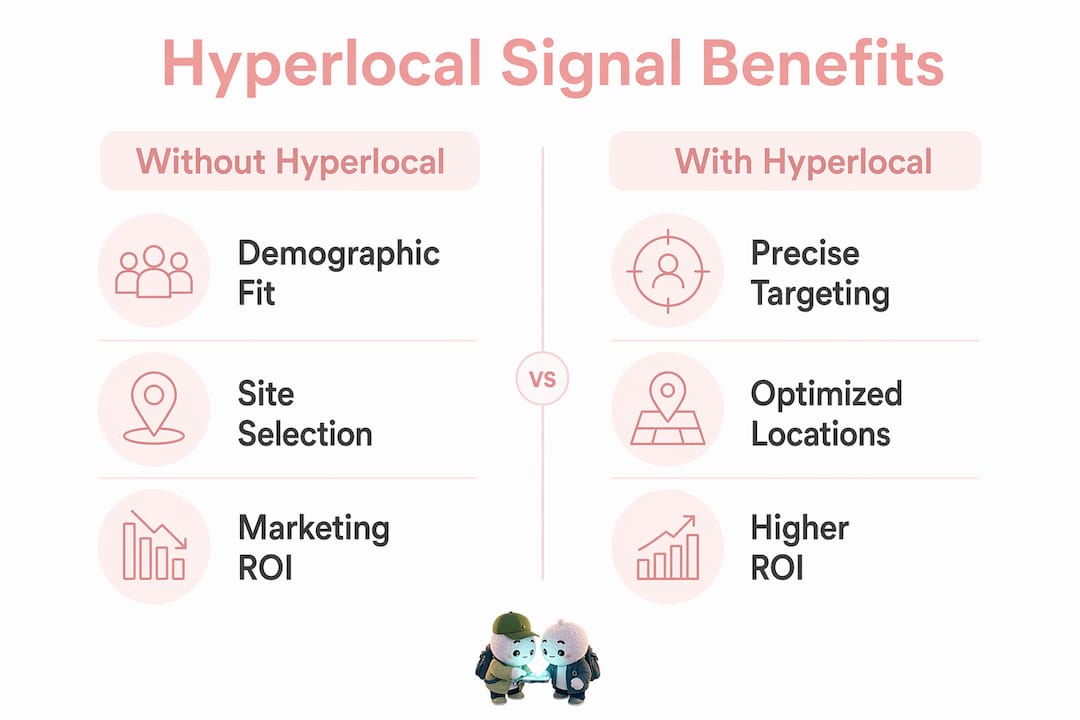
Competitor proximity and cannibalisaton risk are equally important at the neighbourhood level. Two sites two kilometres apart can serve entirely different trade areas if a natural barrier, a park, a railway line, or a major road, separates their catchments. Hyperlocal signals make this visible before you sign a lease. The table below illustrates the difference in decision quality between site selection with and without hyperlocal data.
| Selection criterion | Without hyperlocal signals | With hyperlocal signals |
|---|---|---|
| Demographic fit | City-level census averages | Neighbourhood-level age, income, and life-stage profiles |
| Footfall quality | Total pedestrian count | Visitation patterns by customer segment and time of day |
| Competitor risk | Known brand locations on a map | Trade-area overlap and cannibalisaton probability scores |
| Expansion sequencing | Gut instinct or proximity to HQ | Ranked opportunity scores by neighbourhood signal strength |
| Revenue forecast | Market-size estimates | Trade-area-specific spend capacity and conversion benchmarks |
Pro Tip: Before committing to a new site, cross-reference visitation data with neighbourhood-level AI signals to identify whether the area is gaining or losing commercial momentum. A site that looks strong today may be in a trade area already showing early decline signals.
How do hyperlocal credibility signals affect AI-driven discovery?
AI discovery systems, including Google's Search Generative Experience, Perplexity, and ChatGPT's local recommendations, do not simply rank businesses by keyword relevance. They infer trustworthiness from signal coherence. Forbes notes that AI summaries compress comparisons, making clear hyperlocal answers a trust advantage before a customer even clicks through. A business with a vague or inconsistent local presence is effectively invisible in these environments.
The technical mechanism behind this is the canonical entity chain. When your business name, address, and phone number appear consistently across your Google Business Profile, your website, and third-party citation sources, AI systems can confidently resolve your business as a single, verified entity. Failing to standardise citations and sameAs linkages reduces your visibility in AI-driven discovery, and this disadvantage is projected to persist through 2027.
The risks of what TNGlobal calls a "shadow entity" are significant. A business that claims neighbourhood coverage without corroborating local engagement signals, such as reviews mentioning specific areas, citations from local directories, and entity connections to neighbourhood landmarks, creates a superficial presence that AI systems discount. The practical consequence is that a competitor with fewer resources but stronger signal coherence will appear in AI-generated recommendations ahead of you.
Key credibility signals that AI discovery systems evaluate include:
- Consistency of NAP (name, address, phone number) across all citation sources
- Review velocity, specifically recency and frequency rather than total count, which Google's prominence signals weight heavily in 2026
- SameAs entity linkages connecting your business profile to authoritative local directories
- On-site content that references specific neighbourhoods, streets, and local landmarks
- Third-party mentions from local news sources, community organisations, and area-specific platforms
"Structured neighbourhood claims without corroborating local engagement signals risk superficial visibility without conversion, as AI systems infer genuine service from signal coherence." — TNGlobal
What practical steps can business leaders take with hyperlocal signals?
The starting point for any hyperlocal strategy is your Google Business Profile. GBP signals account for 32% of local pack ranking influence, with primary category selection being the single most influential factor. Choosing the wrong primary category, or leaving secondary categories incomplete, undermines every other hyperlocal investment you make. Audit your GBP quarterly and treat it as a live operational document, not a one-time setup task.
Beyond GBP, the practical steps that generate the most measurable impact are:
- On-site location content: Create dedicated pages for each neighbourhood or service area you genuinely cover. Each page should reference local landmarks, community context, and specific services available in that area. Generic city-level service pages do not generate hyperlocal relevance signals.
- Citation standardisation: Audit your business listings across Google, Bing Places, Apple Maps, Yelp, and relevant industry directories. Inconsistencies in your name, address, or phone number fragment your entity signal and reduce AI discovery confidence.
- Review velocity management: Actively request reviews from recent customers and respond to all reviews within 48 hours. Fresh reviews carry more prominence weight than accumulated totals, so a consistent cadence matters more than a high historic count.
- Trade-area performance monitoring: Track conversions, calls, and direction requests by postcode rather than by campaign. This reveals which neighbourhoods are responding and which require adjusted messaging or increased citation density.
- AI and data partnerships: Platforms that aggregate neighbourhood-level demographic, visitation, and competitor data allow you to scale hyperlocal insights across multiple locations without manual research for each site.
Pro Tip: Align your local SEO strategy with operational reality. If your business genuinely serves a specific neighbourhood, your marketing signals should reflect that service fidelity. Claiming coverage you cannot deliver creates friction at the conversion point and damages the trust signals that AI systems use to recommend you.
Key takeaways
Hyperlocal signals drive business performance because they align relevance, proximity, and prominence at the neighbourhood level where purchase decisions actually happen.
| Point | Details |
|---|---|
| Neighbourhood beats radius | Hyperlocal messaging reduces acquisition costs by up to 50% compared to broad geographic targeting. |
| Site selection requires signal data | Demographic alignment and visitation patterns at the neighbourhood level prevent costly location mistakes. |
| AI discovery rewards coherence | Consistent citation chains and sameAs entity linkages determine visibility in AI-generated recommendations. |
| GBP is the highest-leverage asset | Google Business Profile signals account for 32% of local pack ranking influence; primary category is the top factor. |
| Operational alignment is non-negotiable | Marketing claims must reflect actual neighbourhood service capacity or AI systems and customers both discount the signal. |
The case for treating hyperlocal as a strategic discipline
I have watched businesses invest heavily in city-level SEO campaigns and wonder why their conversion rates plateau. The answer, almost without exception, is that they are generating visibility without generating relevance. Ranking for "plumber in Birmingham" is not the same as being the trusted plumber in Moseley or Harborne. The customer searching at 8pm with a burst pipe is not thinking about Birmingham. They are thinking about their street.
What I find most underappreciated is the compounding effect of hyperlocal signal coherence over time. Businesses that build neighbourhood-level citation density, maintain review velocity, and align their on-site content with genuine service areas do not just rank better. They become the default recommendation in AI-generated results, which is where discovery is increasingly happening. That position is genuinely difficult for competitors to dislodge once established.
The strategic mistake I see most often is treating hyperlocal as a marketing tactic rather than an operational commitment. The Forbes insight on operational trust is the one I return to repeatedly: your marketing signals must reflect your actual service fidelity at the neighbourhood level. A business that claims to serve twelve postcodes but only reliably delivers in four is building a signal structure that will eventually collapse under the weight of its own inconsistency.
My recommendation to business leaders is to start with a signal audit before spending another pound on local advertising. Map where your genuine service capacity sits, build citation and content signals that reflect that reality, and then expand your hyperlocal footprint as your operational capacity grows. That sequence produces durable competitive advantage. The reverse produces expensive noise.
— Aidil
Discover hyperlocal signals with Ontherice
Ontherice uses multiple AI engines to scan neighbourhood-level data across markets, extracting the signals that indicate where commercial momentum is building before it becomes obvious to competitors.

For business leaders and strategists, the AI opportunities platform surfaces hyperlocal trend signals ranked by momentum score, so you can prioritise investment in the areas and sectors gaining traction right now. If you are scaling an emerging brand and need to match your expansion decisions to neighbourhood-level demand signals, the emerging brands tool provides the data layer your site selection process is currently missing. Ontherice turns hyperlocal signal noise into ranked, interpretable intelligence. That is the competitive edge that city-level data cannot provide.
FAQ
What are hyperlocal signals in local SEO?
Hyperlocal signals are data points tied to relevance, proximity, and prominence at the neighbourhood level, including Google Business Profile data, citation consistency, review velocity, and on-site location content. Google's Local Pack algorithm evaluates all three pillars explicitly when determining which businesses to surface.
How do hyperlocal signals affect Google rankings?
Google Business Profile signals account for 32% of local pack ranking influence, with primary category selection being the single most important factor. Review recency and frequency carry more prominence weight than total review count in 2026.
Why do AI discovery systems rely on hyperlocal credibility signals?
AI systems such as Google's Search Generative Experience and Perplexity infer trustworthiness from signal coherence across citation sources, entity linkages, and neighbourhood-specific content. Businesses with inconsistent or vague local signals are discounted in AI-generated recommendations regardless of their overall domain authority.
How can hyperlocal data improve site selection decisions?
Neighbourhood-level demographic alignment and visitation pattern data reveal whether a prospective site's trade area matches a brand's core customer profile and whether competitor overlap creates cannibalisaton risk. City-level averages mask these distinctions and lead to costly location decisions.
What is the difference between local and hyperlocal marketing?
Local marketing targets a broad geographic area such as a city or region, while hyperlocal marketing delivers community and life-stage-specific messaging at the neighbourhood or street level. The distinction matters because hyperlocal targeting generates measurably higher conversion rates and lower acquisition costs than radius-based approaches.