

TL;DR:
- Benchmarking trend accelerators offers a systematic way to identify emerging trends early and compare performance internationally.
- It highlights true program impact through follow-on funding rates, trend velocity, and durable business fundamentals, not superficial metrics.
Benchmarking trend accelerators gives businesses a systematic way to measure which emerging trends are gaining real momentum, and which are noise. Rather than reacting to headlines, you build a repeatable process that surfaces early signals, compares performance against peers, and ties those findings to concrete decisions.
Why benchmarking trend accelerators sharpens your competitive edge
Trend accelerators are evaluation programmes that track how fast a market signal is growing, not just whether it exists. The distinction matters. A trend that doubles in three months tells a different story than one that has crept upward for two years. Benchmarking those programmes means measuring their outputs against defined criteria: follow-on funding rates, trend velocity scores, ecosystem impact, and early signal accuracy.
The core benefits for UK analysts and business professionals are:
- Early positioning. You identify a category before it crowds, giving you time to act rather than react.
- Evidence for decision-makers. Structured benchmarks produce the kind of measurable outcomes that justify budget and strategy shifts to boards and funders.
- Peer comparison. International benchmarking against similar programmes reveals operational gaps you cannot see from inside your own data.
- Signal quality. Monitoring change velocity rather than raw volume filters out short-lived spikes driven by news cycles.
How benchmarking generates strategic advantages for UK businesses
The most telling metric in any accelerator benchmark is the follow-on funding rate. Top-tier programmes report a high proportion of their companies raising follow-on capital within a year of demo day. Most mid-tier programmes sit well below that, and many will not publish the figure at all. That silence is itself a signal.

HubSpot's 2025 research on trend forecasting makes a useful point: the discipline is less about outsmarting the market and more about applying a consistent, mechanical monitoring system that combines quantitative historical data with qualitative research. Regression analysis paired with social media engagement data captures both the "what" and the "why" behind a pattern.
Pro Tip: Before committing to any accelerator programme, ask for follow-on funding rates broken down by cohort. A programme that tracks its outcomes honestly will share them. One that cannot is telling you exactly what to expect.
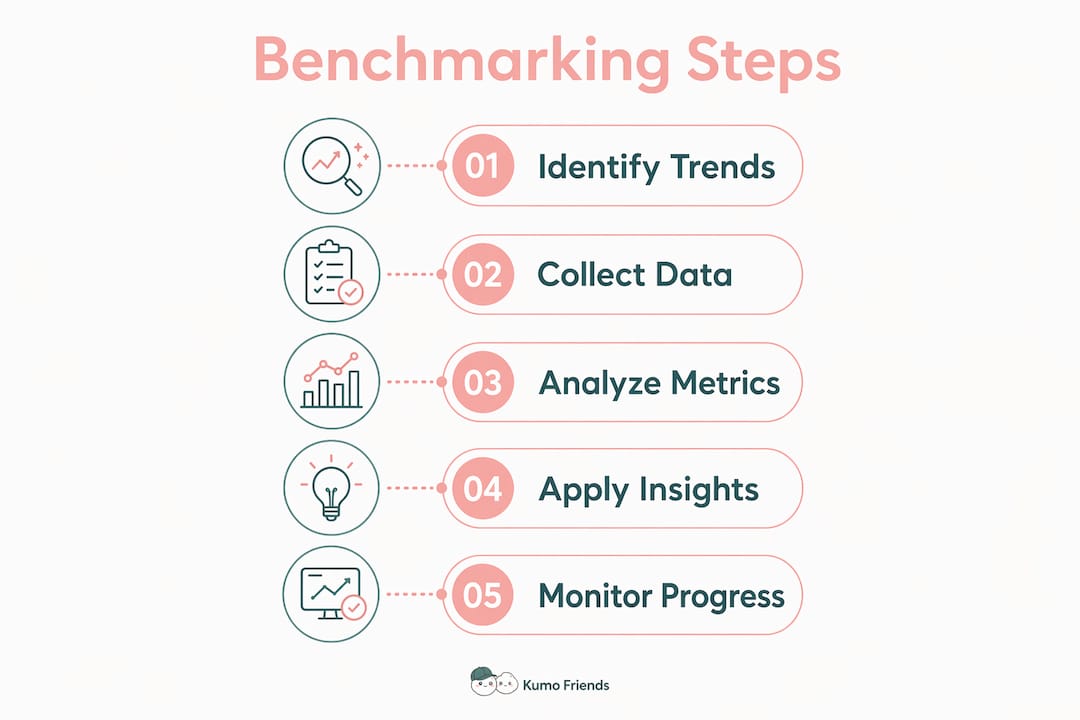
Effective benchmarking in practice draws on several converging methods:
- Trend velocity tracking. Tools that measure growth rate at entry rather than absolute volume catch categories while they are still early. A flat baseline followed by three or more consecutive months of upward movement is the pattern worth watching, not a smooth gradual rise that has been running for years.
- Weak signal detection. Niche forums, Reddit threads, and GitHub repositories surface early demand cues before they appear in mainstream search data. Multiple unrelated users complaining about the same gap within 30 days is a stronger signal than any single spike in public search volume.
- Cross-sector comparison. UK sectors vary considerably in how they apply benchmarking. Financial services tends to prioritise quantitative scoring; creative industries lean on qualitative ecosystem assessments. Comparing practices across sectors, as explored in cross-sector trend monitoring, often reveals transferable methods that single-sector analysts miss.
- Dilution and valuation maths. When benchmarking accelerator programmes specifically, the equity percentage matters less than the implied post-money valuation. A 7% stake for £500K implies a very different position than 7% for £120K. Running that calculation before acceptance is part of rigorous benchmarking practice.
Ontherice applies AI-driven signal analysis to surface exactly these kinds of early-stage patterns, scanning global data points to generate ranked scores across sectors. For UK professionals who want to move from reactive to proactive, detecting hidden trends early is where the practical advantage begins. Cross-company benchmarking frameworks, such as those outlined in AI benchmarking strategy, offer a structured starting point for teams building this capability in 2026.
The common pitfall is optimising for superficial metrics: brand recognition, press mentions, or capital raised during the programme itself. Those figures favour the accelerator's narrative, not yours. True programme impact shows up in founder independence, durable revenue, and repeatable business fundamentals, none of which appear on a logo wall.

Ontherice's market trend signals platform gives UK analysts the AI-driven intelligence layer to benchmark trend accelerators with real data, not guesswork.
Key takeaways
Benchmarking trend accelerators works because it replaces reactive market-watching with a repeatable, evidence-based system that ties early signals to concrete strategic decisions.
| Point | Details |
|---|---|
| Follow-on funding rate | Top programmes report over 80% of companies raising follow-on capital within a year; always ask for cohort-level data. |
| Velocity over volume | Track how fast a trend is growing, not its absolute size, to catch categories before they become crowded. |
| Weak signal sources | Niche forums and developer platforms surface demand cues earlier than mainstream search data. |
| Peer benchmarking value | Comparing against international peers reveals operational gaps invisible from inside your own programme data. |
| Avoid superficial metrics | Brand recognition and demo day press do not measure real accelerator impact; focus on revenue and founder independence. |