
TL;DR:
- Opportunity mapping visualizes and prioritizes customer problems connected to strategic outcomes using a structured framework. It promotes continuous, evidence-based problem framing, aligning cross-functional teams and improving decision-making. Regular updates and disciplined pruning ensure the map remains a relevant, strategic asset that guides the right solutions.
Opportunity mapping is the structured process of visualising and prioritising customer problems and business opportunities to connect them directly to strategic outcomes. Popularised through Teresa Torres's Opportunity Solution Tree (OST) framework, it gives product teams, strategists, and analysts a shared visual language for transforming raw customer feedback into validated, prioritised opportunities. Tools like Usersnap and platforms like Ontherice's AIOpportunities use this logic to surface what matters before resources are committed. The result is a decision-making system grounded in evidence rather than assumption, one that aligns product, engineering, and leadership around the same set of problems worth solving.
What is opportunity mapping and how does it work?
Opportunity mapping is defined as a method for decomposing a desired business outcome into a hierarchy of customer needs, pain points, and desires, then connecting those needs to potential solutions and experiments. The term is often used interchangeably with the Opportunity Solution Tree, though the OST is the specific visual framework while opportunity mapping refers to the broader practice of structuring strategic opportunities in this way.

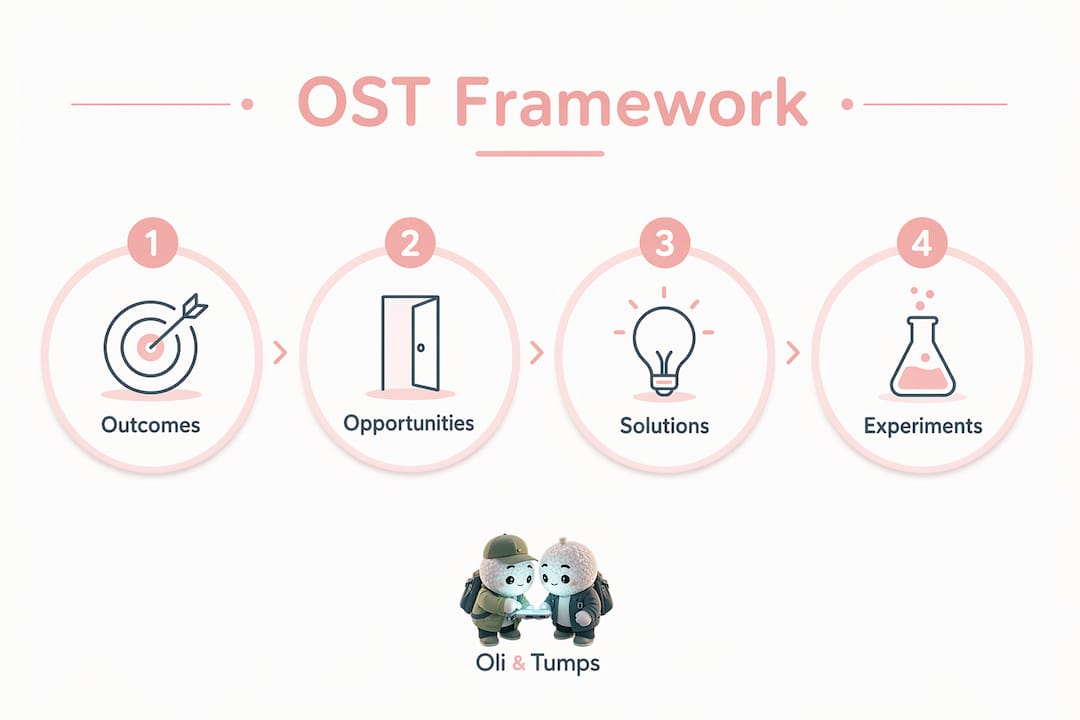
The OST framework comprises four layers: outcomes, opportunities, solutions, and experiments. Each layer has a distinct role. The outcome sits at the top and defines the measurable business goal. Beneath it, opportunities represent the customer needs, pain points, or desires that, if addressed, would move that outcome. Solutions are the product or service ideas that address specific opportunities. Experiments are the tests used to validate whether a solution actually works.
What makes this structure powerful is the parent-child relationship between layers. Each opportunity can have sub-opportunities beneath it, allowing teams to break large, complex problems into smaller, more tractable parts. A parent opportunity like "users struggle to track spending" might decompose into children such as "no visibility of recurring charges" or "difficulty categorising transactions." This decomposition prevents teams from jumping to solutions before they understand the full shape of the problem.
| Layer | Role | Example |
|---|---|---|
| Outcome | Measurable business goal | Increase 30-day user retention by 15% |
| Opportunity | Customer need or pain point | Users lose track of recurring subscriptions |
| Solution | Idea to address the opportunity | Automated subscription tracker feature |
| Experiment | Test to validate the solution | A/B test with 500 users over two weeks |
Pro Tip: When building your first opportunity map, resist the urge to populate every branch. A sparse map with three well-validated opportunities outperforms a sprawling one where nothing has been tested.
The OST also encourages teams to say no to ideas that do not connect to a measurable outcome. This is the discipline that separates opportunity mapping from a standard brainstorm. Every branch on the tree must trace back to the outcome at the top, or it does not belong on the map.
How does opportunity mapping differ from traditional planning methods?
Opportunity mapping is a problem-framing tool, not a feature list. This distinction matters because most teams conflate the two, treating their backlog as a proxy for strategic intent. A backlog tells you what to build next. An opportunity map tells you why that thing is worth building at all.
Traditional backlog management organises features by priority score, stakeholder request, or estimated effort. It answers the question "what do we do next?" Opportunity mapping answers the prior question: "what problem are we actually trying to solve, and for whom?" These are fundamentally different cognitive tasks, and conflating them is one of the most common errors in product strategy.
A few misconceptions are worth addressing directly:
- Opportunity maps are not exhaustive. The goal is not to capture every possible customer need. Effective mapping requires disciplined pruning, keeping only opportunities tied to the stated outcome.
- Opportunity maps are not static. They are living documents updated continuously as new customer insights emerge and validated learnings replace assumptions.
- Opportunity mapping is not a one-time workshop. Teams that treat it as a quarterly exercise rather than a continuous habit lose the compounding benefit of accumulated discovery.
"Opportunity mapping forces teams to slow down and frame the problem properly rather than rushing to solutions." — Product Talk
The contrast with conventional feature prioritisation frameworks like RICE scoring or MoSCoW is also instructive. Those methods assume you already know which problems to solve. Opportunity mapping challenges that assumption at the root. For strategists working in fast-moving markets, this upstream clarity is what separates teams that build the right things from those that build things right.
How to do opportunity mapping: best practices and session structure
A well-run opportunity mapping session typically lasts 45 to 60 minutes, followed by one to two hours of synthesis and prioritisation. That total commitment of two to three hours surprises many teams accustomed to shorter planning rituals, but the analytical phase is where the real value is created.
The session works best when it includes representatives from product, engineering, design, and at least one person with direct customer contact. Leadership involvement is valuable for aligning on the outcome before the session begins. Running a virtual problem framing session with distributed teams requires a shared digital canvas and a clear facilitator role to prevent the discussion from fragmenting.
Here is a structured approach to conducting an effective mapping session:
- Define the outcome. Agree on the single measurable business goal the map will serve. Ambiguity here cascades into every layer below.
- Gather inputs. Collect customer interviews, support tickets, survey data, and usage analytics. Tools like Usersnap centralise this feedback before the session begins.
- Map user needs. In a dedicated zone, list all customer pain points and desires surfaced by the input data. Do not filter yet.
- Map business goals and technical constraints. In separate zones, note what the business needs to achieve and what technical realities bound the solution space.
- Identify overlaps. The intersections between user needs, business goals, and technical feasibility are your highest-priority opportunities.
- Build the tree. Arrange opportunities in parent-child hierarchies beneath the outcome, then attach candidate solutions and planned experiments.
- Prune ruthlessly. Remove any opportunity that does not connect to the stated outcome, regardless of how interesting it appears.
Pro Tip: Many teams underestimate analysis time in opportunity mapping. Block the synthesis phase as a separate calendar event immediately after the session, not as an afterthought. Shallow synthesis produces shallow maps.
Multidisciplinary involvement is not optional. High-performing teams achieve structural alignment across roles through this process, replacing intuition-driven prioritisation with a shared decision-making framework. When engineering understands the customer need behind a solution, and leadership can see how that need connects to the outcome, the entire organisation moves with more coherence.
How opportunity mapping improves market analysis and strategic decisions
Opportunity mapping applied to market analysis shifts the question from "what trends exist?" to "which trends represent unmet needs we are positioned to address?" This reframing is the core benefit for strategists working across sectors. Rather than reacting to every signal, you filter through the lens of your stated outcome.
The importance of opportunity mapping in strategic decision-making comes down to three practical advantages:
- Reduces guesswork. Decisions trace back to validated customer evidence rather than stakeholder opinion or market hype.
- Creates organisational alignment. When product, commercial, and leadership teams share the same opportunity map, debates shift from "what should we build?" to "which opportunity should we prioritise?" That is a more productive conversation.
- Surfaces emerging needs early. Continuous discovery habits, fed by real-time feedback tools, allow teams to spot unmet needs before competitors do. Ontherice's AI-driven market intelligence applies this same logic at scale, scanning global data to identify signals before they reach mainstream awareness.
For analysts conducting cross-sector trend mapping, opportunity maps provide a structured way to evaluate whether a trend represents a genuine customer opportunity or simply noise. A trend that does not connect to a measurable outcome for your organisation belongs in the archive, not the roadmap.
Integrating opportunity mapping with continuous discovery means the map is never finished. New customer interviews add branches. Failed experiments prune them. The map becomes a living record of what the organisation has learned about its customers and markets, compounding in value over time. This is what separates teams that map once from those that build a genuine strategic advantage.
Key takeaways
Opportunity mapping creates strategic clarity by connecting customer needs to measurable outcomes through a structured, continuously updated visual framework.
| Point | Details |
|---|---|
| Four-layer OST structure | Outcomes, opportunities, solutions, and experiments form the backbone of every effective opportunity map. |
| Problem framing over backlog management | Opportunity mapping defines which problems to solve before any solution is considered. |
| Continuous updating is non-negotiable | Treat the map as a living document; discard invalidated opportunities and add new learnings regularly. |
| Synthesis time is underestimated | Block one to two hours for analysis after every session to avoid shallow, inaccurate maps. |
| Alignment drives better decisions | Shared opportunity maps replace intuition with evidence across product, engineering, and leadership teams. |
Why most teams get opportunity mapping wrong
Most teams treat opportunity mapping as a workshop they run once a quarter, produce a tidy diagram, and then file away. That is not opportunity mapping. That is documentation with extra steps.
The genuine value of this practice accumulates through repetition. Every customer interview that updates the map, every failed experiment that prunes a branch, every new signal that opens a sub-opportunity: these are the moments where strategic clarity is actually built. I have seen teams with beautifully structured OSTs that have not been touched in three months. They are not using opportunity mapping. They are using a historical artefact.
The other error I see consistently is conflating comprehensiveness with quality. A map with forty opportunities feels thorough. It is usually a sign that the team has not committed to an outcome. When the outcome is genuinely specific and measurable, most of those forty opportunities fall away immediately. The discipline of pruning is not a nice-to-have. It is the mechanism by which the map becomes useful.
My practical advice: assign one person ownership of the map, schedule a 20-minute review after every customer interview, and treat any opportunity that has not been touched in six weeks as a candidate for removal. Opportunity mapping works when it is a habit embedded in the weekly rhythm of the team, not a project with a start and end date.
— Aidil
Discover AI-powered opportunity mapping with Ontherice
Ontherice's AIOpportunities platform applies the logic of opportunity mapping at market scale, using multiple AI engines to scan global data and surface validated signals before they reach mainstream awareness.

For strategists who need to move from raw market data to prioritised opportunities without spending weeks in synthesis, the platform condenses that analytical phase into real-time intelligence. It identifies which emerging trends connect to measurable business outcomes and which are simply noise. You can also explore the Ontherice whitepaper for a deeper treatment of the frameworks underpinning AI-driven opportunity discovery. If your team is ready to replace intuition-driven prioritisation with evidence-backed decisions, the AIOpportunities platform is the practical next step.
FAQ
What is the opportunity mapping definition in business strategy?
Opportunity mapping is the structured process of connecting customer needs, pain points, and desires to measurable business outcomes through a visual hierarchy. The Opportunity Solution Tree by Teresa Torres is the most widely used framework for this practice.
How long does an opportunity mapping session take?
A standard session runs 45 to 60 minutes, followed by one to two hours of synthesis and prioritisation. Teams that skip the analytical phase produce maps that are too shallow to guide real decisions.
What is the difference between opportunity mapping and a product backlog?
A product backlog organises features by priority. Opportunity mapping frames the customer problems that justify building those features at all. The two tools operate at different levels of strategic abstraction.
What are the main benefits of opportunity mapping for analysts?
Opportunity mapping reduces guesswork, aligns cross-functional teams around shared evidence, and surfaces unmet customer needs before competitors identify them. It replaces opinion-driven prioritisation with a traceable, evidence-based decision framework.
How often should an opportunity map be updated?
Opportunity maps should be updated continuously, after every customer interview, usability test, or experiment result. Treating the map as a living document rather than a finished deliverable is what makes it strategically useful over time.