

TL;DR:
- The attention economy treats human attention as a limited resource that digital platforms compete to monetize through advertising. Platforms like Meta and YouTube use algorithms and persuasive design to maximize user engagement and ad revenue. Protecting attention involves strategies like disabling notifications, setting app limits, and choosing subscription-based services instead of ad-funded ones.
The attention economy is defined as an economic model that treats human attention as a finite, scarce resource that digital platforms compete to capture and monetise. Nobel laureate Herbert Simon articulated this in 1971, stating that "a wealth of information creates a poverty of attention." That observation now underpins a global digital ad market worth over $700 billion, with social media accounting for roughly a third of that figure. Every scroll, click, and pause you make is a transaction in this system, whether you are aware of it or not.
What is attention economy and why does it matter?
The attention economy is the study and practice of treating human cognitive focus as a tradeable commodity. The term was formalised by Herbert Simon, an economist and cognitive scientist whose work on bounded rationality earned him the Nobel Prize in Economics in 1978. His core insight was simple: information supply can grow without limit, but human attention cannot. That asymmetry creates scarcity, and scarcity creates economic value.

The scale of this market is difficult to overstate. Digital advertising revenue surpassed $700 billion in 2025, with social media platforms capturing approximately one third of that total. This means platforms like Meta, TikTok, and YouTube are not primarily in the business of connecting people or distributing content. They are in the business of selling your attention to advertisers. Content is the mechanism; attention is the product.
Understanding the importance of attention economy goes beyond marketing theory. It explains why your phone feels compulsive, why news feeds never end, and why you sometimes spend an hour online without intending to. The system is designed around your cognitive limits, not despite them.
How does attention economy work?
The scarcity problem at the centre of it all
Human attention is biologically constrained. The brain can sustain focused concentration for limited periods before fatigue sets in. Meanwhile, the volume of information produced daily has grown exponentially. This gap between supply and demand is the engine of the attention economy. When something is scarce and valuable, markets form around it.
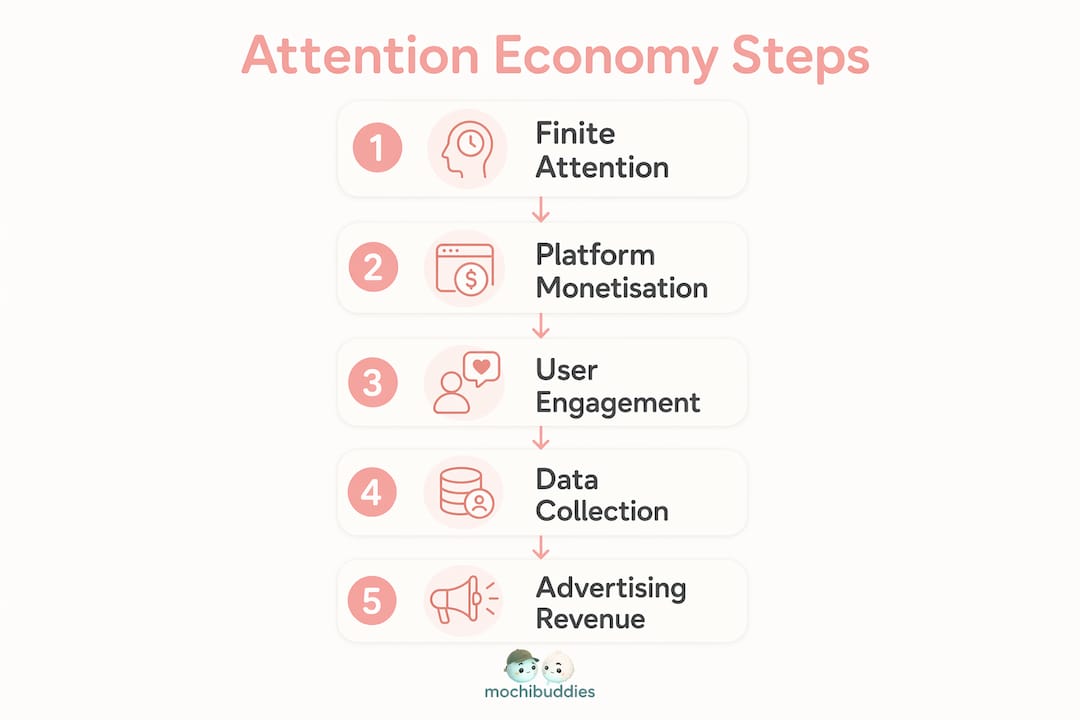
Digital platforms resolve this gap by positioning themselves as curators. They use algorithms to surface content most likely to hold your attention, not content most likely to inform or benefit you. The distinction matters enormously.
How platforms monetise your focus
Google and Meta use surveillance capitalism to extract behavioural data, predict user actions, and sell targeted advertising. The longer you stay on a platform, the more data they collect and the more ad inventory they can sell. Attention duration is the key metric. Every additional minute you spend on a feed is revenue.
Pro Tip: When you use a free digital service, ask yourself what the revenue model is. If the answer is advertising, your attention is the product being sold.
The table below contrasts how traditional media and digital platforms each approach monetisation.
| Dimension | Traditional media | Digital platforms |
|---|---|---|
| Revenue source | Subscription fees and broadcast advertising | Behavioural data and targeted ad auctions |
| Attention metric | Audience reach and ratings | Time on platform and engagement depth |
| Content curation | Editorial teams | Algorithmic personalisation |
| User data use | Limited demographic profiling | Continuous real-time behavioural tracking |
| Feedback loop | Slow, survey-based | Instant, automated, and self-reinforcing |
Advertising incentives drive interface design toward maximising time on platform, often at the direct expense of user wellbeing. This is not a side effect. It is the intended outcome of the business model.
How does the attention economy affect consumer behaviour?
Persuasive design and habit formation
Persuasive design overrides conscious decision-making by creating habitual usage patterns. Infinite scroll removes natural stopping points. Variable reward notifications mimic the psychology of slot machines. Social validation metrics like likes and shares trigger dopamine responses. These are not accidents of engineering. They are deliberate choices made to capture continued attention.
The result is that consumers often engage with content and products in ways that do not reflect their actual preferences. Algorithmic recommendations on platforms like Netflix, Spotify, and YouTube narrow the range of content users encounter, while creating the illusion of personalised choice. Tailored advertising on Meta and Google surfaces products at moments of peak susceptibility, nudging purchasing decisions that users may later regret.
Common tactics used to capture attention
Platforms and advertisers deploy a consistent set of techniques to hold focus and drive engagement. Recognising them is the first step to managing their effect on your behaviour.
- Infinite scroll: Removes the natural endpoint of a page, eliminating the moment of conscious choice to continue.
- Push notifications: Interrupt focus at unpredictable intervals, creating compulsive checking behaviour.
- Autoplay: Queues the next video or episode before the user has decided to continue, exploiting inertia.
- Social proof signals: Displays like counts, share numbers, and comment volumes to signal what others find worth watching.
- Personalised content streams: Uses past behaviour to surface content engineered to match existing preferences and biases.
- Urgency and scarcity cues: Limited-time offers and countdown timers exploit loss aversion to accelerate decisions.
The common misconception is that technology itself is the problem. The real issue is the ad-funded business model that incentivises distraction. A social media platform funded by subscriptions rather than advertising has no financial reason to keep you scrolling past the point of satisfaction. You can explore how social media business models shape these patterns in more detail.
What emerging technologies are reshaping the attention economy?
The attention economy is evolving beyond screen-based interactions into territory that raises serious questions about privacy and autonomy. Three developments are particularly significant.
-
Brain-machine interfaces: Companies like Neuralink are developing direct neural interfaces that could, in theory, monitor cognitive states in real time. Emerging technologies including brain-machine interfaces and multimodal AI enable deeper monitoring of attention beyond anything a screen can capture. The commodification of internal cognitive states represents a qualitative shift in the attention economy.
-
Eye-tracking and physiological monitoring: Tools that track gaze patterns, pupil dilation, and facial expressions are already used in advertising research and UX testing. Companies like Neurable are building consumer-grade headsets that measure focus and cognitive load. This data is far more granular than click behaviour.
-
Multimodal AI systems: Google's Gemini and similar multimodal AI models can process text, image, audio, and video simultaneously. This capability allows platforms to generate content that is precisely calibrated to individual attention patterns, making algorithmic recommendations significantly more effective at holding focus.
Pro Tip: Before adopting any new AI-powered productivity or wellness tool, check whether it collects physiological or gaze data. That data has significant commercial value and may be sold or shared.
The attention economy is evolving from a marketing tool into a system that uses AI and physiological tracking to enclose subjective attention itself. This is not a distant concern. The infrastructure is being built now. You can track how AI tools are influencing this shift across industries.
How can you protect your attention in a distracted world?
Treating attention as a finite budget is the most practical reframe available to professionals and individuals navigating the digital environment. Attention is a non-renewable cognitive resource that platforms are designed to fragment. Reclaiming it requires deliberate strategy, not willpower alone.
The attention economy profits when users cannot focus. Understanding the business model behind a platform changes how you interact with it. A feed that feels entertaining is also a revenue-generating mechanism. Holding both ideas simultaneously is a form of cognitive defence.
Practical steps to protect your attention include the following.
- Audit your notification settings: Disable all non-essential push notifications. Each notification is a deliberate interruption designed to pull you back into a platform.
- Use time-blocking: Allocate specific periods for checking email and social media rather than responding to every prompt in real time.
- Set app time limits: iOS Screen Time and Android Digital Wellbeing both allow hard limits on individual apps. Use them as a structural constraint, not a suggestion.
- Identify your peak focus hours: Most people have a two to four hour window of peak cognitive performance. Protect that window from digital interruption entirely.
- Read platform terms and privacy policies: Understanding what data a platform collects clarifies its business model and your role within it.
- Choose subscription-funded services where possible: A service funded by subscriptions rather than advertising has less financial incentive to maximise your time on platform.
The attention economy conflicts directly with the knowledge economy, where employers require sustained concentration and deep work. Managing this tension is not a personal failing. It is a structural challenge that requires structural solutions. Screen time alone is not the core problem; the incentive architecture behind the platforms is.
Key takeaways
The attention economy is a system where human cognitive focus is treated as a scarce commodity, monetised through advertising, and intensified by AI and physiological tracking technologies.
| Point | Details |
|---|---|
| Attention is the product | Free digital platforms sell your attention to advertisers, not services to you. |
| Persuasive design is deliberate | Infinite scroll, autoplay, and notifications are engineered to override conscious choice. |
| Emerging tech deepens the problem | Brain-machine interfaces and multimodal AI extend commodification beyond screen behaviour. |
| Business models drive distraction | Ad-funded platforms have a financial incentive to keep you engaged past the point of benefit. |
| Structural solutions work better | Time-blocking, app limits, and subscription services address the system, not just the symptom. |
The uncomfortable truth about who is really in control
I have spent years watching professionals convince themselves that they are in control of their digital habits. They are not, and neither am I, at least not by default. The attention economy is not a passive backdrop to modern life. It is an active system with billions of pounds of engineering behind it, designed to exploit the same cognitive shortcuts that helped our ancestors survive.
What I find most clarifying is the distinction between technology and incentive. The problem is not that smartphones exist or that social media connects people. The problem is that the dominant business model rewards distraction. A platform funded by subscriptions behaves differently from one funded by advertising. That is not a philosophical point. It is a structural one.
The attention economy clashes with the knowledge economy in ways that most organisations have not yet reckoned with. Knowledge workers are expected to produce deep, sustained thinking while using tools that are architecturally opposed to deep, sustained thinking. That tension will not resolve itself. It requires deliberate choices at both the individual and organisational level.
My honest recommendation is to treat attention budgeting the way you treat financial budgeting. You would not leave your bank account open to unlimited withdrawals. Your cognitive capacity deserves the same protection. The platforms will not change their models voluntarily. The regulation is slow. The only reliable lever you have right now is awareness and deliberate design of your own environment.
— Aidil
Discover attention signals before they go mainstream
The attention economy rewards those who spot what is gaining traction before the crowd does. Ontherice is built precisely for that purpose. Its AI-powered signal engines scan global data points across markets, extracting meaningful patterns from noisy information to surface what is rising before it reaches mainstream awareness.
Whether you are a marketer trying to understand where consumer attention is shifting, or a professional tracking which technologies are reshaping engagement, Ontherice gives you the intelligence to act early. Explore the AI opportunities Ontherice has identified across sectors, or use the traffic analytics tools to measure and interpret digital engagement signals in real time. Staying ahead in the attention economy starts with knowing where attention is moving next.
FAQ
What is the attention economy definition?
The attention economy is an economic model that treats human attention as a scarce, finite resource that platforms compete to capture and sell to advertisers. Herbert Simon coined the concept in 1971, describing how information abundance creates a poverty of attention.
How does the attention economy work in practice?
Platforms like Google and Meta collect behavioural data to predict user actions and sell targeted advertising, using attention duration as the primary revenue metric. The longer you engage, the more ad inventory the platform can generate.
What are the main attention economy examples?
Infinite scroll on Instagram, autoplay on YouTube, and personalised content feeds on TikTok are all attention economy examples. Each feature is designed to extend engagement time and increase the volume of advertising a user sees.
Is the attention economy harmful?
The attention economy is not inherently harmful, but its dominant ad-funded model creates financial incentives to maximise engagement at the expense of user wellbeing. Persuasive design techniques deliberately override conscious decision-making to sustain habitual usage.
How can I protect my attention from platform manipulation?
Treat attention as a finite budget by disabling non-essential notifications, using app time limits via iOS Screen Time or Android Digital Wellbeing, and choosing subscription-funded services where possible. Understanding the business model behind a platform is the most effective first step.