
Large language models earn their keep when a trend signal is noisy, cross-domain, or buried in text, not when the job is dense numeric forecasting. Ablation work behind Are Language Models Actually Useful for Time Series Forecasting? found that stripping the LLM component out of forecasting pipelines matched or beat the full model in 26 of 26 test cases on several benchmarks. Ontherice runs on that principle: LLMs for synthesis and context, specialised time-series models for the numbers, with modality alignment and compute cost as the two things most teams underestimate.
TL;DR:
- Using large language models for trend analysis excels at synthesizing unstructured data but offers little advantage in dense, stationary numeric forecasting tasks.
- Modality alignment and pre-processing techniques significantly improve LLM performance, making them suitable mainly for contextual and cross-domain reasoning rather than raw numeric prediction.
- A tiered approach that assigns routine classification to smaller models and reserves LLMs for high-value, ambiguous tasks reduces costs and latency without sacrificing accuracy.
- Verifying LLM trend calls involves tracking prompt versions, source lineage, and setting human review thresholds based on confidence or business impact.
- Future improvements will focus on smarter routing, integrated pre-alignment, and tighter human-LLM collaboration, with tools like Ontherice streamlining implementation.
Table of Contents
- What is llm trend analysis and how does the pipeline actually run?
- Does the ablation evidence really rule out LLMs for forecasting?
- How do you verify and trace LLM-generated trend calls?
- What does a production-ready LLM workflow look like?
- How OnTheRice implements signal detection and verification
- How did LLMs end up analysing trends in the first place?
- Where is LLM trend analysis actually working right now?
- What goes wrong with LLMs in trend forecasting?
- How should decision-makers actually use LLM trend outputs?
- Where is LLM-based trend analysis heading next?
- Three lessons from deploying LLM trend analysis in production
- Try Ontherice: tools built for this exact pipeline
- Sources
What is llm trend analysis and how does the pipeline actually run?
LLM trend analysis is the practice of using large language models to read noisy, unstructured signals (news, forum chatter, filings, search queries) and turn them into a structured, explainable narrative about what's rising or fading in a market. It's a different job from time-series forecasting, and treating the two as interchangeable is where most pipelines go wrong.
A working pipeline follows a fixed sequence. Skip a step and you lose either accuracy or the ability to explain your own output later.
- Ingest raw signals from your chosen sources, tagged with source, timestamp, and geography at the point of capture.
- Clean and enrich — deduplicate, resolve entities ("Meta" and "Facebook" as one entity), and attach metadata that survives downstream transformations.
- Align modalities using pre-alignment techniques that map statistical features (change points, seasonality markers) to textual prototypes before anything touches an LLM, a step research on modality alignment shows matters more than model size.
- Engineer features separately for numeric series and text, keeping both representations available downstream.
- Route each task: numeric-heavy forecasting goes to a linear or time-series model; context-heavy reasoning goes to the LLM.
- Generate the narrative — the LLM synthesises findings into a readable summary with cited evidence.
- Verify with a human before anything reaches a decision-maker.
Required artefacts at every stage: source metadata, a lineage record showing how each data point transformed, and timestamps that never get overwritten. Without those three, you can't audit a claim six months later when someone asks where it came from.
Where teams fall back to simpler models most often: step five, when the numeric series is dense, stationary, and doesn't need contextual reasoning. Forcing an LLM through that step usually adds latency and cost without adding accuracy.
Does the ablation evidence really rule out LLMs for forecasting?
Not entirely, but it should make you sceptical of any pipeline that defaults to an LLM for every numeric task. The ablation study behind the arXiv time-series paper tested this directly: removing the LLM component from forecasting architectures didn't degrade performance in the majority of cases, it often improved metrics like MAE, while cutting compute cost substantially.
Statistic callout: Across the benchmarks tested, ablated (LLM-free) forecasters matched or outperformed their LLM-based counterparts in every test case.
The mechanism behind this comes down to modality alignment. When you convert a numeric time series into tokens an LLM can process, you're forcing a sequence built for language onto data that has none of language's grammar. Done carelessly, this produces what researchers call pseudo-alignment: the model appears to be processing the series correctly but is actually pattern-matching on artefacts of the tokenisation, not the underlying trend. Work on modality alignment found that pre-alignment, mapping statistical features to textual prototypes before the LLM ever sees them, consistently outperforms post-alignment approaches that bolt language reasoning on after the fact.
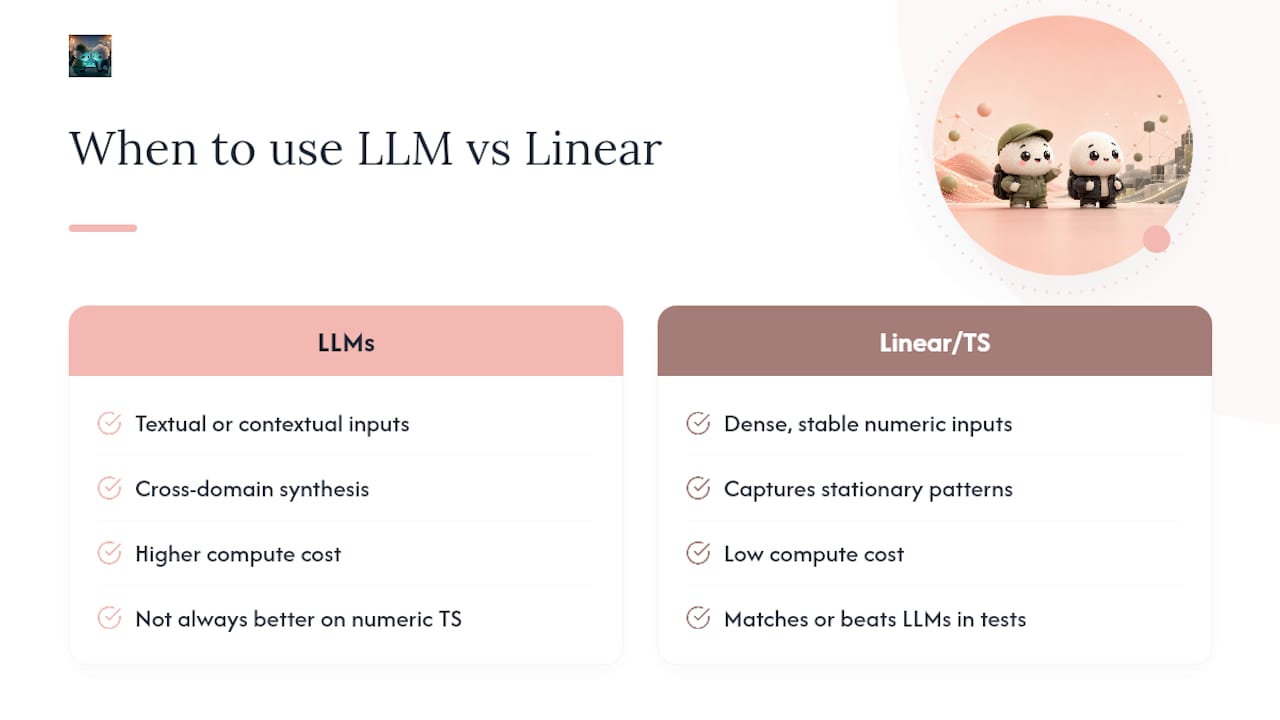
That same research also found that lighter architectures like DLinear, TSMixer, and FITS matched or beat LLM-based approaches on many time-series tasks at a fraction of the compute cost.
Pro Tip: Run a cheap linear baseline (DLinear or a simple ARIMA model) alongside any LLM-based forecast for the first month of a new pipeline. If the baseline wins or ties, you've just found a permanent cost saving.
The selection rule that falls out of this: reach for an LLM when the task needs textual or contextual reasoning, cross-domain generalisation, or synthesis across sources with no fixed schema. Reach for a linear or time-series model when the input is dense, stable, purely numeric, and the pattern is stationary enough that a statistical model can capture it without help.
How do you verify and trace LLM-generated trend calls?
Trend calls that can't be checked are opinions with better formatting. Verification starts with defining what "success" means numerically, not just narratively.
Three metrics do most of the work: precision and recall for signal detection (how many real trends you catch versus false alarms), lead time (how far ahead of mainstream awareness the signal fired), and explanation fidelity (whether the LLM's stated reasoning actually matches the data that triggered the call).
- Log every prompt version and model version against the output it produced.
- Keep a dataset lineage record so you can trace a claim back to its original source.
- Run periodic ablations to check whether the LLM component is still adding value as your data mix shifts.
- Set a human review threshold: any signal above a defined confidence or business-impact level gets checked by a person before publication.
Traceability practices like these echo what autonomous LLM research systems found in practice: automated pipelines can generate full research artefacts end to end, but they need data-chaining and human oversight to be genuinely reproducible.
| Metric | What it measures | Typical review trigger |
|---|---|---|
| Precision/recall | False alarm rate vs missed trends | Recall drop signals data drift |
| Lead time | Days/weeks ahead of mainstream pickup | Shrinking lead time flags market saturation |
| Explanation fidelity | Does the stated reason match the evidence | Mismatch triggers manual audit |
An experiment registry, versioning datasets, prompts, and models together, makes rollbacks safe when a routing change or prompt tweak quietly degrades quality.
What does a production-ready LLM workflow look like?
Getting from a working prototype to something that runs reliably in production is mostly about orchestration, not model choice. A few prompt patterns cover most trend-analysis tasks, and the discipline is in how you route work between them.
- Labelling prompts: ask the model to categorise a signal against a fixed taxonomy (sector, sentiment, novelty) rather than free-form tagging, which keeps outputs comparable over time.
- Hypothesis-generation prompts: feed the model a cluster of related signals and ask it to propose two or three competing explanations, not one confident answer.
- Anomaly-explanation prompts: when a metric spikes, ask the model to cross-reference the spike against recent text signals before accepting a causal story.
- Executive summary prompts: constrain length and require the model to cite the specific data points behind each claim.
Routing decides which of these actually hits an LLM. Research on LLM routing in time-series forecasting found that pre-alignment combined with routing diagnostics, logging when a task passed through the LLM versus a lighter encoder, correlated with measurable reductions in forecasting error. In practice, that means tiered inference: cheap heuristics or small models handle routine classification, and the expensive LLM pass is reserved for ambiguous or high-value cases.
Pro Tip: Cap token budgets per task type before you deploy, not after your first invoice. It forces you to design prompts that ask for exactly what you need, nothing more.
Cost control also comes from caching repeated queries, falling back to lightweight models when the LLM API is degraded, and monitoring latency against a defined SLA so a slow signal doesn't miss its window. Market pressure on inference pricing, tracked in LLM market data for 2026, makes tiering less of a nice-to-have and more of a budget necessity as providers and pricing models keep shifting.
How OnTheRice implements signal detection and verification
Ontherice runs a multi-engine architecture rather than a single model call: separate AI engines extract signals from different data types, cross-check one another, and feed into a transparent scoring system rather than a black-box confidence number. That structure exists because no single model handles noisy market signals, structured deal feeds, and cross-domain reasoning equally well.
- Multiple engines specialise by signal type, then a scoring layer reconciles their outputs into a single ranked view.
- Predictions are timestamped and checked against outcomes on the Ontherice proof page, so accuracy claims are checkable rather than asserted.
- Users can query live AI directly to test a hypothesis against current signals instead of waiting for a scheduled report.
You can replicate parts of this pipeline yourself using the routing and traceability principles covered above, and the market analysis tips guide walks through an early-detection checklist that pairs well with it.
How did LLMs end up analysing trends in the first place?
Trend detection used to live entirely in statistics: moving averages, regression models, and analysts manually reading trade publications. Large language models entered the picture only once transformer architectures made it feasible to process unstructured text at scale, somewhere around the GPT-3 era in the early 2020s, when firms started experimenting with feeding news and social data into general-purpose models rather than building bespoke NLP pipelines for each source.
The early phase treated LLMs as a universal tool: point one at a spreadsheet or a time series, tokenise the numbers, and expect language-model reasoning to somehow generalise to forecasting. That assumption held for a surprisingly long time, given how little evidence supported it. It took dedicated ablation research, including the study behind the time-series forecasting paper, to demonstrate that this generalisation mostly didn't happen. Removing the LLM component from forecasting pipelines didn't hurt performance in most tested cases.
That finding pushed the field toward a more specialised view: LLMs for the parts of trend analysis that need language understanding, context, and synthesis; purpose-built statistical models for the parts that need numeric precision. Modality alignment research followed, explaining why naive tokenisation of numbers into language failed and what pre-alignment techniques could fix. The current generation of trend-analysis tools, Ontherice among them, reflects that split rather than the earlier one-model-fits-all assumption.
Where is LLM trend analysis actually working right now?
The clearest wins show up wherever a decision-maker needs to synthesise dozens of scattered, unstructured sources faster than a human team could read them. Retail and consumer goods teams use LLM-driven pipelines to scan product reviews, social chatter, and search queries together, catching a flavour or format trend weeks before it shows up in sales data, precisely the cross-domain synthesis task ablation research suggests LLMs handle well.

Financial research desks use similar pipelines to cluster earnings call transcripts, regulatory filings, and news coverage into a single narrative about sector momentum, work that would take an analyst days to compile manually and that benefits from an LLM's ability to hold context across long, varied documents.
Job market and hiring platforms apply the same logic to skills-demand tracking: parsing job postings, professional network activity, and course enrolment data to spot which skills are gaining traction before formal labour statistics catch up. That's a genuinely cross-domain problem where dense numeric forecasting alone would miss the textual signal driving the shift.
Where it works less well is anywhere the underlying task is really just numeric forecasting wearing a trend-analysis label, a demand curve, a stock price, a sensor reading. Teams that plugged LLMs directly into those tasks without a lighter fallback tended to see the cost and latency increase that ablation studies flagged, with no accuracy gain to show for it. The pattern across working deployments is consistent: LLMs add value proportional to how much unstructured, contextual reasoning the task actually requires.
What goes wrong with LLMs in trend forecasting?
The single biggest failure mode is treating an LLM as a general-purpose forecasting engine rather than a synthesis tool. Naive tokenisation of raw numbers into text tokens strips out the statistical structure the model needs, producing the pseudo-alignment problem documented in modality alignment research: the model looks like it's reasoning about the series but is actually responding to artefacts of how the numbers were encoded.

Cost is the second issue, and it compounds quietly. Every LLM pass through a high-volume signal stream adds latency and API spend, and without inference tiering, teams end up paying premium prices for tasks a linear model would have solved for a fraction of the cost, a pressure that market pricing data suggests is only getting sharper as providers diverge on cost structure.
Hallucination remains a real risk in narrative synthesis specifically, an LLM can generate a plausible-sounding explanation for a trend that doesn't actually match the underlying evidence. This is why explanation fidelity has to be a tracked metric, not an assumption.
Complex, open-ended research goals also expose the limits of full automation. Findings from automated LLM research systems show that as task complexity rises, human gating becomes essential for catching failure modes the model itself can't detect, novelty assessment being the clearest example. Data drift compounds this: a pipeline tuned on last quarter's signal mix can silently degrade as new sources or new noise patterns enter the system, which is exactly why periodic ablations matter even after deployment, not just during initial model selection.
How should decision-makers actually use LLM trend outputs?
The best-run teams treat LLM output as a strong first draft, not a final verdict. That single mindset shift prevents most of the downstream problems that come from over-trusting a narrative summary.
Pair every LLM-generated trend call with its supporting evidence trail before it reaches a decision-maker, the specific data points, sources, and reasoning steps that produced the claim. If the model can't produce that trail, treat the output as a hypothesis to investigate, not a finding to act on.
Set a confidence or business-impact threshold above which human review is mandatory, not optional. This is the same human-in-the-loop principle research on automated LLM systems points to: automation accelerates the work, but complex or high-stakes goals still benefit from a person checking the model's reasoning against the evidence.
Cross-check LLM narrative output against a lighter statistical model whenever the underlying task touches numeric forecasting. Agreement between the two increases confidence; disagreement is a signal to dig deeper before committing budget or strategy to the call.
Finally, build the review cadence into your calendar rather than your crisis response. Revisit your source mix and prompt templates on a fixed schedule, quarterly works for most teams, rather than waiting for an obviously wrong call to trigger a rethink. Trend detection pipelines drift quietly long before they fail loudly.
Where is LLM-based trend analysis heading next?
Routing sophistication is the clearest near-term development. Current systems increasingly log routing diagnostics, token-level records of when a task passed through the LLM versus a lighter encoder, and research into this area suggests these logs will soon drive automated routing decisions rather than static rules, letting a pipeline learn which signal types genuinely benefit from LLM reasoning over time.
Pre-alignment techniques are also maturing quickly. Rather than treating modality alignment as a one-off preprocessing step, emerging approaches build alignment directly into the model architecture, reducing the pseudo-alignment failures that plague naive tokenisation. Expect time-specific encoders purpose-built for this handoff to become more common than general-purpose LLMs adapted after the fact.
Copilot architectures look set to replace fully autonomous pipelines for complex tasks. Findings on automated research systems suggest that as task complexity increases, the winning pattern isn't full automation, it's tighter human-LLM collaboration with better tooling for that handoff, rather than removing people from the loop entirely.
Cost pressure will keep pushing tiering forward. As the LLM provider market continues shifting on pricing and capability, expect more granular inference tiers, routine classification on cheap models, complex synthesis reserved for premium ones, to become standard architecture rather than an optimisation only larger teams bother with.
Three lessons from deploying LLM trend analysis in production
Scaling synthesis worked better than expected: an LLM reading hundreds of documents genuinely outperforms a human team on breadth. What surprised us was how often modality misalignment quietly wrecked numeric accuracy while the narrative output still sounded confident. The lesson for teams: instrument everything, pair LLM reasoning with lightweight statistical checks, and never let a fluent explanation substitute for human review on anything that touches a real decision.
— Aidil
Try Ontherice: tools built for this exact pipeline
Ontherice is the practical shortcut to the pipeline above, without building your own routing, alignment, and verification stack from scratch. The AIOpportunities page covers the discovery and deep-signal stages, surfacing cross-domain trends before they hit mainstream coverage. The AiTools page supports the orchestration and integration work covered in the workflow section above, and the GeneralSignals feed gives you a live stream to test ingestion and scoring against your own hypotheses.

Every prediction on the platform is timestamped and checked against what actually happened, so you're not taking accuracy claims on faith. If you want to see how the scoring holds up, start with the AIOpportunities page and run a live query against a sector you already track. You'll know within a few sessions whether the signal quality matches what your own pipeline produces, and whether it's worth building on top of.
Sources
Signal quality varies enormously by source, and treating them all the same is the fastest way to drown your pipeline in noise. Some signals arrive fast and dirty; others arrive slow and clean. Knowing which is which determines how you weight and clean them.
- Are Language Models Actually Useful for Time Series Forecasting?
- LLM Statistics 2026: Market size and provider share (Axis Intelligence)
Preparation matters as much as source selection. Entity resolution stops "Elon Musk" and "Musk" fragmenting a signal into two weaker ones. Geotagging lets you separate a genuinely global trend from a regional spike. Timestamping at ingestion, not at processing, protects temporal fidelity.
Converting non-text signals into LLM-friendly context without losing that fidelity means describing the shape of the data in words the model can reason over (rather than dumping raw numbers into a prompt), a step that connects directly to the modality alignment problem covered next.