

TL;DR:
- Anticipating market shifts early allows organizations to act before trends become mainstream. AI visibility data provides a 4-12 week lead time, enabling proactive strategy adjustments. Building structured processes and cross-functional teams helps interpret signals and prevent costly reactive decisions.
Anticipating market shifts means detecting early indicators before market consensus forms, giving you the lead time to act rather than react. Most businesses treat market change as something that happens to them. The professionals who consistently outperform their sectors treat it as something they can see coming. AI visibility data now provides a 4–12 week lead time over traditional market research for detecting new trends. That window is the difference between setting the agenda and scrambling to catch up. Professional foresight models operate on a 12–36 month horizon, scanning weak signals and stress-testing strategies against plausible futures. Bain & Company frames this well: the level of conviction in a prediction determines strategic posture, with high conviction driving bold bets and low conviction demanding resilience and optionality.
What tools and frameworks help detect early market signals?
Signal detection is the foundation of market foresight. Without a structured approach to reading signals, analysts end up reacting to headlines rather than leading with insight.
The four signal types worth tracking
AI visibility data is the most reliable leading indicator available to analysts today. When query patterns shift inside AI platforms, they reveal changes in how buyers think and what problems they are trying to solve, often weeks before those changes appear in sales data or industry reports.
The four signal types that matter most are:
- Query emergence: new search and AI query patterns appearing in a category for the first time
- Attribute shifts: buyers changing the language they use to describe what they want (e.g. moving from "affordable" to "sustainable" in product queries)
- Category fragmentation: a broad market splitting into distinct sub-segments with different needs
- Competitive convergence: multiple players from different sectors moving toward the same customer problem simultaneously
Market shifts often emerge at the intersection of two or three niche trends, not from obvious macro signals. That intersection is where the real lead time lives.
Scoring and prioritising signals
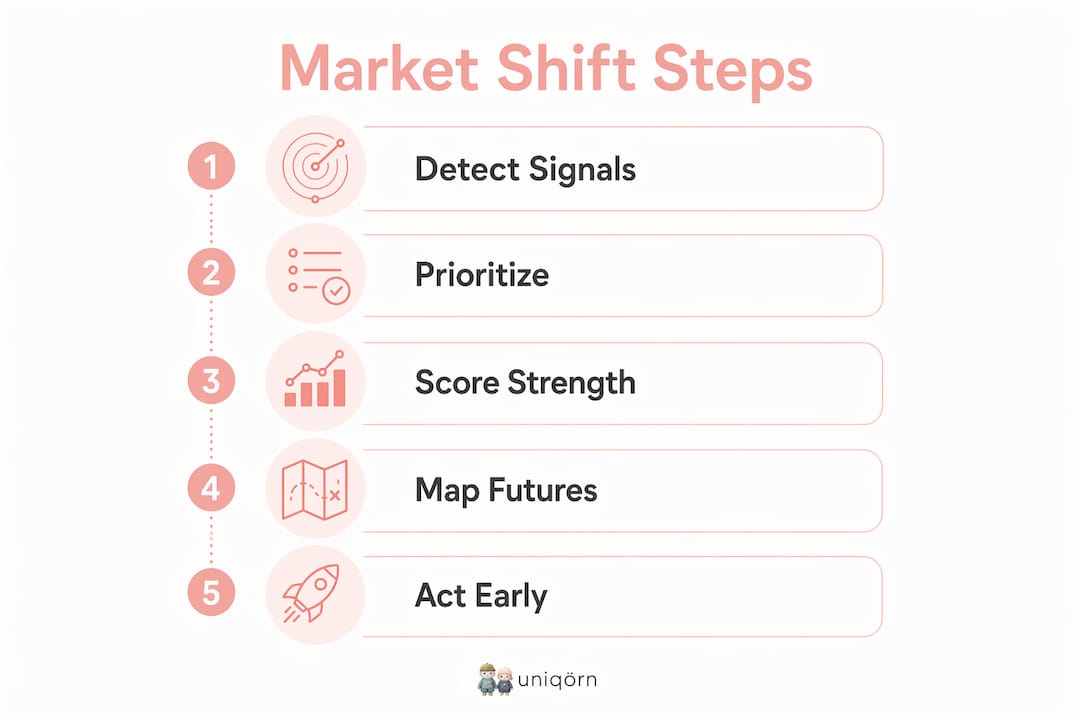
Not every signal deserves a strategy pivot. A practical scoring method rates each signal on three dimensions: strength (how many independent data sources confirm it), direction (whether it is accelerating or plateauing), and urgency (how quickly it could affect your market position).
Tracking friction in niche communities, such as forum discussions, support ticket patterns, or specialist publications, gives companies early advantage before competitors react. This kind of friction tracking is cheap and often more revealing than expensive primary research.
Pro Tip: Set up a shared signal log across departments. Sales, product, and customer success teams each see different early signals. A weekly five-minute update from each team into a shared document creates a cross-functional early warning system at near-zero cost.
Strategic foresight tools extend this further. War games and scenario stress-tests challenge internal biases and prepare organisations for shocks. They work best when run quarterly, not annually, because the signals that matter most move faster than annual planning cycles allow.
How can you map future market shifts and manage uncertainty?
Mapping future shifts is not about predicting one correct outcome. It is about preparing your organisation to perform well across multiple plausible outcomes.

The 12–36 month foresight horizon is the standard professional frame for this work. Within that window, the goal is to identify the key strategic questions your business must answer in the next 18–24 months. Those questions, not forecasts, drive the most useful scenario work.
A structured mapping process follows these steps:
- Define your key strategic questions. What decisions will your organisation need to make in the next 18 months that cannot easily be reversed? These are the decisions that scenario planning must inform.
- Build two to four plausible scenarios. Each scenario should reflect a different combination of the signals you are tracking. Avoid building one "optimistic" and one "pessimistic" scenario. That binary framing produces poor decisions.
- Identify no-regret moves. These are actions that deliver value regardless of which scenario unfolds. Investing in data infrastructure, cross-training teams, and shortening product development cycles are classic no-regret moves.
- Set trigger points. Define in advance the specific signal thresholds that would cause you to shift strategy. A trigger point might be a competitor entering your category, a regulatory announcement, or a measurable shift in buyer query language.
- Revisit quarterly. Scenario planning must be revisited quarterly to update strategy based on new evidence. Annual reviews are too slow for the current pace of market change.
Pro Tip: Use AI as a thinking partner to map assumption gaps. Structured prompts that ask "what would have to be true for this scenario to unfold?" surface blind spots faster than traditional brainstorming.
Using AI to map assumption gaps enhances foresight by pressure-testing strategies before inflection points arrive. The goal is not to eliminate uncertainty. It is to reduce the number of surprises that catch you without a prepared response.
What steps implement early market shift anticipation in your organisation?
Foresight without process is just intuition. The organisations that consistently anticipate market shifts have built repeatable systems, not just hired perceptive analysts.
Building the system
Start with a baseline AI visibility audit. Define a broad query universe relevant to your category: the terms buyers use, the problems they describe, and the adjacent categories they explore. This baseline gives you a reference point for detecting change.
Next, develop a shared signal language across departments. When sales says "customers keep asking about X" and product says "we are seeing friction around Y," those observations need to map to the same classification system. Without shared language, signals get lost in translation between teams.
The weekly review cycle is the operational heartbeat of the system:
- Review new signals from AI visibility data and niche community monitoring
- Tag each signal by type, strength, and urgency
- Flag any signals that have crossed a pre-defined threshold
- Assign ownership for follow-up or experimental validation
Small-scale experiments validate signals before large bets. If your signal scoring suggests a new buyer segment is emerging, run a targeted campaign or a limited product variant before committing full resources. Trend validations show evidence of growth within 4–8 weeks of initial AI signals, which means your experiment window is short and the feedback is fast.
The feedback loop closes when experimental results feed back into signal scoring. A signal that generates strong experimental results moves up in priority. One that produces weak results gets downgraded. This disciplined cycle prevents the system from drifting toward confirmation bias.
Pro Tip: Assign a "signal steward" role within your team. This person owns the weekly review, maintains the signal log, and escalates high-urgency signals to leadership. Rotating this role quarterly keeps the perspective fresh.
You can learn more about AI-driven trend discovery and how it applies to early market detection across sectors.
What pitfalls should you avoid when anticipating market shifts?
The most common failure in market foresight is not missing the signal. It is misreading it.
"The biggest risk in trend anticipation is not ignorance of the future. It is overconfidence in a single version of it. Organisations that commit fully to one predicted outcome lose the flexibility to respond when reality diverges, and it always diverges."
Mistaking noise for signal is the first pitfall. A spike in social media discussion about a topic is not a market shift. It is a conversation. The signal only becomes meaningful when it appears across multiple independent data sources: AI query data, niche forum activity, sales friction, and customer support patterns simultaneously.
Ignoring intersecting niche trends is the second pitfall. Analysts who focus only on broad macro signals miss the convergence of niche trends where real market shifts originate. The electric vehicle market did not emerge from a single macro trend. It emerged from the intersection of battery technology costs, urban air quality regulation, and shifting consumer identity around sustainability.
The third pitfall is failing to validate signals with complementary data. A signal confirmed by only one source is a hypothesis, not intelligence. Cross-reference AI visibility data with customer interviews, sales team observations, and regulatory monitoring before escalating a signal to strategic priority.
Delayed response is the fourth pitfall, and the most costly. Early signal detection protects timing and market positioning before costs rise. Once a shift reaches mainstream awareness, talent costs increase, advertising costs increase, and the first-mover advantage evaporates.
The fifth pitfall is over-reaction. Not every signal requires a strategy pivot. Forecasting should focus on no-regret moves and trigger points that allow mid-course corrections. Build the discipline to act on strong signals and observe weak ones, rather than treating every data point as a call to action.
Key takeaways
Anticipating market shifts requires a repeatable system that combines AI visibility data, structured scenario planning, and disciplined signal validation to act before competitors reach consensus.
| Point | Details |
|---|---|
| AI data leads by weeks | AI visibility signals precede traditional market research by 4–12 weeks, giving you time to act. |
| Signals need scoring | Rate every signal by strength, direction, and urgency before escalating to strategic priority. |
| Scenarios beat forecasts | Build two to four plausible futures and identify no-regret moves that work across all of them. |
| Validation prevents over-reaction | Cross-reference signals across AI data, customer insight, and niche community monitoring before committing. |
| Feedback loops close the system | Link experimental results back to signal scoring to prevent confirmation bias and keep priorities current. |
Why reactive strategy is the most expensive habit in business
I have spent years watching organisations confuse awareness with foresight. They read the same industry reports, attend the same conferences, and then wonder why they keep arriving at market shifts just as the opportunity is closing. The problem is not access to information. It is the absence of a system for interpreting it early enough to matter.
The shift from reactive to proactive strategy is not primarily a technology problem. It is a cultural one. Teams need permission to act on weak signals before they become obvious. That requires leaders who treat early conviction as a skill to develop, not a gamble to avoid. Successful market anticipation means framing strategic choices as flexible bets, continuously reassessing exposure and adjusting investments in adaptability.
What I have found actually works is combining AI-driven signal detection with genuine cross-functional dialogue. The AI surfaces the pattern. The human conversation reveals whether it matters to your specific market position. Neither works well without the other. Analysts who treat AI output as a final answer miss the interpretation layer. Analysts who ignore AI data rely on intuition that is too slow for current market velocity.
The uncomfortable truth is that most organisations already have enough signal data. They lack the process to act on it before it becomes obvious. Build the process. The signals are already there.
— Aidil
Ontherice: your platform for early market signals
Market foresight requires data that moves faster than your competitors' reports.

Ontherice is built for exactly this. SignalsInternational scans global data points to surface sector-level signals before they reach mainstream awareness, giving analysts a structured view of what is gaining momentum across international markets. GeneralSignals aggregates broad market insights into ranked outputs, so your team spends less time gathering and more time deciding. The AI Opportunities tool identifies emerging marketplace openings by processing noisy data into clear, scored signals. Ontherice is the platform for professionals who want to see the shift before the crowd does.
FAQ
What does anticipating market shifts mean in practice?
Anticipating market shifts means detecting early indicators, such as AI query changes, niche community friction, and category fragmentation, before those signals reach mainstream awareness. The goal is to act during the lead time window rather than after consensus forms.
How far ahead can you reliably forecast market shifts?
Professional foresight models use a 12–36 month horizon, focusing on key strategic questions for the next 18–24 months. AI visibility data can provide a 4–12 week lead time on specific trend signals within that broader window.
What is the difference between a signal and noise?
A signal is confirmed by multiple independent data sources simultaneously: AI query data, sales friction, niche forum activity, and customer feedback. Noise is a spike in one data source, typically social media, without corroboration elsewhere.
How often should scenario plans be updated?
Scenario plans should be revisited quarterly, not annually. Market signals move faster than annual planning cycles allow, and quarterly reviews ensure your strategic assumptions reflect current evidence rather than last year's conditions.
What is a no-regret move in market strategy?
A no-regret move is an action that delivers value regardless of which future scenario unfolds. Examples include investing in data infrastructure, shortening product development cycles, and building cross-functional signal monitoring processes.