
A Google search spike is a sharp, temporary rise in how often people search a term, distinct from ranking volatility, which is movement in where pages sit on the results page. The two get confused constantly, and mixing them up wastes hours chasing the wrong problem.
When you spot one, run three checks before touching anything else. First, open Google Trends and look at the Rising or Breakout signal for the term. Second, cross-check Search Console impressions and Google Analytics sessions to see whether real traffic backs up what Trends is showing. Third, scan news and social platforms for whatever triggered it, a launch, a story, a viral moment.
If the baseline volume is tiny, pause. A jump from four searches to twelve looks dramatic as a percentage and means almost nothing in practice.
- Check Trends for Rising/Breakout status and the timeframe involved
- Confirm with Search Console impressions and GA sessions, not just Trends alone
- Search news and social for the likely trigger before you write a word
Key Takeaways
A Google search spike only merits editorial action once impressions, sessions, and a real-world trigger all point the same direction.
| Point | Details |
|---|---|
| Define before you react | A search spike is a demand shift; ranking volatility is a positioning shift. Confirm which one you're seeing. |
| Cross-check every signal | Pair Google Trends with Search Console impressions and Analytics sessions before trusting any single tool. |
| Watch the baseline | Small absolute numbers create huge percentage swings; a jump from four to twelve searches is not a trend. |
| Match content to trigger | News-driven spikes need speed; seasonal and low-volume spikes need updates or a monitored draft. |
| Use ranked signals to save time | Ontherice scores spikes through multiple AI engines to filter noise before a term reaches your content calendar. |
Table of Contents
- What causes google search spikes and how Trends reports them
- How to detect a genuine search spike
- How early-signal platforms cut through spike noise
- Separating signal from noise: a decision framework
- Turning a spike into a content decision
- Setting cadence, thresholds, and alerts that actually work
- Where spike analysis goes wrong
- Try Ontherice for faster spike detection
- Frequently asked questions
- Sources
What causes google search spikes and how Trends reports them
Most spikes trace back to a handful of triggers: breaking news, sport, product launches, seasonal habits, or something catching fire on social media. None of these are mysterious once you know what to look for.
- Breaking news or a public event (a recall, an announcement, a scandal)
- Sporting fixtures and results
- Product launches or major updates
- Seasonal rhythms that repeat every year
- Social virality that spills over into search
Google Trends doesn't show raw search counts. It shows a relative index from 0 to 100, scaled against the highest point in your chosen timeframe and region, built from an anonymised, sampled dataset rather than a full census of every query. That distinction matters more than most people realise: a score of 100 tells you when interest peaked, not how many people searched.
Seasonality is the easiest pattern to recognise once you're looking for it. Diet-related queries climb every January. Turkey searches spike in November. Champagne searches peak in December. None of that is a spike worth chasing editorially; it's a calendar doing what calendars do.

Pro Tip: Set your Trends comparison window to at least 12 months before judging whether something is new or just the same seasonal pattern arriving on schedule.
How to detect a genuine search spike
Detecting a real spike, rather than a blip, means running the same checks in the same order every time. Skipping steps is how false positives get published as news.
- Open Google Trends first. Set the timeframe to cover at least the past 90 days, compare the term across regions, and check whether it's flagged as Rising or Breakout rather than a normal fluctuation.
- Pull Search Console data next. Look at impressions and the specific queries driving them, not just clicks, since impressions are a steadier signal when click volume is thin.
- Check Google Analytics sessions and landing pages. Confirm the traffic is actually arriving somewhere on your site, not just appearing in aggregate search interest.
- Layer in a third-party rank tracker. These tools flag ranking volatility, which is a different animal from a genuine demand spike, and the two often get conflated.
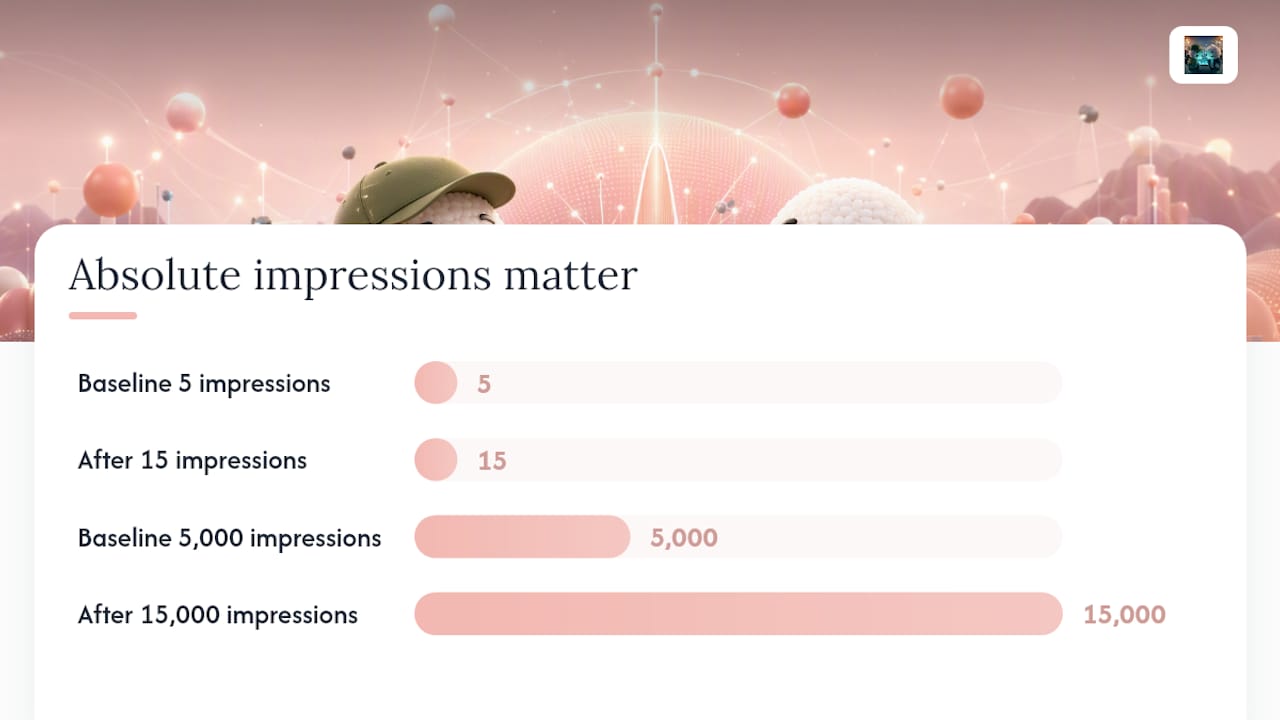
- Compare absolute numbers against percentage change. A 200% jump from five impressions to fifteen is statistical noise; the same percentage jump from 5,000 to 15,000 is a real event.
Query-level and page-level data tell different stories. A spike concentrated in one query but spread across many pages usually points to broad topical interest. A spike hitting one page across many queries usually points to something specific about that page.
Pro Tip: Widen your sampling window before reacting to a single day's numbers. Google's own debugging guidance recommends comparing 16 months of data to separate genuine shifts from seasonal noise, and the same principle works in reverse for spikes.
How early-signal platforms cut through spike noise
Raw Trends data and third-party rank trackers both suffer from the same weakness: they show you movement without telling you whether that movement means anything. A single tracker registering a "volatility pulse" doesn't confirm a real shift in demand, it just confirms that something moved somewhere.
Ontherice approaches the problem differently by running multiple AI engines against the same raw signals and scoring the overlap. Where one tracker might flag a spike based on a handful of queries in a narrow category, an ensemble approach cross-references that movement against sector-wide patterns before it ever reaches a ranking.
- Multiple AI engines analyse the same raw data independently, then their outputs are combined into a single score
- Noise filtering strips out isolated, low-baseline blips that would otherwise look identical to genuine surges
- Sector rankings surface which opportunities are actually gaining momentum relative to their category, not just in isolation
- Transparent accuracy tracking lets you see how prior signals performed, rather than taking a ranking on faith
The gap between a raw Trends chart and an actionable opportunity is exactly the gap that ensemble scoring is built to close. One engine flagging a term is a data point. Several engines converging on the same term, independently, across different data sources, is a signal worth a content team's time.
For a content team drowning in tracker alerts and Trends screenshots, the practical benefit is speed with less second-guessing: a ranked list of opportunities rather than a wall of unfiltered noise, with category matching doing the work of separating a genuine sector shift from a one-off blip.
Separating signal from noise: a decision framework
Not every spike deserves a response, and treating them all the same way is how content calendars fill up with wasted effort. Run through these questions before deciding anything.
- What's the baseline volume? If the term normally gets a trickle of searches, a spike is easy to trigger and easy to overstate.
- Is it geographically concentrated? A spike confined to one city or region often points to a local event, not a national trend worth a broad content push.
- Is there a correlated news or social event? If you can find the trigger in under two minutes, you're dealing with an event-driven spike, which behaves very differently from organic, unexplained demand.
- Is SERP intent stable? Check whether the results page for the term still shows the same mix of informational, transactional, or navigational results as before the spike.
Low-baseline amplification is the trap most teams fall into. Extreme events, like a major sporting tournament pushing search queries per second to record highs, generate huge numbers that are almost entirely curiosity, not sustained demand a typical publisher can monetise.
Before publishing anything, run a short SERP intent checklist:
- Are the top results evergreen explainers, or fresh news coverage?
- Do any results look transactional (products, bookings, pricing)?
- Is the volume likely to hold for weeks, or fade within days?
If the top results are dominated by breaking news outlets, you're looking at curiosity, not a content gap. If evergreen guides are holding position despite the spike, that's a stronger case for genuinely useful search volume increases worth targeting.
Turning a spike into a content decision
Once you've confirmed a spike is real, the next question is what to do about it, and the answer depends entirely on what triggered it.
- News-driven spikes call for speed. A quick roundup or news-style page published within hours captures the bulk of the available traffic, because interest here fades fast.
- Seasonal spikes call for updates, not new pages. Refresh an existing evergreen explainer with current information rather than building something from scratch every year.
- Low-volume, unexplained spikes call for restraint. Draft something, hold it, and watch for a second confirming signal before committing resources to a full rewrite.
- Data-led or category-wide surges call for deeper analysis pieces, since these tend to have longer shelf lives and reward the extra research time.
Measurement matters as much as the publishing decision. Track the full funnel from impressions to click-through rate to actual conversions, not just whether the page got indexed. A short A/B test on headline or meta description can tell you within days whether the spike is translating into clicks, and whether those clicks are doing anything useful once they land.
Setting cadence, thresholds, and alerts that actually work
Enterprise sites with steady traffic can check daily without drowning in noise. Smaller sites are better served checking weekly, since daily checks on low volume mostly surface statistical wobble rather than anything real.
- Set alert thresholds on impressions, not clicks; impressions are the steadier of the two metrics when volume is thin
- Use a relative threshold against a 30 day baseline (for example, a 50% jump against the trailing average) alongside an absolute floor to avoid triggering on tiny numbers
- Log every alert with the query, region, timeframe, initial diagnosis, and the next step taken
Pro Tip: Impressions rarely lie the way click percentages can. A tiny site can show a "50% drop" that's really just two clicks instead of four, which is exactly why impressions deserve more weight in your alert logic than raw click swings.
Where spike analysis goes wrong
The most common mistake is treating the Trends index as if it were a raw volume figure, when it's a relative score against the region and window you've selected. A score of 40 in one search means nothing next to a score of 40 in a different one.
- Reacting to a single day's blip on a small site, where five extra searches can look like a 300% surge
- Confusing ranking volatility (a tracker score wobbling) with an actual rise in demand
- Skipping the Search Console indexing check before assuming a spike or drop reflects real-world interest, when the cause might be a crawling issue
- Trusting one tracker's volatility pulse without a second source; composite indices have shown moderate pulses fading within a day
Small absolute numbers create large percentage swings almost by definition. Always cross-check against a second data source before treating any of this as fact.
Balancing speed and analytical rigour

Speed wins with news-driven spikes; every hour of delay costs traffic that won't come back. Rigour wins with anything conversion-related, where a wrong call costs more than a missed news cycle.
Three rules hold up in practice: never act on one data source alone, always separate the trigger from the trend, and treat low-baseline spikes as drafts, not deadlines. For teams that want this triage done faster and with less manual cross-referencing, Ontherice ranks opportunities by conviction rather than raw volume, which is the part most trackers skip entirely.
Try Ontherice for faster spike detection
Chasing every Trends alert and tracker notification by hand costs analysts hours they don't have, and by the time three tools agree on something, the opportunity has often already peaked. Ontherice runs that cross-referencing continuously, so a spike arrives already scored against sector-wide patterns instead of sitting alone in a spreadsheet.

The platform surfaces early alerts before a term becomes obvious, ranks opportunities by conviction rather than raw Trends volume, filters out the low-baseline noise that wastes editorial time, and exports signal cards your content team can act on directly. If you want to see how a spike looks once it's been through that filtering, the AI-driven opportunity feed is the place to start, with a free tier that shows the ranked signals before you commit to anything paid.
Frequently asked questions
Is a Google search spike the same as a ranking update? No. A search spike reflects a change in how many people are searching a term. A ranking update or ranking volatility reflects movement in where pages appear on the results page, and the two can happen completely independently of each other.
How long does a typical search spike last? It depends entirely on the trigger. News-driven spikes usually fade within days. Seasonal spikes recur on a predictable annual cycle. Genuine category shifts, confirmed across several weeks of data, tend to hold far longer.
Should I publish immediately when I see a spike in Google Trends? Only if you've confirmed it with Search Console impressions and a real-world trigger. If the baseline volume is low or the spike is confined to a single day, a monitored draft is safer than a rushed publish.
What's the difference between search volume increases and ranking volatility? Search volume increases reflect genuine demand changes measurable in Trends, Search Console, and Analytics. Ranking volatility is tracked by third-party SERP monitoring tools and reflects positioning changes, which can happen with no change in actual search interest at all.
Sources
For deeper validation, start with Google's own ranking systems documentation and the Search Console traffic drop guide. For macro context on demand shifts, the OECD's weekly GDP tracker offers a useful cross-check. Explore Ontherice's ranked signals for ongoing spike monitoring.
- Debug Google search traffic drops | Google Search Central (documentation)
- Google On When Not To Worry About Traffic Fluctuations | Search Engine Journal
- Google volatility spikes Aug 12-13: what trackers show | Digital Applied