
TL;DR:
- Many organizations mistakenly treat innovation as a single activity, which causes programs to stall. Properly defining innovation archetypes enables leaders to allocate resources, build teams, and measure success more effectively. AI is transforming traditional frameworks, creating new archetypes that require updated strategic responses to remain competitive.
Most organisations treat innovation as a single activity, something that happens when a team has a clever idea or a budget is earmarked for R&D. This misunderstanding is precisely why so many innovation programmes stall. Defining innovation archetypes properly gives leaders a far more precise instrument. Instead of asking "are we innovative?", you can ask "which kind of innovation are we pursuing, are we structured for it, and do we have the right leadership in place?" That shift in framing changes everything about how you allocate resources, build teams, and measure success.
Table of Contents
- Key takeaways
- Defining innovation archetypes: core concepts and frameworks
- Leadership archetypes and their role in innovation
- How AI is reshaping innovation archetypes
- Applying innovation archetypes strategically
- Comparing innovation archetypes and frameworks
- My perspective on getting archetypes right
- Discover how Ontherice supports your innovation strategy
- FAQ
Key takeaways
| Point | Details |
|---|---|
| Archetypes are not theory, they are tools | Use defined innovation archetypes to diagnose gaps, align leadership, and prioritise investment with precision. |
| Frameworks vary by focus area | Doblin's ten types, the four strategic types, and leadership archetypes each serve a different diagnostic purpose. |
| Leadership must match the archetype | Misalignment between leadership style and innovation type is one of the most common causes of programme failure. |
| AI is creating new archetypes | Agentic services and outcome-based models are mutating traditional frameworks and require updated strategic responses. |
| Hybridising archetypes outperforms purity | Organisations that blend complementary archetypes achieve better economic coherence than those locked into one model. |
Defining innovation archetypes: core concepts and frameworks
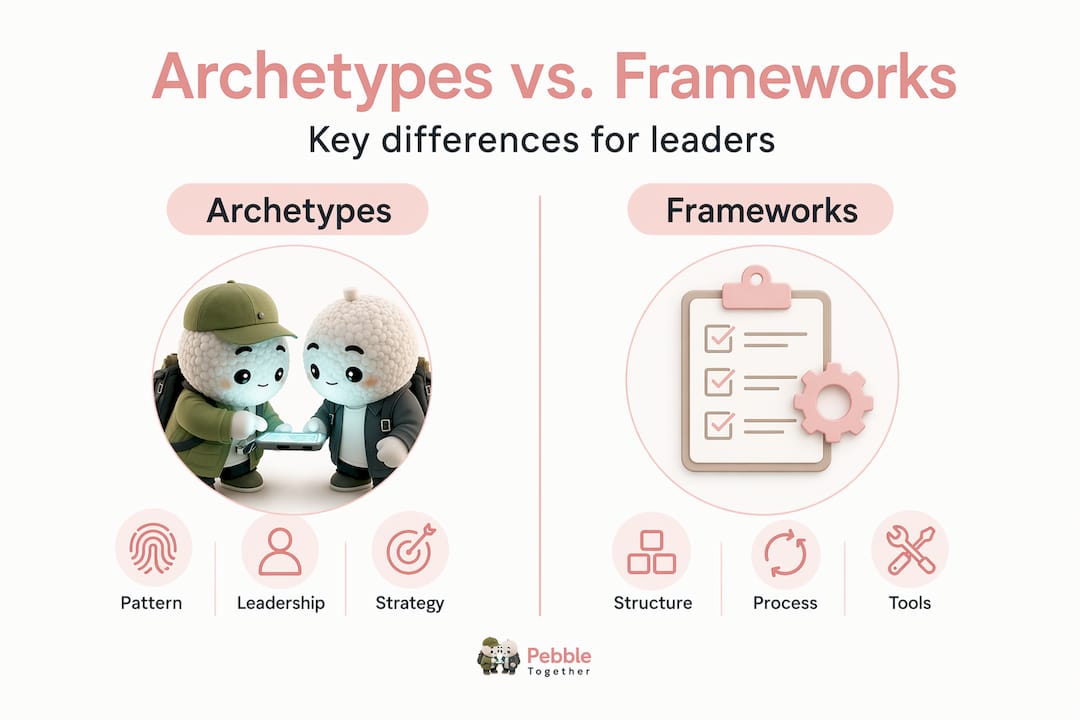
An innovation archetype is a recurring pattern of innovation behaviour and strategy that an organisation consistently exhibits or consciously chooses to pursue. It is not a description of a single project. It describes the system by which an organisation generates and captures value through change.
The most widely applied tool for understanding innovation models is Doblin's Ten Types of Innovation, which groups innovation across three clusters: Configuration, Offering, and Experience. Configuration covers how a business is organised and makes money, including Profit Model, Network, Structure, and Process. Offering covers what is delivered, specifically Product Performance and Product System. Experience governs how customers interact with the business through Service, Channel, Brand, and Customer Engagement. Most organisations default to product-level innovation while leaving the other nine types under-utilised. That is a structural blind spot, not a strategy.
The four strategic types provide a different and equally important lens:
- Incremental innovation refines existing products or processes and operates within known markets. It demands operational discipline, not creative disruption.
- Adjacent innovation extends current capabilities into new markets or customer segments. It requires a blend of existing strengths and exploratory thinking.
- Disruptive innovation enters markets from below or from the periphery, targeting overlooked customers before scaling upward.
- Radical innovation creates entirely new categories. It requires protected environments and executive sponsorship because it cannot survive inside normal governance structures.
A critical misconception worth naming directly: many leaders assume their organisation practises radical innovation because they aspire to it. The archetype you fund and govern is your actual archetype, not the one in your strategy presentation. Radical innovation demands protected spaces and executive air cover that most organisations never actually provide.
Pro Tip: Map your last five innovation initiatives against the ten Doblin types. If they cluster in two or three types, you have identified your de facto archetype and your portfolio gaps simultaneously.
Leadership archetypes and their role in innovation
No innovation framework functions without the right leadership archetype supporting it. Eight primary leadership archetypes have been identified in research on organisational behaviour: the Strategist, Change-Catalyst, Transactor, Builder, Innovator, Processor, Communicator, and Coach. Each one creates a distinct organisational environment.
The critical insight is not which archetype is "best." It is whether your dominant leadership archetype is congruent with the innovation archetype you are pursuing. A Processor archetype excels at incremental innovation. It will suppress radical innovation through governance overhead alone. A Builder archetype drives adjacent and disruptive plays but will frustrate teams in mature, efficiency-focused phases.

In deep tech specifically, founder CEO archetypes fall into five distinct types: the Scientist-Steward, the Systems Builder, the Visionary Narrator, the Domain Insider, and the Repeat Founder. Each one leads effectively in a specific phase of company development. A Scientist-Steward is ideal for early-stage technical validation but will struggle at the commercialisation stage where a Visionary Narrator's communication strengths become critical.
What makes this genuinely useful for organisations is the concept of complementary archetype pairings. Complementary pairings such as a Scientist-Steward working alongside a Systems Builder create productive tension between exploration and execution. Neither archetype alone can sustain the full innovation lifecycle.
- Diagnose your current dominant leadership archetype honestly, not aspirationally
- Identify which phase of innovation your organisation is in right now
- Assess whether the archetype fit is aligned or whether you have a gap requiring a complementary hire or structural change
- Build collective leadership that integrates diverse archetypes rather than centralising around one style
Collective leadership that integrates diverse archetypes provides the adaptive flexibility needed for sustained innovation across multiple horizons. This is particularly relevant for organisations managing both incremental and disruptive innovation simultaneously.
How AI is reshaping innovation archetypes
The emergence of AI is not merely adding a new tool to existing archetypes. It is mutating them at the structural level. New AI-driven archetypes include Strategic Enablers, Full-Stack Integrators, Specialised Dominators, Domain Specialists, and Focused Experts. These do not map cleanly onto the traditional four strategic types or the Doblin framework.
The most significant shift is the move away from per-seat SaaS models toward agentic services and outcome-based pricing. A traditional SaaS business monetises access. An agentic service business monetises results. That is a fundamentally different value proposition, and it requires a fundamentally different innovation archetype to build and sustain.
For strategists, AI trend examples across sectors show that the organisations gaining ground are those that have consciously updated their archetype rather than layering AI features onto an existing model. The archetype must change first; the product follows.
Three implications stand out for business leaders right now:
- Organisations structured around product-centric archetypes must assess whether their value capture mechanism remains viable as AI commoditises features
- The boundary between Service and Product archetypes is dissolving; hybrid models that blend both are becoming the default competitive position
- How to categorise innovation in AI-influenced environments requires updated frameworks, not just updated language
Applying innovation archetypes strategically
Understanding the archetypes is step one. Using them to make decisions is where the value actually sits. Here is a practical approach for diagnosing and deploying archetypes within your organisation.
- Audit your current innovation portfolio against a recognised framework. Use Doblin's Ten Types to map where investment is concentrated and where there are gaps. Be factual, not aspirational.
- Identify your organisational phase. A pre-revenue startup and a mature enterprise face entirely different archetype requirements. Innovation maturity models such as INSPIRE and the Innovation Maturity Index identify specific gaps in leadership, culture, and venture-building that correspond to phase-specific archetype needs.
- Assess leadership archetype alignment. Use the findings from a leadership archetype diagnostic to test whether your dominant leaders are suited to your declared innovation type.
- Design a hybrid if needed. Hybridising archetypes rather than rigidly following one model leads to greater economic coherence. A SaaS business adding consumption-based AI pricing is a classic hybrid in action.
- Embed archetypes into governance. Build your innovation review criteria, budget gates, and team structures around the archetype you have chosen, not around generic project management principles.
Pro Tip: The most dangerous archetype selection is the aspirational one. Effective leaders identify their current compounding loops, whether that is dependency, distribution, or workflow lock-in, and select archetypes that reinforce those loops rather than contradict them.
Innovation embedded within core organisational processes consistently outperforms innovation treated as a parallel activity. Archetype selection must therefore shape operating models, not just strategy documents.
| Diagnosis tool | Best use case | Archetype fit |
|---|---|---|
| Doblin's Ten Types | Portfolio gap analysis | All types; especially Offering and Experience gaps |
| Four strategic types | Governance and investment decisions | Incremental to radical spectrum |
| Innovation Maturity Index | Cultural and capability readiness | All phases; highlights structural deficits |
| Leadership archetype diagnostic | Team composition and succession | Phase-specific alignment |
Comparing innovation archetypes and frameworks
No single framework covers everything. The most effective strategists treat types of innovation frameworks as complementary lenses rather than competing theories.
| Framework | Focus area | Risk profile | Organisational phase | Leadership fit |
|---|---|---|---|---|
| Doblin's Ten Types | Portfolio breadth | Low to high | All phases | Strategist, Innovator |
| Four strategic types | Investment governance | Incremental to radical | Growth to mature | Builder, Processor |
| Leadership archetypes | Human capital alignment | Depends on type | All phases | All types |
| AI-driven archetypes | Business model mutation | High | Early to growth | Change-Catalyst, Innovator |
The Doblin framework tells you where to innovate. The four strategic types tell you how much risk to take and at what pace. Leadership archetypes tell you who should lead it. AI-driven archetypes tell you what the landscape is becoming.
Used together, these frameworks give you a genuinely three-dimensional picture of your innovation position. Used in isolation, each one leaves substantial blind spots. The organisations that consistently out-innovate peers are not those with the cleverest ideas. They are the ones with the most rigorous self-awareness about which archetypes they inhabit, and the discipline to close the gaps.
My perspective on getting archetypes right
I have seen organisations spend considerable resources on innovation strategy only to produce frameworks that gather dust. The problem is almost never the framework itself. It is the gap between the archetype an organisation claims and the archetype it actually operates.
The most instructive pattern I observe is what I would call aspirational archetype inflation. A company says it is pursuing radical innovation while structuring its governance, talent, and budgets entirely around incremental delivery. The declared archetype and the real archetype are two different things. Until leaders close that gap, no amount of methodology will help.
What I find genuinely underappreciated is the value of complementary archetype pairings at the leadership level. The productive tension between a technically deep founder and a commercially sharp executor is not a personality conflict. It is architecture. It is how exploration and execution stay in balance without one consuming the other.
AI is accelerating archetype obsolescence in ways that should concern any leader relying on frameworks built before 2020. The mutation from per-seat models to agentic, outcome-based archetypes is not a trend to monitor for later. It is a decision most organisations need to make now, before their current archetype locks them out of the next competitive position.
My honest advice: spend less time picking the most exciting archetype and more time being ruthlessly honest about the one you are already living. Build from there.
— Aidil
Discover how Ontherice supports your innovation strategy
If you are actively working to understand and apply innovation archetypes within your organisation, the quality of your market intelligence is what separates a good decision from a great one. Ontherice uses multiple AI engines to scan global signals and identify what is gaining momentum before it reaches mainstream awareness, precisely the kind of early visibility that informs archetype decisions before competitors catch up.

The B2BSignals platform gives business leaders and strategists access to real-time intelligence that supports innovation portfolio decisions and competitive positioning. For leaders specifically tracking AI-driven business model shifts, AIOpportunities surfaces emerging patterns across sectors where new archetypes are forming. If your innovation strategy depends on knowing what is next rather than reacting to what has already happened, Ontherice gives you the signal advantage your archetype planning requires.
FAQ
What are innovation archetypes?
Innovation archetypes are recurring patterns of innovation behaviour and strategy that organisations exhibit across their operations. They describe the system by which a business generates and captures value through change, not just individual projects.
How does Doblin's framework help with understanding innovation models?
Doblin's Ten Types of Innovation categorises innovation across Configuration, Offering, and Experience clusters, covering ten specific types from Profit Model to Customer Engagement. It helps leaders identify which dimensions of innovation are under-invested in their current portfolio.
Why does leadership archetype alignment matter?
Misalignment between leadership archetype and innovation type is a leading cause of innovation programme failure. A governance-heavy leadership style will structurally suppress radical innovation regardless of declared strategy.
How is AI changing innovation archetypes?
AI is mutating traditional business model archetypes by replacing per-seat SaaS models with agentic services and outcome-based pricing structures. New categories such as Strategic Enablers and Full-Stack Integrators require updated frameworks for categorising innovation.
What is the risk of aspirational archetype selection?
Choosing an archetype based on aspiration rather than operational reality creates misalignment across budget, governance, and talent. Effective leaders identify their existing compounding loops first, then select archetypes that reinforce them.