
TL;DR:
- Market sensing continuously detects early market signals using AI and real-time data, offering a strategic advantage. It covers broader sources than traditional research, focusing on emerging topics, sentiment shifts, and supply disruptions to inform faster decision-making. Implementing sensing as a capability involves clear processes, the right teams, and technology, with measurable KPIs guiding continuous improvement.
Market sensing is the continuous process of detecting early signals from markets, customers, and competitive environments so that decision-makers can act before a shift becomes obvious to everyone. Where traditional research tells you what happened, sensing tells you what is happening right now and, at its best, what is about to happen next. Platforms such as Ontherice apply multiple AI engines to noisy public data, surfacing ranked signals in real time. That combination of AI processing, GDPR-compliant data sourcing, and the academic framing of sensing as a dynamic capability is what separates modern market sensing from a quarterly survey.
Table of Contents
- What does market sensing actually cover?
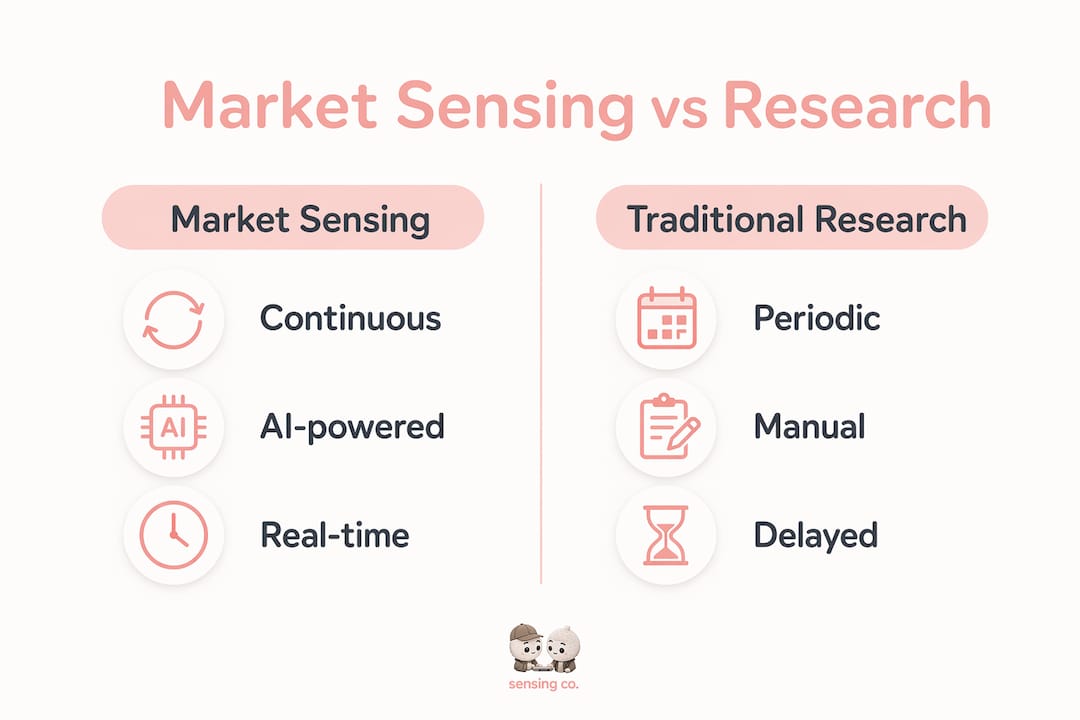
- How does market sensing differ from traditional market research?
- Why are AI and real-time sensing strategically urgent for UK businesses?
- How do you operationalise market sensing in practice?
- How do you measure whether sensing is working?
- A practical checklist for UK businesses: first 90 days
- How Ontherice operationalises market sensing
- Key takeaways
- The gap between sensing and actually deciding
- Try Ontherice for your next sensing pilot
- Useful sources and further reading
What does market sensing actually cover?
The scope is broader than most strategists initially expect. Core data sources include social media conversations, digital behavioural signals, transactional records, IoT-generated activity, published policy and regulatory notices, and outputs from research institutions. Each source type contributes a different layer of signal.
Common signal types to watch for:
- Emerging topics: a cluster of conversations around a theme that did not exist three months ago
- Sentiment shifts: a measurable change in tone around a brand, regulation, or product category
- Anomalous behaviours: a spike or drop in search volume, app downloads, or footfall that breaks a seasonal pattern
- Transaction pattern changes: a sudden redistribution of spend across product lines or channels
- Supply-chain interruptions: upstream disruptions that will reach consumers before they appear in official data
The flow runs: raw signal → AI filtration → human sense-making → calibrated experiment → strategic decision. Think of it as a river with a sluice gate: the AI controls the gate, letting through only the signals worth a strategist's attention. A retail example makes this concrete: a sudden rise in searches for "thermal workwear" combined with a drop in standard uniform queries is a signal. The insight is that a cold-weather shift is arriving earlier than forecast. The action is a stock reorder placed two weeks ahead of a competitor's. For a broader catalogue of what these signals look like in practice, the innovation signals guide is worth bookmarking.

How does market sensing differ from traditional market research?
Nigel Piercy draws the sharpest line: market research typically starts from the company's product view, asking "how do customers respond to what we offer?" Market sensing starts from the customer's perspective, asking "what emotions, beliefs, and reasons are driving their choices right now?" That inversion changes everything about what you measure and when.
SMU PhD research frames sensing as a dynamic capability rather than a periodic project. The distinction matters because a capability is built into the organisation's operating rhythm; a project ends.
| Dimension | Market sensing | Traditional market research |
|---|---|---|
| Timeframe | Continuous, real-time | Periodic, retrospective |
| Typical inputs | Digital signals, social data, IoT, behavioural streams | Surveys, focus groups, structured interviews |
| Typical outputs | Early trend signals, anomaly alerts, ranked opportunities | Validated findings, segmentation reports |
| Primary users | Strategists, product owners, commercial leads | Marketing teams, brand managers |
| Main decisions supported | Early bets, risk mitigation, experiment design | Campaign validation, product launch readiness |
Qualitative techniques such as interviews and focus groups still have a place, but they work best when they deepen understanding of a signal that digital monitoring has already surfaced, not as the primary detection mechanism.
Why are AI and real-time sensing strategically urgent for UK businesses?
Three business benefits stand out when sensing is powered by AI and real-time data:
- Shorter lead time to insight: AI can process thousands of data points in the time a human analyst would review a spreadsheet, compressing the gap between a market shift and an informed response.
- Earlier opportunity capture: sensing capability helps firms identify gaps in value propositions before competitors do, particularly in slow-growth sectors where marginal timing advantages compound.
- Faster risk mitigation: a regulatory announcement from the FCA or a sudden shift in UK consumer confidence can be detected within hours rather than weeks.
A UK-specific illustration: when the government announced changes to energy efficiency requirements for commercial properties, businesses with live sensing picked up the signal from parliamentary feeds and trade body commentary days before mainstream press coverage. They had time to brief procurement teams and adjust supplier conversations. Those relying on monthly research digests did not.
Deloitte's work on generative AI use cases confirms that AI multiplies sensing value by filtering noisy signals and surfacing higher-quality leads. The dynamic capability framing reinforces why this matters structurally: firms that embed sensing into their operating model, rather than commissioning it occasionally, build a compounding advantage. For a sharper view of how this plays out across sectors, the market intelligence trends analysis is a useful companion.
How do you operationalise market sensing in practice?
Turning sensing from a concept into a repeatable capability requires three things working together: the right people, a clear process, and technology that fits the team's maturity.
Core team roles:
- Sensing lead: owns the signal backlog and prioritisation
- Data engineer: manages ingestion pipelines and source quality
- Analyst: interprets signals and drafts experiment briefs
- Product owner: connects signals to roadmap decisions
- Legal/ethics reviewer: ensures GDPR compliance and data minimisation from day one
- Change sponsor: secures budget and removes organisational blockers
Process flow: continuous ingestion → AI-powered signal filtration → human sense-making → small calibrated experiments → decision loop. The experiment step is where most teams stall. Sensing without experimentation is just observation; the signal only earns its keep when it drives a testable hypothesis.
Under UK GDPR, data minimisation and privacy-by-design are non-negotiable from the first ingestion pipeline, not an afterthought added before launch.
90-day rollout:
- Weeks 1–2: Define pilot scope, identify two or three priority signal domains, map existing data sources.
- Weeks 3–4: Vendor due diligence, data provenance checks, legal/ethics sign-off on sources.
- Weeks 5–8: Build ingestion pipeline, configure AI filtration, set initial signal thresholds.
- Weeks 9–10: Run first human sense-making sessions; document signal-to-insight conversion rate.
- Weeks 11–12: Launch two small experiments based on top signals; measure and report.
For a step-by-step scanning process to complement this, the trend opportunity scanning guide covers the mechanics in detail.
Pro Tip: Set your AI signal threshold conservatively at first — err on the side of more signals rather than fewer. Once you have two weeks of data, review false positives with your analyst and tighten the threshold incrementally. This preserves early-warning sensitivity while reducing noise fatigue in the team.
Research on market knowledge sourcing shows that in high-dynamism markets, broad neutral sources such as research institutions and cross-sector monitoring outperform narrow competitor-focused sourcing for early detection. Build your source mix accordingly.
How do you measure whether sensing is working?
Measurement is where many pilots lose momentum. Without clear KPIs, sensing becomes a cost centre rather than a capability.
| KPI | Definition | Illustrative target | How to interpret |
|---|---|---|---|
| Lead time to insight | Days from signal emergence to briefing note | a few days | Shorter is better; benchmark against your pre-sensing baseline |
| Signal precision | Proportion of flagged signals that prove actionable | a moderate range | Too low suggests threshold is too loose |
| Signal recall | Proportion of real market shifts that were detected | generally high | Too low suggests source coverage gaps |
| Experiment conversion rate | Proportion of signal-driven experiments producing a positive outcome | a modest proportion | Calibrate to your sector's typical test-and-learn rate |
| Stakeholder adoption rate | Proportion of target users actively querying the sensing system | generally above 50% | Low adoption usually signals a UX or communication problem, not a data problem |
Build a first analytics sprint dashboard around six widgets: lead time trend, precision trend, recall trend, experiment pipeline status, adoption rate, and a live signal volume chart. These six give you enough to run a monthly sensing review without drowning in data.
A practical checklist for UK businesses: first 90 days
- Scope the pilot: choose one business question (e.g. "what early signals predict demand shifts in our top product category?").
- Audit existing data: catalogue internal sources before adding external ones.
- Vendor due diligence: ask three questions of every platform: Where does your data originate and how is provenance documented? How do you track and publish ranking or prediction accuracy? What is your privacy posture and how do you support GDPR compliance for UK clients?
- Set a budget bracket: small pilots (one team, one domain) typically run on tooling and analyst time; medium pilots add data licensing and a part-time data engineer; enterprise deployments add integration work and governance infrastructure.
- Onboard two or three data sources: start narrow. Quality of ingestion matters more than breadth at this stage.
- Run the first sense-making session: bring sensing lead, analyst, and one business stakeholder together to review the first signal batch.
- Design two experiments: each experiment should have a clear hypothesis, a measurable outcome, and a two-week time limit.
- Evaluate and decide: at day 90, assess lead time, precision, and adoption. Decide whether to scale, pivot the source mix, or extend the pilot.
An AI product validation tool such as Spark Concept can help teams stress-test the hypotheses generated from early signals before committing experiment budget.
How Ontherice operationalises market sensing
Ontherice implements the sensing workflow end to end. Multiple AI engines ingest noisy public data across finance, technology, crypto, jobs, brands, and products, then extract ranked signals with transparent accuracy tracking. Users can query the live AI directly to interrogate specific signals or sectors, which compresses the sense-making step considerably.
A typical pilot workflow on the platform:
- Define pilot scope and select relevant signal domains from the sector index
- Activate ingestion across chosen domains; the platform handles source normalisation
- Review ranked signal cards; flag the top signals for human sense-making
- Design small experiments based on the highest-confidence signals
- Track signal accuracy over time using the built-in ranking history to validate the platform's predictions against outcomes
The freemium model means teams can explore the core signal feeds before committing. Access Points unlock deeper insight cards and premium feeds, making it straightforward to scale spend in line with pilot results. The AI Opportunities feed is a practical starting point for teams focused on technology and innovation signals.
Key takeaways
Market sensing, operationalised as a continuous AI-powered capability rather than a periodic project, gives UK strategists a measurable lead-time advantage over competitors still relying on retrospective research.
| Point | Details |
|---|---|
| Definition and purpose | Market sensing detects early signals continuously, giving decision-makers time to act before shifts become obvious. |
| Sensing vs research | Sensing is real-time and customer-centric; research is periodic and product-centric — both have a role, but they answer different questions. |
| First 90 days | Scope one business question, audit sources, run vendor due diligence, and launch two small experiments before scaling. |
| Measurement | Track lead time to insight, signal precision, and stakeholder adoption from day one; a six-widget dashboard covers the essentials. |
| Ontherice | The platform's multi-engine AI, transparent accuracy tracking, and freemium Access Points model make it a practical starting point for UK sensing pilots. |
The gap between sensing and actually deciding
There is a version of market sensing that organisations do very well and a version that quietly fails. The difference is almost never the technology.
The teams that get genuine value from sensing are the ones who treat a signal as the start of a conversation, not a conclusion. They bring the analyst, the product owner, and a sceptic into the same room, argue about what the signal actually means, and then design the smallest possible experiment to test their interpretation. The teams that struggle tend to do the opposite: they let the AI surface a signal, accept it at face value, and either act too boldly or not at all.
The dynamic capability framing from SMU research captures this well. Sensing is not a tool you deploy; it is a muscle you build. The governance, the learning loops, the culture of small bets — these matter as much as the ingestion pipeline. A platform that shows you its accuracy history and lets you interrogate signals directly, as Ontherice does, makes the conversation easier. But the conversation still has to happen.
Try Ontherice for your next sensing pilot
Most sensing pilots stall not because the data is wrong but because teams have no clear starting point. Ontherice removes that friction. The platform's AI Opportunities feed gives you ranked, real-time signals across multiple sectors from day one, with transparent accuracy tracking so you can evaluate signal quality before committing further. The freemium model means your first signals cost nothing; Access Points let you go deeper when a signal warrants it.
To prepare for a trial: identify one business question you want sensing to answer, note two or three sectors or domains most relevant to your team, and bring one stakeholder who owns the decision the signals would inform. A brief onboarding session covers signal navigation, accuracy interpretation, and how to set up your first experiment brief.
UK pilots should confirm that any external data vendor meets ICO guidance on data minimisation and privacy-by-design before connecting live feeds. Ontherice's public data sourcing model is designed with that requirement in mind.
Start with the AI Opportunities feed and run your first signal review this week.
Useful sources and further reading
- SMU PhD: market sensing as a dynamic capability — the foundational academic framing; essential reading for anyone building a governance case for sensing investment.
- SMU PhD: experimentation within market sensing — explains how small calibrated experiments convert signals into strategic decisions.
- Nigel Piercy: management frameworks in rapidly changing markets — the authoritative source for the sensing-vs-research distinction.
- Deloitte: generative AI use cases — practical framing of how AI multiplies signal quality and reduces noise.
- ScienceDirect: market knowledge sourcing and sensing capability — empirical evidence linking knowledge source mix to sensing effectiveness and revenue growth.
- ScienceDirect: market-sensing capability, knowledge creation and innovation — useful for teams making the case that sensing drives innovation, not just intelligence.
- ICO guidance on UK GDPR — the primary reference for data minimisation, privacy-by-design, and vendor due diligence requirements for UK pilots.
- Ontherice rankings engine — explains how the platform's ranking and accuracy-tracking features work; useful for procurement and technical due diligence conversations.