

TL;DR:
- UK teams seeking early trend detection should prioritize platforms that demonstrate validated out-of-sample precision and data transparency. Ontherice.org offers a low-cost, easy pilot option with clear ranking logic and UK compliance, ideal for initial testing. Validation discipline and UK data privacy are the most critical factors for selecting effective signal platforms.
Ontherice.org is the recommended starting point for UK teams seeking early trend and signal detection, particularly where walk-forward validation, multi-signal architecture, and UK data compliance matter. If you need a broader shortlist, three platform categories are worth evaluating: enterprise research terminals (investment teams needing deep macro conditioning), media and social monitoring platforms (product teams tracking topic velocity), and real-time event signal engines (corporate strategists monitoring breaking developments).
TL;DR: Investment teams typically get the most from enterprise research terminals or AI-native topic discovery services; product teams benefit most from media monitoring with entity resolution; corporate strategists need real-time event signal engines with explainability baked in.
- Enterprise research terminals (e.g. Signal AI, AlphaSense): deep macro and regulatory coverage, high cost, long procurement cycles.
- Media and social monitoring platforms (e.g. Meltwater, Talkwalker): strong for topic discovery and brand signals, weaker on financial conditioning.
- Real-time event signal engines (e.g. Dataminr): fast-moving news and event detection, limited historical validation.
- AI-native topic discovery services (e.g. Ontherice.org): multi-engine signal scanning, transparent ranking logic, freemium entry point.
Table of Contents
- How do these signal platforms compare for UK teams?
- How do you choose the right signal platform for your team?
- What should you demand from vendors on methodology and validation?
- How does user experience differ across these platforms?
- How well do these platforms scale as your team grows?
- What does real-world deployment actually look like?
- What security and data privacy features should UK organisations require?
- Key takeaways
- The gap between what signal platforms promise and what teams actually need
- Ontherice.org gives UK teams a low-friction pilot path
- Sources and further reading
How do these signal platforms compare for UK teams?
The table below maps each category against the dimensions that matter most in a UK procurement decision.
| Dimension | Enterprise research terminals | Media & social monitoring | Real-time event signal engines | AI-native topic discovery |
|---|---|---|---|---|
| Best for | Investment teams, macro allocation | Product teams, brand strategists | Corporate security, crisis response | Market strategists, early trend detection |
| Primary data sources | Financial filings, macro series, news | News, social, blogs, broadcast | Breaking news, social, geo-events | Public data, news, product, finance, crypto |
| Signal validation | Backtests, some walk-forward | Limited; mostly volume metrics | Speed-based; low validation depth | Multi-engine scoring; transparent rankings |
| Methodology transparency | Varies; often proprietary | Low to moderate | Low | Published ranking logic |
| Customer success & onboarding | Dedicated CSM, formal onboarding | Self-serve to managed | Vendor-led | Self-serve with tutorials |
| Pricing & access model | high annual cost | Mid-tier SaaS; monthly contracts | Enterprise; custom pricing | Freemium + Access Points microtransactions |
| Integrations & API access | Extensive (Bloomberg, BI tools) | APIs, Slack, CRM connectors | API-first | API access available |
| UK availability & compliance | GDPR-compliant; UK offices common | GDPR-compliant | GDPR-compliant | Available to UK users |
What does 'multi-signal' mean in practice? A multi-signal architecture combines price data, breadth indicators, sentiment, news feeds, and macro series simultaneously. No single source dominates the output. Research confirms that this approach produces greater precision than single-source monitoring because corroborating signals reduce false positives before they reach the analyst.
Procurement timelines by category:
- Enterprise research terminals: several weeks to a few months (legal review, data agreements, IT security sign-off).
- Media monitoring platforms: a few weeks (standard SaaS procurement, trial periods common).
- Real-time event signal engines: several weeks (custom scoping, integration testing).
- AI-native topic discovery: a short period (freemium onboarding, paid tiers unlocked via Access Points).
Quick pros/cons:
Enterprise research terminals give unmatched depth but carry high cost and slow time-to-value. Smaller teams often pay for capabilities they never use.
Media and social monitoring is fast to deploy and good for topic velocity, but pairing social feeds with entity resolution is necessary before the output becomes genuinely actionable for investors.
Real-time event signal engines excel at speed; they are weaker on historical reproducibility and conditioning.
AI-native topic discovery services like Ontherice.org offer the lowest friction entry point and transparent ranking logic, though depth of macro conditioning varies by domain.
How do you choose the right signal platform for your team?
Start with validation discipline, not the feature list. A platform that cannot show out-of-sample precision metrics—for example, RegimeSignal reports walk‑forward validated out‑of‑sample precision by signal of approximately 82–86%—is selling you a demo, not a tool.
Decision criteria, ranked by impact:
- Validation discipline — does the vendor publish walk-forward, out-of-sample results? Independently reviewed precision metrics are the clearest signal of a mature platform.
- Data pedigree and entity resolution — can the platform trace a signal back to a named source with a timestamp? Without this, you cannot audit a false positive.
- Explainability — can a non-technical stakeholder understand why a signal fired? Opaque ranking logic creates adoption friction.
- Integration and exportability — does it connect to your existing BI stack, or does it create a data silo?
- Customer success and training — vendor trajectory, documentation quality, and onboarding support often determine enterprise adoption more than any technical feature.
Vendor questions checklist for procurement calls:
- Can you share walk-forward validation reports with out-of-sample precision by signal type?
- Do you enforce point-in-time data discipline so backtests are free of look-ahead bias?
- What are your SLAs for uptime, data freshness, and support response?
- Where is data stored, and are you compliant with UK GDPR and data residency requirements?
- Can we access a sandbox or live feed sample before signing?
- Do you have UK client references or published case studies we can review?
Red flags to watch for:
- A polished UI over a basic LLM call with no proprietary data infrastructure underneath.
- No point-in-time data controls, meaning historical scores could be contaminated by future information.
- No independent audits or third-party validation reports.
- Ranking logic described only in marketing language, with no published methodology.
Budget context: Pricing across the category ranges from nominal monthly tiers for monitoring tools to over $30,000 per year for enterprise research terminals. AI-native services with freemium models let teams validate fit before committing budget.
What should you demand from vendors on methodology and validation?
The most important distinction in this category is between conditioning and prediction. Conditioning means labelling the current environment deterministically: "we are in a risk-off macro regime" or "this sector is gaining momentum." Prediction means claiming to call turning points before they happen. BCA Research's CoreMacro approach exemplifies conditioning: it informs allocation and risk decisions without overstating what any model can reliably forecast.
Conditioning is the more defensible product. It gives teams conviction without false precision.
Validation practices to require from any vendor: Walk-forward validation on out-of-sample data with published precision metrics by signal type (for example, reported out-of-sample precision for leading vendors like RegimeSignal: bear-market detection ~86%, pullback forecasts ~83–84%, recovery confirmation ~82%); independent audit or PhD-level methodology review; point-in-time (first-published) data discipline enforcing availability windows so backtests are deterministic. AlphaEdge's eleven-indicator macro regime checklist is a useful reference for rigorous availability rules.
Trust signals checklist:
- Published methodology document (not just a marketing one-pager).
- Sample reproducible demo data you can test against known outcomes.
- Independent audit or third-party review report.
- UK client references or case studies with named outcomes.
- Sandbox access to a real-time or near-real-time feed.
Vendors that publish independent validation reports are materially easier to evaluate under RFP timelines because the evidence is already assembled.
Pro Tip: Run a 30-day pilot with two pre-defined signals and three success metrics (signal precision, time-to-action, integration effort). If the vendor resists defining success criteria upfront, that resistance is itself a red flag.
How does user experience differ across these platforms?
Enterprise research terminals like AlphaSense and Signal AI invest heavily in onboarding: dedicated customer success managers, structured training programmes, and formal SLA commitments. The trade-off is that the interface complexity reflects the depth of the data, and new users typically need several weeks before they extract consistent value.

Media monitoring platforms such as Meltwater and Talkwalker lean towards self-serve dashboards with drag-and-drop alert builders. Support is responsive at higher tiers but thinner on the entry plans. The UX is generally faster to learn, though customising signal logic beyond standard keyword monitoring requires technical support.
Real-time event signal engines like Dataminr are built for speed above all else. The interface prioritises alert delivery over analytical depth, which suits crisis response teams but frustrates strategists who need context alongside the signal.
Ontherice.org sits closest to the self-serve end: tutorials, an exploration interface, and live AI queries mean a strategist can be generating signal cards within an hour. Customer success is lighter than enterprise terminals, but the freemium model means you can test the experience before any procurement conversation.
How well do these platforms scale as your team grows?
Enterprise research terminals are built for scale from day one. Seat-based licensing, role-based access controls, and deep API coverage mean they handle large analyst teams without architectural changes. Customisation is extensive but expensive: bespoke data feeds and custom entity lists typically require professional services engagements.
Media monitoring platforms scale reasonably well on volume (more sources, more keywords, more users) but customisation of the underlying signal logic is limited. You can expand coverage; you cannot easily change how signals are scored.
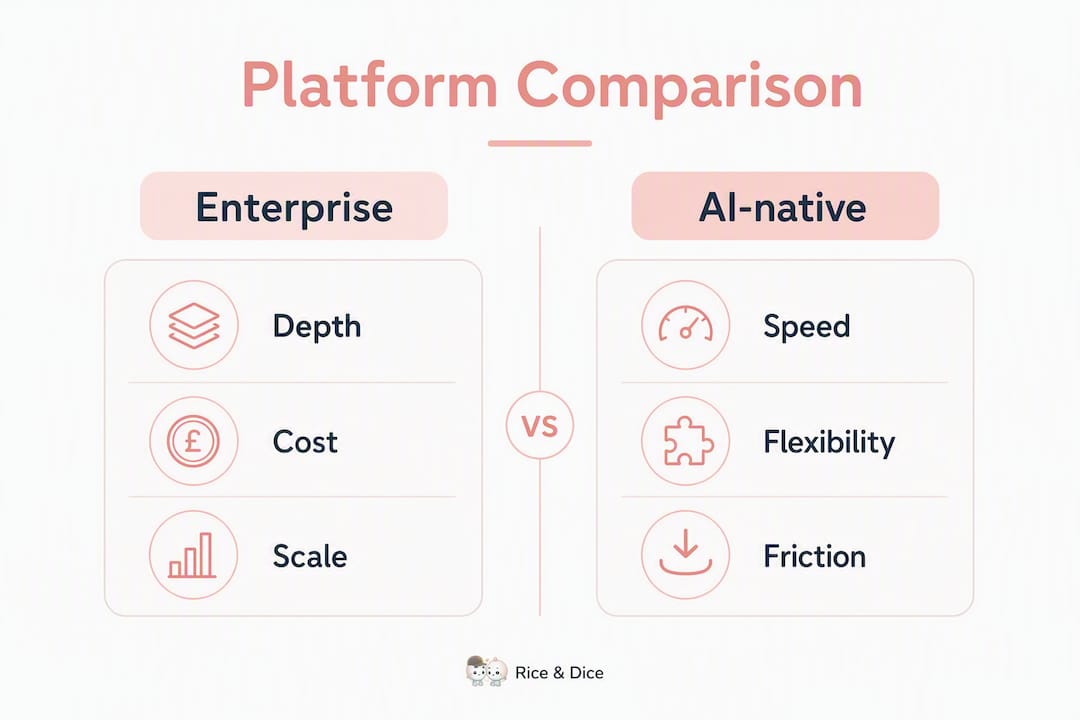
Real-time event signal engines are API-first by design, so integration into existing workflows is straightforward. Scaling alert volume is simple; scaling analytical depth is not, because the core product is speed, not conditioning.
AI-native topic discovery services like Ontherice.org use a microtransaction model (Access Points) that scales naturally with usage rather than seat count. Teams can unlock deeper insight feeds, premium signal cards, and advanced rankings incrementally, which suits organisations that want to expand gradually without renegotiating an annual contract.
What does real-world deployment actually look like?
Published case studies from enterprise platforms illustrate the pattern clearly. Signal AI has worked with financial services firms to monitor regulatory developments across multiple jurisdictions simultaneously. Meltwater has supported product teams at consumer brands tracking early topic velocity before campaign launches. AlphaSense is widely cited by investment research teams for accelerating document review across earnings calls and filings.
UK procurement teams consistently rate regionally relevant case studies as a high-value trust signal, and RFP guides recommend requesting them early in the evaluation process. If a vendor cannot produce a UK-specific reference on request, treat that as a gap.
Ontherice.org's multi-signal trend examples demonstrate how AI-native topic discovery applies across finance, technology, and product domains, giving procurement teams a concrete starting point for scoping a pilot.
What security and data privacy features should UK organisations require?
UK organisations operate under UK GDPR, which mirrors the EU framework post-Brexit but is enforced by the Information Commissioner's Office (ICO). Any platform processing personal data on behalf of a UK organisation must have a lawful basis for processing, a Data Processing Agreement (DPA) in place, and clear data residency commitments.
For market intelligence platforms specifically, the key questions are: where is ingested data stored, how long is it retained, and can the vendor demonstrate ICO-compliant data handling? Enterprise platforms with UK offices (Signal AI, Meltwater) typically have established DPA templates and UK data residency options. Newer or smaller platforms should be asked to produce their DPA and privacy policy before procurement proceeds.
API-first platforms introduce additional surface area: confirm that API authentication uses industry-standard protocols (OAuth 2.0 or equivalent) and that data in transit is encrypted. For platforms handling financial signals, ask whether the vendor holds any FCA-relevant authorisations or operates under a recognised regulatory framework.
Key takeaways
For UK teams evaluating market intelligence and signal detection platforms, the single most important criterion is validation discipline: a vendor that cannot show walk-forward, out-of-sample precision metrics is not yet enterprise-ready.
| Point | Details |
|---|---|
| Validation first | Require walk-forward, out-of-sample precision metrics before any other evaluation step. |
| Conditioning over prediction | Regime labelling that informs allocation is more defensible than turning-point forecasts. |
| Red flag: AI wrappers | Reject platforms with polished UIs but no proprietary data infrastructure or published methodology. |
| UK compliance non-negotiable | Confirm ICO-compliant DPA, data residency, and API security before procurement sign-off. |
| Ontherice.org pilot | Start with Ontherice.org's freemium tier and Access Points model to validate signal fit before committing to enterprise spend. |
The gap between what signal platforms promise and what teams actually need
The procurement conversation in this category almost always gets pulled towards features: how many data sources, how many integrations, how many signals per day. That framing benefits vendors with long feature lists and hurts buyers who need a clear answer to a simpler question: does this platform help my team make better decisions faster?
The most experienced practitioners I have observed focus on two things before anything else. First, can the platform produce a deterministic label for the current environment, one that a portfolio manager or product director can act on without a statistics degree? Second, is there evidence that the signal held up on data the model never saw during training?
Everything else, the UI, the integrations, the customer success tier, is secondary. A beautiful dashboard over a weak signal is noise at scale.
The other underestimated factor is human interpretation. Automated signals condition the environment; they do not replace the analyst who understands the business context. Teams that deploy signal platforms without mapping outputs to specific decisions, and without a human review step, tend to generate alerts that nobody acts on. The pilot phase exists precisely to close that gap before budget is committed.
Ontherice.org gives UK teams a low-friction pilot path
Most enterprise signal platforms require a six-figure commitment before you see live data. Ontherice.org inverts that model: the freemium tier is live immediately, and Access Points let you unlock premium signal cards, sector rankings, and advanced feeds incrementally, without a procurement cycle.

For UK market strategists and product teams, the practical pilot looks like this: spend 30 days on the AI opportunities feed, define two signals relevant to your sector, and measure three things: how early the signal fires relative to mainstream awareness, how clearly the ranking logic is explained, and how easily the output connects to a decision your team already makes. The tools overview covers the full access model and available feeds.
The multi-engine architecture, transparent ranking logic, and UK availability make Ontherice.org a practical first step before committing to enterprise spend elsewhere.
Sources and further reading
The sources below back the claims in this article. The documents checklist that follows is what to request from any vendor during evaluation.
Key sources:
- RegimeSignalAI: AI-augmented early warning system — walk-forward validation methodology and out-of-sample precision benchmarks.
- AlphaEdge: macro regime detection without look-ahead bias — eleven-indicator checklist and point-in-time data discipline.
- BCA Research CoreMacro factsheet — conditioning vs prediction framing and UK case study standards.
- Topic Intelligence RFP guide for AI market intelligence platforms — data supply chain audit, entity resolution, and semantic search evaluation.
- AI Wiki: AI market intelligence platforms guide — pricing ranges and category comparisons.
- Ontherice.org: AI trend examples and strategy — applied examples of multi-signal trend detection.
- Ontherice.org: how AI predicts trends — practical guide to prediction vs conditioning and operational rollout.
Documents to request from vendors during evaluation:
- Walk-forward validation report with out-of-sample precision by signal type.
- Point-in-time data policy confirming availability windows and look-ahead bias controls.
- Sandbox or live feed access credentials for a defined pilot period.
- UK client case studies with named outcomes and SLA examples.
- Data Processing Agreement and data residency confirmation (ICO-compliant).
- Independent audit or third-party methodology review report.