
Real-time data pipelines, in the sense that matters to a strategist or investor, are simply the plumbing that turns live public events into a ranked, validated signal on your screen before the crowd catches on. The value isn't the engineering, it's the delay you avoid: signals decay by the minute, so the pipeline that gets a validated alert to you fastest is the one that actually changes your decisions.
TL;DR:
- Signals decay significantly within 15 minutes, and delaying action beyond this window erodes most of the potential alpha, especially in sentiment-driven trades.
- Providers must ensure low latency, transparent signal ranking, and reliable delivery guarantees, as operational support and system robustness are crucial for responsiveness.
- The most effective pipelines combine diverse data sources, real-time processing architectures, and clear validation records to ensure accuracy and timeliness.
- Practical evaluation includes requesting sample payloads, measuring actual latency, and examining support and validation evidence before committing to a provider.
- Operational readiness and internal team processes often determine success more than the technical quality of the signals themselves.
Table of Contents
- What a real-time data pipeline actually delivers to you
- Why latency matters: the 15-minute decay problem
- Core components consumers should expect in a market-facing pipeline
- How to evaluate providers and data feeds before you commit
- Turning alerts into action without losing the speed advantage
- What the evidence actually shows about predictive accuracy
- Common architectures behind the feeds you rely on
- Keeping a live feed reliable: the challenges vendors rarely mention upfront
- Data privacy and security: what to check before you connect a feed
- Where real-time pipelines earn their keep across industries
- Author perspective: how market consumers should prioritise pipeline features
- Try OnTheRice: your next step towards live, validated signals
- Sources
What a real-time data pipeline actually delivers to you
Strip away the infrastructure talk and a market-facing pipeline produces a small set of outputs you can act on immediately. It ranks emerging trends, scores them for confidence, and pushes them to wherever your team already works.
Typical outputs include:
- Ranked signals showing which sectors, brands, or assets are gaining momentum right now
- Trend cards with plain-language summaries of what's moving and why
- Confidence scores that tell you how much weight to put on a given alert
- Sector and category rankings updated as new data lands
Delivery channels matter as much as the signal itself. Most providers push through dashboards for browsing, APIs for programmatic pulls, and webhook or Slack/email alerts for anything urgent enough to need a human eye immediately. A treasury desk might want a webhook straight into an execution workflow, while a product team monitoring category trends is often happy checking a dashboard once a day. Investor research teams tend to sit somewhere between the two, wanting both the dashboard for context and the alert for anything that crosses a threshold worth a second look.
Why latency matters: the 15-minute decay problem
Speed isn't a nice-to-have here, it's the entire point. Context Analytics tested minute-level sentiment flags across 1,854 tickers and found that waiting just 15 minutes to act on a signal materially reduced the abnormal returns available in the first half hour after the flag appeared.
Statistic to remember: a 15-minute delay is enough to erode most of the captureable alpha in an intraday sentiment signal, according to research by Context Analytics. That's not a rounding error, it's the difference between acting on a signal and reading about it after the fact.
On the flow-intelligence side, LSEG Data & Analytics reported 65.5% directional accuracy in predicting quarterly 13F changes at 86% confidence, rising to 71.1% for their highest-confidence signals. That's benchmarked against actual regulatory filings, not a back-tested guess.
What this means for your team, practically:
- Sentiment and news-driven signals need action within minutes, not hours
- Flow-based signals (institutional positioning, order-flow patterns) hold predictive value over a longer horizon, sometimes days to months ahead of a 13F filing becoming public
- The useful window shrinks the closer your use case sits to execution, and stretches the closer it sits to strategic allocation
Core components consumers should expect in a market-facing pipeline
Most buyers evaluate a pipeline the wrong way, focusing on the AI model rather than the plumbing around it. Five components decide whether a feed is genuinely useful.
- Data source coverage and mapping. A serious feed pulls from social chatter, news wires, order flow, point-of-sale data, and web telemetry, and tells you honestly which sources feed which signal.
- Signal extraction and ranking transparency. Noise filtering and scoring only earn trust when you can see the provenance behind a rank, not just the final number.
- Latency and delivery guarantees. Ask whether delivery is streamed continuously or batched every few minutes; the SLA type changes what you can realistically do with the alert.
- Integration readiness. API documentation, webhook support, sandbox environments, and sample payloads determine how quickly your team can plug a feed into existing workflows.
- Validation and audit trails. Back-tests, ground-truth comparisons against known events, and downloadable sample datasets separate a credible provider from a marketing claim.
Advanced NLP and edge computing now let providers cut latency and improve sentiment accuracy simultaneously, which is why the gap between a good feed and an average one has widened rather than narrowed over the past couple of years.
Pro Tip: Before you commit to a feed, ask for a sample payload from a known historical event (an earnings surprise, a product recall) and check whether the signal would have fired early enough to matter.
How to evaluate providers and data feeds before you commit
Run this checklist on any call with a vendor, not just the feeds you're seriously considering.
- Measure latency directly. Ask for round-trip timing from event occurrence to alert delivery, not just an advertised "real-time" label.
- Request sample data and SLA terms in writing. A verbal promise about uptime means nothing once you're relying on it for trading decisions.
- Ask for validation evidence. Back-test summaries, specific event windows, hit rates, and honest disclosure of false positives tell you more than any sales deck.
- Probe operational support. Support hours, runbook access, and incident escalation paths matter enormously the first time a feed goes dark mid-session.
- Check integration readiness. Sandbox access and clear API documentation usually predict onboarding time better than anything a salesperson tells you.
- Ask how long onboarding actually takes. If nobody can give you a number, treat that as a signal in itself.
A guide comparing AI-native versus augmented market insights software is worth reading before these calls, since the two approaches answer this checklist very differently.
Turning alerts into action without losing the speed advantage
A fast pipeline delivering into a slow organisation is worse than no pipeline at all, because the false sense of currency causes teams to relax on process. The fix is a simple playbook: triage the alert, assign an owner within minutes, act, then log the outcome for review.
- Triage on arrival. Someone specific, not "the team", decides within a set window whether an alert warrants action.
- Assign by severity. Execution-critical alerts need a response SLA measured in minutes; strategic or sector-level alerts can tolerate hours.
- Automate the handoff. Webhooks into execution engines or Slack triggers remove the manual relay step that eats most of your latency budget.
- Review and recalibrate. After each significant alert, check whether the signal threshold was right and adjust rather than leaving it static.
Operational readiness, not signal quality, is often the limiting factor in whether a live feed actually changes outcomes.
Pro Tip: Set a different response SLA for each alert channel rather than one blanket rule. A webhook triggering an execution system should have a tighter deadline than a weekly digest email.
What the evidence actually shows about predictive accuracy
Two studies give a genuinely useful read on where real-time signals hold up and where they don't. LSEG's flow-intelligence research found that predictive power varied significantly by sector, with energy performing strongest among the sectors tested against 13F filings.
Context Analytics' sentiment work reinforces a different point: it's not just whether a signal is right, but how fast you act on being right. Their intraday testing across 1,854 tickers showed the abnormal returns from a sentiment flag concentrate heavily in the first 30 minutes.
Three takeaways for anyone actually using these feeds:
- Flow-based signals reward patience and benchmarking against regulatory disclosures, sometimes offering a days-to-months head start
- Sentiment-based signals reward speed above almost everything else
- Sector variance is real; a feed that performs well in energy or finance may lag in sectors with thinner public data trails
Common architectures behind the feeds you rely on
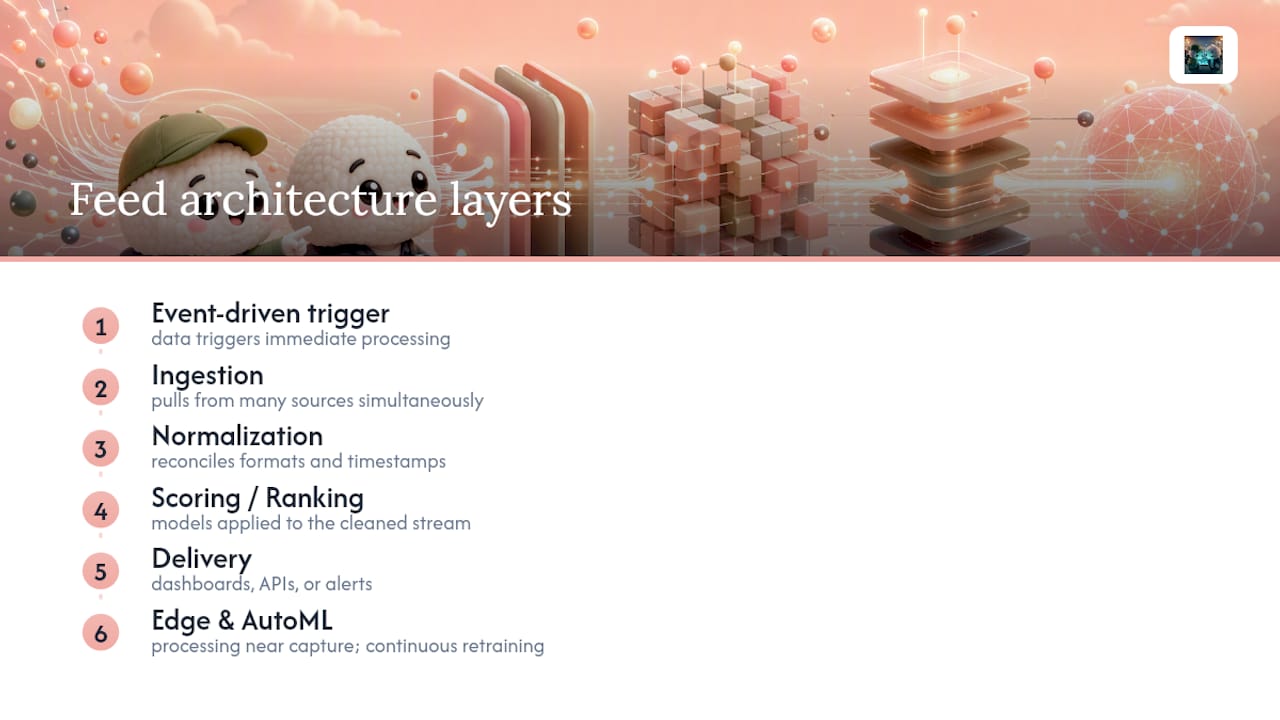
You don't need to build one of these systems, but knowing the shape of it helps you ask sharper vendor questions. Most consumer-facing market intelligence platforms sit on an event-driven architecture: incoming data (a tweet, a filing, a POS scan) triggers processing immediately rather than waiting for a scheduled batch job. That's the core distinction between a feed that's genuinely live and one that's merely "frequently updated."
Underneath, providers typically run a layered setup: an ingestion layer pulling from multiple sources simultaneously, a normalisation layer that reconciles formats and timestamps, a scoring or ranking engine that applies models to the cleaned stream, and a delivery layer pushing the result out through dashboards, APIs, or alerts. The specific technologies vary, but the pattern holds across the industry.
What's changed recently is where the processing happens. Edge computing is increasingly used to shrink the distance between data capture and analysis, while AutoML lets models retrain continuously rather than waiting for a scheduled update cycle. For you as a buyer, the architectural question that actually matters isn't "what stack do they use" but "how much of that stack is visible to me through documentation and sandbox access." A provider who can't explain their own pipeline in plain terms usually can't explain their own failures either.
Keeping a live feed reliable: the challenges vendors rarely mention upfront
Three problems recur across almost every real-time provider, and they're worth asking about directly rather than assuming they've been solved.
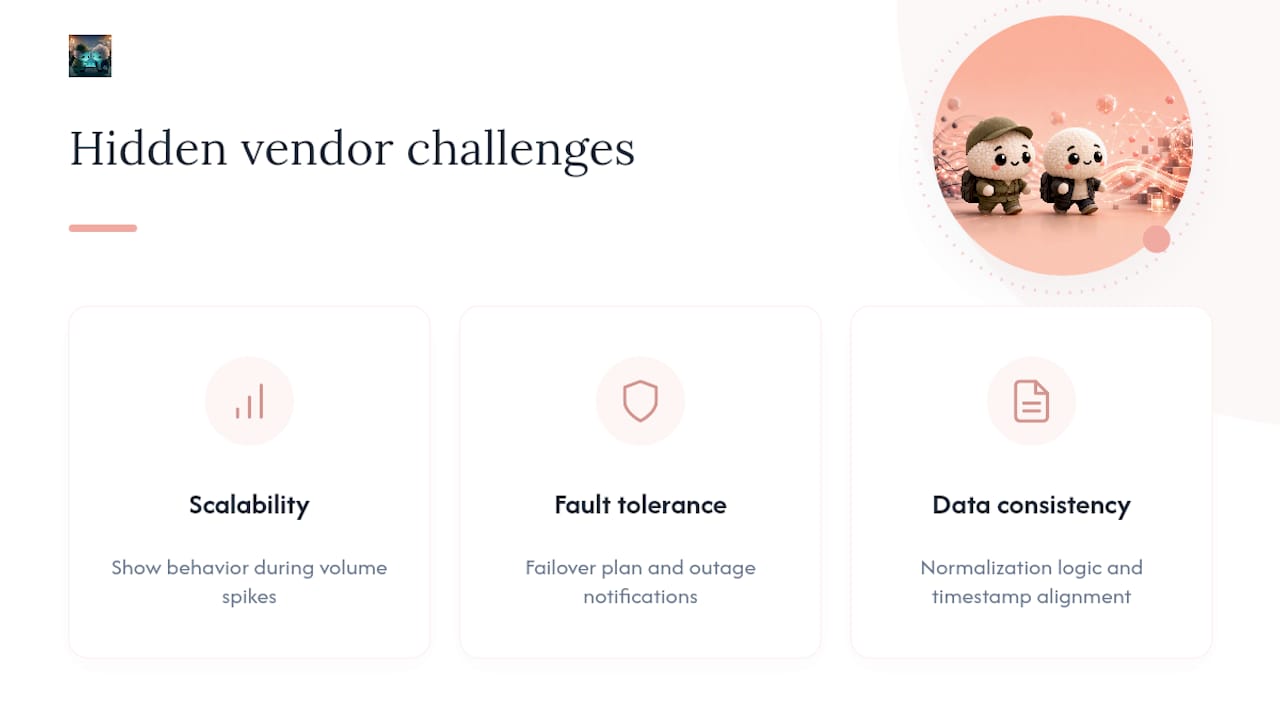
Scalability is the obvious one: a feed that performs well at low volume can degrade badly during a high-activity event, exactly when you need it most. Ask providers how their system behaves during volume spikes, not just on a normal Tuesday.
Fault tolerance matters more than most buyers realise until the first outage. A pipeline with no failover plan will simply go dark during a market-moving event, and you won't know whether the silence means "nothing is happening" or "the system is down." Ask what happens when a data source drops out mid-stream, and whether you'd be notified.
Data consistency is the quiet one. When multiple sources feed a single ranking, timestamp drift or format mismatches between sources can produce a ranking that looks confident but is built on slightly stale or misaligned inputs. The best providers show their normalisation logic openly rather than treating it as a black box.
Best practice on your side of the relationship is straightforward: ask for uptime history, ask what redundancy looks like, and treat a provider's willingness to discuss failure modes as a better signal of maturity than their marketing copy.
Data privacy and security: what to check before you connect a feed
Any pipeline ingesting social, web, and transactional data touches material that carries real privacy weight, even when the output is an anonymised trend score. Ask specifically how a provider handles personally identifiable information at the ingestion stage, since that's where risk concentrates before any anonymisation or aggregation happens downstream.
Access control matters just as much as ingestion practice. If your organisation is pulling signals through an API, confirm how credentials are scoped, whether data is encrypted in transit and at rest, and how long raw inputs are retained before deletion. A provider that can't answer these plainly is a provider you should be cautious about connecting to your execution systems.
Governance questions worth raising directly with any vendor: who audits their data sourcing, what happens to your query history, and whether your organisation's own usage patterns are ever aggregated into a training set without disclosure. None of this should feel like an obstacle. A provider confident in their practices will answer quickly and specifically, and hesitation on these questions is itself useful information.
Where real-time pipelines earn their keep across industries
The clearest use case is still trading and treasury, where HSBC frames AI market tools as synthesis engines that turn overwhelming data streams into scenario-based answers, cutting the need for internal engineering teams to build anything from scratch.
Outside pure finance, the applications spread further than most people expect:
- Retail and product teams use trend rankings to spot category momentum before it shows up in quarterly sales reports, adjusting inventory or marketing spend early
- Marketing teams track social sentiment shifts to catch a brand crisis or a viral moment while there's still time to respond
- Investor research desks use flow-based signals as an early read on institutional positioning, well before quarterly filings confirm it
- Crypto-focused teams rely on faster-moving feeds given how quickly sentiment translates into price action in that market
Real-time AI analytics has widened access to these tools well beyond large institutions, which is arguably the bigger story: signal access that used to require a trading desk's infrastructure budget is now something a small strategy team can subscribe to directly.
Author perspective: how market consumers should prioritise pipeline features
Most buyers rank features backwards. They chase model sophistication first and ask about latency last, when the evidence points the other way entirely. A brilliant model on a slow feed is just an expensive way to arrive late.
If I were prioritising a shortlist, low latency with transparent scoring would sit above everything else, because you can't retroactively fix a delay once the alpha has decayed. Right behind that: insist on validated feeds where you can run your own back-test against a sample dataset before paying for anything, rather than trusting a vendor's own performance claims.
The uncomfortable truth is that operational readiness inside your own team usually decides the outcome more than the feed does. The best signal in the world is worthless if it sits in an inbox for two hours before anyone reads it.
— Aidil
Try OnTheRice: your next step towards live, validated signals
The platform is designed for spotting a signal early, showing why it ranked the way it did, and allowing follow-up questions directly through live AI queries rather than waiting on a support ticket. The platform scans public data across multiple domains and aims to show its ranking logic transparently rather than hiding it behind a black-box score.

If you want to see how this works before committing anything, start by requesting sample signals through AI-driven opportunity feeds or browsing the live AI tools available on the platform. For anyone specifically tracking monetary or macro moves, the GlobalMoney feed is worth checking first, and crypto-focused readers should look at SignalsRisingCrypto for sector-specific rankings. Core browsing is free; deeper insight cards and premium feeds unlock through Access Points, so you can test the ranking quality yourself before spending anything.
Sources
- Speed Matters: Capturing Intraday Alpha from Real-Time Sentiment Shifts - Context Analytics
- How real-time flow intelligence is reshaping trading insight
- HSBC AI Markets: From Data to Decisions