
Yes, an AI chat is the right first tool for most early-stage market research jobs: persona drafts, competitor scans, hypothesis lists, survey guides. It is the wrong tool for anything you need to defend with a client, a board, or a regulator without checking it first. Pick one task, open ChatGPT, Claude, or a research-focused assistant, and run a one-hour pilot using one of the prompts below. If what you actually want is early signal detection across sectors rather than one-off chat answers, OnTheRice is built for that specific job.
Pro Tip: Time-box your first pilot to sixty minutes. If you haven't got a usable draft persona or competitor summary in that window, the prompt needs fixing, not the tool.
Key Takeaways
AI chat tools speed up secondary market research dramatically, but they require human verification before any output informs a real business decision.
| Point | Details |
|---|---|
| Start with a pilot | Run a one-hour test using a persona, competitor scan, or sentiment prompt before scaling up. |
| Separate secondary from primary research | Use chat for synthesis and hypotheses, not as a substitute for surveys or interviews. |
| Verify before you present | Cross-check every statistic or citation against a primary source before it reaches a deck. |
| Match the tool to the task | Plain chat suits drafting; retrieval-augmented or agentic tools suit tasks needing citations. |
| Move to continuous monitoring with OnTheRice | Use OnTheRice's ranked signal feeds when a one-off chat answer needs to become an ongoing watch. |
Table of Contents
- What is AI chat for market research?
- What tasks can an AI chat handle in market research?
- How do you run an AI-chat research workflow, step by step?
- How do you evaluate an AI chat setup for research work?
- What are the risks of using AI chat for research?
- What types of AI research tools are on the market?
- Where does an enterprise signal platform fit alongside chat tools?
- How should you adapt AI chat prompts for your industry?
- Ready to move from a one-off pilot to ongoing signal tracking?
- Frequently asked questions
- Sources
What is AI chat for market research?
AI chat for market research means using conversational large language models, search-augmented chat, and increasingly agentic assistants to gather, synthesise, and draft research outputs on demand. It covers everything from a plain ChatGPT conversation to retrieval-augmented tools that cite sources as they answer.
The distinction that matters most is quick secondary research versus primary research. An AI chat is excellent at synthesising what already exists: summarising competitor positioning, drafting a hypothesis list, sketching a buyer persona from scattered inputs. It cannot conduct a genuine survey, interview a real customer, or observe actual behaviour. Wharton's AI research guidance puts it plainly: these tools augment researchers, they do not replace the fieldwork.
Picture a product manager who needs an ideal customer profile by Friday. Instead of a two-week discovery sprint, they paste their existing customer notes and a competitor's pricing page into an AI chat and ask for:
- A draft ICP with firmographics and pain points
- A one-paragraph synthesis of how a named competitor positions against that profile
- Three testable hypotheses about unmet needs
That's a two-hour task instead of a two-week one, with the caveat that every claim still needs a human check before it reaches a deck.
What tasks can an AI chat handle in market research?
Six tasks consistently deliver value: buyer personas, competitor messaging synthesis, trend scanning, survey design, sentiment analysis, and hypothesis generation. Each one plays to what LLMs actually do well: pattern recognition and language synthesis across large amounts of text, fast.
Take three of the highest-value examples:
- Persona drafting. Feed in customer interview notes or CRM export summaries and ask for a structured persona with goals, objections, and buying triggers. Output looks like a one-page profile you'd normally spend a day building in a workshop.
- Competitor scan. Paste three competitors' homepage and pricing copy and ask the chat to synthesise shared claims, gaps, and differentiation angles. Output is a comparison table you can sanity-check against the source pages in minutes.
- Sentiment summary. Drop in fifty product reviews or support tickets and ask for the top three recurring complaints and the top two praised features. Output is a short bullet list, not a dashboard, but it tells you where to look next.
Generative models are particularly strong at this kind of automated synthesis of qualitative inputs, including building synthetic personas that stand in for a segment while you validate the real one.
There's no universal time saving figure worth quoting, but the qualitative pattern is consistent: tasks that used to take a day of manual reading and note-taking now take an hour of prompting and checking. Enterprise appetite for this kind of tooling is rising fast too. Gartner's outlook has worldwide IT spending growing 10.8% in 2026, much of it flowing into AI tooling and the infrastructure behind it. Move from chat to deeper, validated methods the moment a finding will inform a pricing decision, a funding pitch, or anything with legal exposure.
How do you run an AI-chat research workflow, step by step?
Four workflows cover most of what business professionals need from conversational AI research, using ChatGPT for market research style prompting: be specific, assign a role, and iterate rather than expecting a perfect answer first time.
1. Rapid ICP and persona creation
Paste in whatever customer data you have: sales call notes, support tickets, LinkedIn bios of existing clients.
Prompt: "You are a senior market researcher. Based on the customer notes below, draft an ideal customer profile including company size, role, top three pain points, and buying triggers. Flag any assumptions you're making due to missing data."
Expected output: a structured one-page persona with clearly marked assumptions. Validation check: cross-reference every "pain point" claim against at least one direct quote in your source notes.
2. Competitor messaging synthesis and gap analysis
Paste in the homepage and pricing page text of two or three competitors.
Prompt: "Act as a positioning strategist. Compare these three competitors' messaging. Identify shared claims, unique differentiators, and one gap in the market none of them are addressing."
Expected output: a short table plus a one-paragraph gap hypothesis. Validation check: visit each competitor page yourself to confirm the quoted claims are current.
3. Trend scan and signal extraction

Paste recent news headlines, forum threads, or search-trend snapshots related to your sector.
Prompt: "Review the following sources. Identify three emerging themes, rate each by how much supporting evidence appears across the sources, and note where evidence is thin."
Expected output: a ranked list of themes with a confidence note per theme. Validation check: for any theme rated high-confidence, trace it back to at least two independent sources.
4. Survey and interview guide generation
Describe your research question in one sentence.
Prompt: "I need to understand why mid-market SaaS buyers churn within the first ninety days. Draft a ten-question customer interview guide, then propose a simple coding framework for categorising open-text responses."
Expected output: a numbered question list plus three to five coding categories. Validation check: pilot the guide on two real customers before rolling it out.
Pro Tip: Front-load context before asking for output. Paste your data, state the role you want the model to play, then ask the question, in that order. Reversing the order produces vaguer answers.
Common anti-patterns to avoid:
- Asking one giant open-ended question instead of breaking the task into stepwise follow-ups
- Accepting a confident-sounding statistic without asking "what's this based on?"
- Skipping the role assignment, which tends to produce generic, textbook-style answers
For anything that resembles a claim with a number attached, run this quick verification pass: ask the model to cite its reasoning, check any factual claim against a primary source, and treat sample sizes or percentages as unverified until you've found them yourself. Newer agentic features, like ChatGPT's Deep Research on GPT-5.2, run multi-step searches and attach citations automatically, which cuts manual synthesis time but still needs a human checking those citations actually say what the summary claims.
How do you evaluate an AI chat setup for research work?
Not every conversational AI tool is built the same way, and the differences matter once you're relying on outputs for real decisions. Run any candidate tool or vendor through this checklist during a trial:
- Data sources. Does it tell you where an answer came from, or is it a black box?
- Citation transparency. Can you click through to the original source for any factual claim?
- Customisability. Can you adjust prompts, save templates, or build repeatable agent workflows for your specific sector?
- Security and access controls. Who else can see the data you paste in, and where is it stored?
- Integration. Can outputs export to CSV, connect via API, or feed into your existing dashboard rather than living only in a chat window?
Red flags worth walking away from: no citations at all, synthesis that can't be traced back to source text, or an export function that doesn't exist. A quick scoring rubric during a trial: score each criterion one to five, total them, and treat anything scoring under fifteen out of twenty-five as not ready for anything beyond casual exploration. Staged adoption, tested with clear guardrails before wider rollout, consistently beats an all-at-once switch.
What are the risks of using AI chat for research?
Four limitations show up repeatedly: hallucinations, out-of-date training data, no access to your proprietary datasets, and sampling bias when using synthetic respondents as stand-ins for real customers. None of these are reasons to avoid the tools. They're reasons to build verification into the workflow rather than treating chat output as finished research.
Ethically, two things deserve attention. First, if you're using synthetic personas or AI-generated "respondents" to simulate customer feedback, be transparent internally that it's a simulation, not real consent-based data collection. Second, be careful what you paste in: proprietary customer data or unreleased product details dropped into a public chat interface may not stay private, depending on the tool's terms.
- Cross-check any statistic the model gives you against a primary source before it reaches a slide
- Treat synthetic respondent output as a hypothesis generator, never as validated customer evidence
- Keep genuinely sensitive data out of consumer-grade chat tools entirely
Structured experimental framing measurably improves the reliability of inferences drawn from observational data, which is the academic case for exactly this kind of discipline.
Pro Tip: Keep a simple log: which claims came from AI synthesis, which came from a verified primary source. It takes thirty seconds per finding and saves you from an awkward conversation later.
What types of AI research tools are on the market?
Five broad categories cover almost everything you'll encounter, and knowing which one you're looking at tells you what it's actually good for.
- LLM chat interfaces (ChatGPT, Claude and similar): best for fast synthesis, drafting, and brainstorming; weakest on citation and up-to-date facts.
- Search-augmented, retrieval-based chat: pulls from live web sources and attaches citations, outperforming plain chat when currency and traceability matter, thanks to advances in retrieval-augmented generation.
- Agentic research assistants: run multi-step tasks autonomously, useful for scanning dozens of sources without manual prompting each one.
- Synthetic-respondent platforms: simulate consumer reactions at scale, useful for early-stage hypothesis testing before a real survey.
- Integrated signal and insight workbenches: combine multiple data feeds with dashboarding, best when you need ongoing monitoring rather than a one-off answer.
Most of these categories now export to CSV or connect via API, so outputs can feed into whatever dashboard or research stack you already run rather than sitting stranded in a chat log.
Where does an enterprise signal platform fit alongside chat tools?
Chat tools are excellent for one-off synthesis. They're weak at continuous monitoring across sectors, which is a different job entirely. That's the gap OnTheRice is built to fill: rather than asking a chatbot the same question every Monday, OnTheRice runs multiple AI engines constantly against public data to surface early signals with a transparent ranking, so you see momentum building before it's obvious.
Mapped against the workflows above:
- The trend scan workflow becomes continuous rather than manual. Instead of pasting headlines into a chat weekly, a live AI query surfaces the same category of signal automatically.
- The competitor and market gap analysis benefits from sector-specific feeds, whether that's general signals or a vertical example like culinary trend signals, giving a starting point richer than a single prompt's context window.
- The hypothesis generation step gets a transparency advantage: OnTheRice's ranking methodology is visible, so you can see why a signal scored the way it did rather than trusting an opaque summary.
Picture a strategist tracking an emerging category, say a niche wellness ingredient. A single chat prompt might summarise last week's headlines. A continuous signal feed would have flagged the early mentions three weeks earlier, before the trend had a name, giving the strategist a head start a one-off chat session structurally cannot provide.
How should you adapt AI chat prompts for your industry?
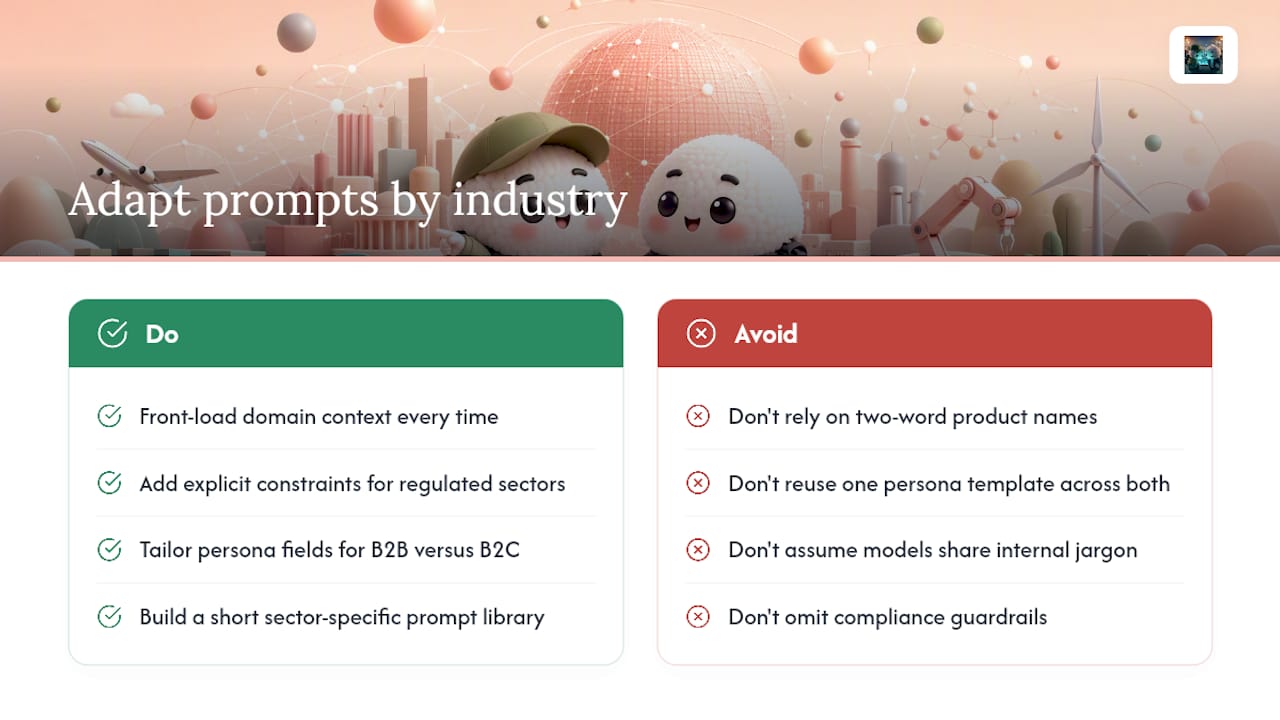
Generic prompts produce generic output. The fix is front-loading domain context every time, not hoping the model infers your industry from a two-word product name.
For regulated sectors like healthcare or financial services, add explicit constraints to every prompt: "Do not make clinical efficacy claims" or "Flag anything that would need compliance review before publication." This matters more than most researchers assume, because a model with no guardrail will happily generate a confident-sounding claim about drug interactions or investment returns that no compliance team would ever approve.
For B2B versus B2C research, the persona structure needs different fields entirely. A B2B prompt should ask for buying committee roles, procurement triggers, and contract cycle length. A B2C prompt needs household context, price sensitivity, and channel preference. Reusing one persona template across both produces a profile missing exactly the details that matter.
Build a short prompt library specific to your sector rather than starting from scratch each time. A single saved template covering "role plus context plus output format plus constraints" for your top three recurring research tasks, personas, competitor scans, and sentiment reviews, will save more time over a quarter than any individual clever prompt.
Industry-specific jargon also needs explicit definition. If your sector uses a term ambiguously (a "churn event" means something different in SaaS than in telecoms), define it in the prompt rather than assuming the model shares your internal shorthand. Vague terms produce vague, occasionally wrong, categorisation in sentiment and coding tasks.
A practitioner's starter experiment
Pick one real question this week: define it in a sentence, run two different prompts against it, verify one claim against a primary source, then revise the prompt and try again. Time-box it to an afternoon. Expect a rough draft output and one verified fact, nothing more. That's enough to know if the workflow is worth scaling.
Ready to move from a one-off pilot to ongoing signal tracking?
A single AI chat prompt answers one question, once. What most professionals actually need is the same question answered continuously, without re-prompting every week. OnTheRice extends exactly that pilot instinct into an always-on feed: once you've proven a workflow works with a manual chat prompt, the same category of signal can run automatically through OnTheRice's engines, scored and ranked, updating as new data lands rather than going stale the moment you close the chat window.
If your pilot surfaced a category worth watching, whether that's a product trend, a crypto signal, or a regional deal pattern, the next step is checking what's already live. Browse current signal feeds to see real examples of the ranking system in action, or go straight to AIOpportunities if you're ready to unlock deeper, gated insight beyond the free tier.
Frequently asked questions
Can ChatGPT replace a market research agency? No. It replaces some of the early secondary research an agency would do, drafting personas, summarising competitors, but it cannot run primary fieldwork, recruit real respondents, or take legal responsibility for findings the way a research firm does.
How accurate is AI chat for competitor analysis? It's only as accurate as the source text you provide and the model's training data. Always verify pricing, feature claims, and positioning statements against the competitor's live pages before publishing anything based on a chat summary.
Is it safe to paste customer data into an AI chat? Only if the tool's terms guarantee that data isn't used for model training and your organisation's data policy permits it. Treat consumer-grade chat tools as unsuitable for genuinely sensitive or proprietary customer information.
What's the difference between AI chat and a signal detection platform like OnTheRice? A chat tool answers a question once, when you ask it. A signal platform like OnTheRice runs continuously, scanning public data and updating rankings so you catch emerging trends without re-prompting manually every time.
This article is general information, not a substitute for advice from a qualified doctor. Consult a qualified healthcare professional about your own circumstances before acting on anything here.