
Data fusion for signals means combining heterogeneous public data — news, social chatter, search interest, registries, transactions — with AI models to surface early market and trend signals before they show up in headline numbers. The single practice that separates reliable systems from noisy ones is baseline-first, gated fusion: build a trusted time-series forecast first, then let event or text data in only when it demonstrably improves that forecast, a principle formalised in recent work like GS-Fuse. Everything else in this guide covers the mechanics of doing that properly, from ingestion to testing to failure recovery.
TL;DR:
- Accurate baseline forecasting from trusted time-series data is essential before incorporating event or text signals to prevent noise from misleading the system.
- Layered pipeline design with source tagging and appropriate refresh intervals reduces errors caused by stale or unreliable data sources.
- Formal testing methods, like loss-gap analysis, are necessary to verify whether text signals truly improve forecast accuracy.
- Common failure modes include missing data, source bias, duplicate amplification, and brittle integrations, which require redundancy, source weighting, and provenance audits.
- Gated fusion approaches outperform simple combination models by admitting auxiliary signals only when they demonstrably enhance the baseline forecast.
Table of Contents
- What is signal data integration and how does the pipeline work?
- Which fusion architectures actually combine market and event data well?
- How do you build canonical entities and a controlled vocabulary?
- How do you test whether a news signal actually improves forecasts?
- What are the most common failure modes in signal fusion systems?
- How do fused signals turn into alerts and decisions?
- What data fusion algorithms and techniques underpin signal detection?
- How do you approach multi-modal fusion across heterogeneous data types?
- Which metrics actually measure signal fusion performance?
- What determines whether a fusion system scales?
- An editorial take on where fusion pipelines actually go wrong
- How Ontherice turns this into a working feed
- Sources
- FAQ
What is signal data integration and how does the pipeline work?
Treat your pipeline as five distinct layers, not one big scrape. Naming the layers matters because each has different freshness needs, different failure modes, and different trust levels.
- Universe layer: the entities you track (companies, products, categories, geographies).
- Enrichment layer: registries, filings, job postings, patent data — slow-moving but high-trust.
- Events layer: news, social posts, search spikes — fast, noisy, high-volume.
- Financials/metrics layer: prices, volumes, transaction counts — the time-series backbone.
- Pipeline/delivery layer: the scoring, alerting, and output logic that ties everything together.
Cadence varies wildly across sources: registry data might refresh weekly, search interest hourly, social feeds by the minute. Operationally, expect rate limits, geo-gating, and IP trust scoring from most public APIs — polite crawling (respecting robots directives, spacing requests, rotating through legitimate access tiers) keeps you from getting blocked mid-analysis. NexGenData's guidance on building market-intelligence datasets makes the case that layered pipeline design, not the scraping itself, is where most projects succeed or fail. Every field entering the pipeline needs a source tag from day one, because retrofitting provenance later is far harder than logging it at ingestion.
Which fusion architectures actually combine market and event data well?
The pattern that holds up best in practice is baseline-first gating. You compute a forecast from trusted time-series data alone, then compute a second forecast that also has access to event text. If the augmented forecast doesn't meaningfully beat the baseline, the gate stays shut and the text gets ignored for that instance. GS-Fuse formalises exactly this idea with a Granger-supervised gate: it treats the gap between restricted and unrestricted forecasts as a training signal, teaching the model when event data genuinely helps rather than just adds noise.
A related approach, MSGCA, uses gated cross-attention to progressively integrate indicator sequences, dynamic documents, and relational graphs rather than mashing every modality together at once. The "progressive" part matters. Fusing three or four data types simultaneously tends to produce unstable models that overfit to whichever modality has the loudest signal in training. MSGCA's staged integration keeps each modality's contribution auditable.
Both approaches depend on alignment. Instance alignment means matching an event to the correct entity and time window; token or time alignment means matching the granularity of text (a headline, published at 09:14) to the granularity of your time series (a five-minute price bar, or a daily volume count). Get this wrong and you'll correlate Tuesday's news with Wednesday's price move, which is a fast way to convince yourself a coincidence is a causal signal. The trade-off is straightforward: finer alignment gives sharper causal claims but costs latency and computational overhead, so most production systems settle on the coarsest granularity that still catches the effect they're testing for.
How do you build canonical entities and a controlled vocabulary?
Heterogeneous sources describe the same entity in different ways. A regulatory filing might use a full legal name; a news article uses a nickname; a job posting uses a subsidiary brand. Multi-source data fusion collapses without a consistent way to resolve these into one canonical record.
Start by defining canonical dimensions before you write any matching logic:
- Market and category — a fixed taxonomy, not free text, so a "fintech" tag means the same thing everywhere.
- Geography — standardised at a consistent granularity (country, region, or city, chosen once and applied everywhere).
- Forecast period — the time horizon a signal claims to predict (next week, next quarter).
- Outcome labels — a controlled vocabulary for direction (rising, falling, stable) rather than free-text sentiment.
For entity resolution itself, Coronium's aggregation guidance recommends picking one canonical key per entity type, fuzzy-matching candidate records against it, and logging every merge decision so a human can review and undo a bad match later. Silent auto-merging is how two similarly named companies end up sharing a signal history.
Pro Tip: Attach a source URL and a fetch timestamp to every single field, not just every record. When a signal looks wrong six weeks later, you want to know exactly which source and which moment produced that one number, not just which batch job ran.
Schedule refresh intervals per source and add drift alerts, so a registry that stops updating doesn't silently go stale while your pipeline keeps treating it as current.
How do you test whether a news signal actually improves forecasts?
This is where most teams either overtrust or completely dismiss text-derived signals, usually because they never ran a proper test. The rigorous version borrows directly from Granger causality: build a restricted forecast using only the trusted time series, then an unrestricted forecast that also has access to the candidate signal, using the same decoder for both. The gap between their losses is your evidence. GS-Fuse turns that loss-gap into a supervision signal for the gate itself, so the model learns case by case when the auxiliary data earns its place.
The heartbeat matters as much as the model. GDELT's real-time detection approach compares the past hour of mention volume against the previous three days, refreshed on a 15-minute cadence. That short window against a longer baseline is what catches a glimmer before it becomes obvious to everyone.
Run this as a rolling-window, out-of-sample backtest rather than a single train/test split, since a signal that worked in one quarter can decay fast. Track three metrics on an ongoing basis: the loss-gap itself, detection precision and recall against known events, and signal persistence (does the signal keep firing for the same underlying event, or was it a one-off spike?). Be cautious with sample size. Low-volume, early-stage signals by definition don't have much history, and a gate trained on too few true positives will overfit to noise that happened to correlate once.
What are the most common failure modes in signal fusion systems?
Systematic reviews of AI-driven early-warning systems consistently point to the same recurring problems: incomplete or fragmented data, bias baked into which sources get monitored, black-box scoring that nobody can explain, and integration failures when systems built independently try to talk to each other.
- Missing data: a source goes dark (rate-limited, deprecated API, paywalled) and the gap looks like a real absence of activity rather than a collection failure.
- Bias: monitoring English-language, US-heavy sources by default means signals from other markets systematically arrive late or not at all.
- Duplicate wire amplification: one wire story gets syndicated across fifty outlets, and a naive volume count mistakes that for fifty independent confirmations.
- Brittle integrations: a downstream dashboard breaks silently when an upstream schema changes a field name.
Mitigate with redundancy across sources rather than single-point dependence, down-weight sources with a history of unreliability instead of dropping them outright, and run periodic provenance audits to catch drift before users do.
Pro Tip: Build graceful degradation into the pipeline: if one enrichment source fails, the system should keep scoring on the layers that still work and flag the gap, rather than halting the whole feed.
Human-in-the-loop triage for anything above a certain confidence threshold catches the false positives that automated gates alone will miss.
How do fused signals turn into alerts and decisions?
A raw fused signal isn't an action. It moves through a lifecycle: a glimmer (a single anomalous mention or data point), then a weak signal (repeated but sparse), then trajectory analysis (is it accelerating, plateauing, or fading), then finally a decision threshold that triggers an alert.
- Singleton trajectories — one-off spikes that rarely warrant action; treat these as noise unless corroborated.
- Sparse recurrent trajectories — intermittent recurrence over weeks, often the profile of a genuinely emerging trend worth tracking closely.
- Mega-cluster trajectories — rapid convergence across many independent sources at once, the pattern structure-based emergence detection is designed to catch roughly 18 hours earlier than simple volume counts in retrospective testing.
Alert design has to account for persistence windows (don't fire on a single data point), deduplication (collapse the fifty-outlet wire story into one event), and explainability (an analyst should be able to click through and see exactly which sources triggered the alert). Practical downstream integration, whether that's a Slack feed, a dashboard, or an export into a research workflow, is what separates a research prototype from something teams actually use daily.
What data fusion algorithms and techniques underpin signal detection?
Most signal fusion architectures draw on a small set of established statistical techniques, adapted for market and text data rather than sensor streams. Bayesian methods update a belief about an entity's trajectory as new evidence arrives, weighting each new observation by its reliability against a prior distribution, useful when sources vary widely in trustworthiness. Dempster-Shafer theory goes a step further by explicitly modelling uncertainty and conflict between sources, rather than forcing every piece of evidence into a single probability, which suits situations where two sources flatly contradict each other and you need to represent that disagreement rather than average it away.
Kalman filtering, originally built for tracking physical systems, has found a second life in market-signal contexts as a way to smooth noisy sequential estimates (like a rolling sentiment score) while still reacting quickly to genuine shifts. It works well when you have a reasonably continuous underlying process and want to filter jitter without lagging behind real moves.
Gated neural approaches, including GS-Fuse and MSGCA discussed earlier, are the more recent addition to this toolkit. They don't replace Bayesian or Kalman-style methods so much as sit alongside them: a Kalman filter might smooth your baseline time series, while a Granger-supervised gate decides whether text-derived features get admitted on top of that smoothed baseline. In practice, the most resilient systems combine the older statistical rigour of Bayesian updating with the newer gating mechanisms rather than betting everything on one technique. Each has a different failure mode: Bayesian methods struggle when priors are badly specified, Dempster-Shafer combination rules can produce counterintuitive results under high conflict, and Kalman filters assume a linearity that market data doesn't always respect.
How do you approach multi-modal fusion across heterogeneous data types?
Three broad strategies dominate multimodal signal fusion, and the choice between them comes down to how much you trust each modality independently. Early fusion concatenates raw or lightly processed features from every source before any modelling happens, which is simple but lets a noisy modality dominate if it isn't carefully weighted. Late fusion runs separate models per modality and combines their outputs (often just an average or a learned weighting), which keeps modalities independent and easy to debug, but misses interactions between them.

Hybrid or gated fusion, the approach behind both GS-Fuse and MSGCA, sits between the two: it processes modalities somewhat independently but uses a learned gate or attention mechanism to decide how much each one contributes to the final output, instance by instance. This is why gated approaches have become the practical default for high-stakes forecasting. They keep the interpretability advantages of late fusion (you can inspect what the gate decided) while still capturing cross-modal interaction when it genuinely exists.
A practical rule of thumb: use early fusion when your sources are similarly reliable and similarly scaled, use late fusion when you need to debug each modality independently or one source has intermittent outages, and use gated fusion when you specifically suspect that one modality (usually event text) is only sometimes useful and you need the model to learn that conditionality rather than assume it.
Which metrics actually measure signal fusion performance?
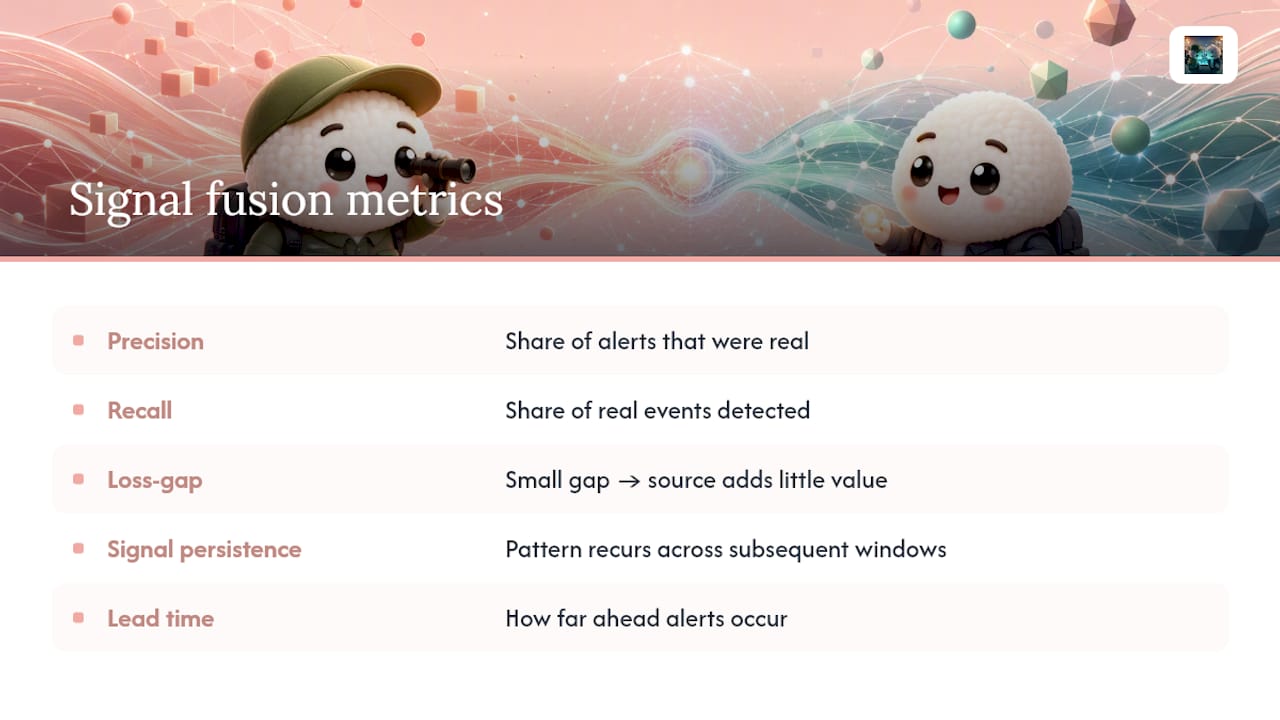
Standard forecasting metrics like mean absolute error tell you almost nothing useful on their own for early-signal detection, because the interesting cases are rare by definition. Detection precision and recall against a labelled set of known past events matter far more: precision tells you how many alerts were real, recall tells you how many real events you caught at all.
The loss-gap between restricted and unrestricted forecasts, the same figure that supervises the GS-Fuse gate, doubles as an evaluation metric in its own right: a persistently small gap across a whole source category suggests that source isn't earning its place in the pipeline and could be down-weighted or dropped.
Signal persistence measures whether a detected pattern keeps recurring for the same underlying event over subsequent windows, distinguishing a genuine emerging trend from a one-off spike that happened to clear the threshold once. Lead time, how far ahead of a confirmed event a system flagged it, is the metric investors and strategists care about most directly, though it's only meaningful when measured against a clearly defined ground-truth event log, which is harder to build than it sounds.
There's no single industry-standard benchmark dataset for market and trend signal fusion the way there is for image classification, largely because "ground truth" for an emerging trend is inherently fuzzy and often only confirmed retrospectively. That absence is itself worth noting: any evaluation claim in this space should specify exactly what counted as a true positive and over what window, because two teams using the phrase "90% precision" can mean very different things.
What determines whether a fusion system scales?
The computational bottleneck in signal fusion is rarely the model architecture itself; it's the entity-resolution and alignment steps that run before any model sees the data. Fuzzy-matching millions of entity mentions against a canonical registry, per Coronium's aggregation research, scales far worse than the downstream forecasting model if it isn't indexed properly from the start.
Real-time fusion and batch fusion trade off differently at scale. Real-time pipelines (the GDELT-style rolling-window approach covered earlier) need low-latency access to recent data and tolerate some imprecision in exchange for speed. Batch fusion can afford heavier processing, like full-cluster structural analysis, because it runs on a schedule rather than under a latency budget. Most production systems run both: a fast, coarse real-time layer for alerting, and a slower batch layer that periodically re-scores and corrects the real-time output.
As source count grows, the practical scaling question becomes less "can the model handle more data" and more "can the ingestion and canonicalisation layer keep up without falling behind its own refresh schedule." A pipeline that misses its refresh window for even one high-volume source starts serving stale data that looks current, which is a worse failure than an outright outage because nothing visibly breaks.
An editorial take on where fusion pipelines actually go wrong
Most teams building signal systems obsess over model architecture and underinvest in the boring parts: entity resolution, provenance, and knowing when to say no to a data source. The GS-Fuse and MSGCA papers get attention because gating is elegant, but the gate is only as good as the baseline it's gating against, and plenty of teams skip building a solid baseline because it feels like the less interesting half of the problem.
Applying gated fusion and multi-engine scoring has reinforced one lesson repeatedly: transparency about why a signal fired matters more to users than raw accuracy claims... The commitment that matters most is simple: every score should trace back to sources a user can inspect themselves.
— Aidil
How Ontherice turns this into a working feed
Baseline-first, gated fusion is run in production, not just as a research pattern. Multiple AI engines score sectors independently, a transparent ranking system shows the provenance behind each result, and live AI queries let you ask directly why a particular trend surfaced.

If building and maintaining your own entity resolution, gating, and alerting stack sounds like months of engineering you'd rather skip, a platform provides a ready-made pipeline. The GeneralSignals feed is a starting point for teams wanting broad market coverage without building bespoke infrastructure, while a rankings engine shows the mechanics behind how sector scores get generated and updated. Try a live query against a sector you already track, compare it against your own baseline expectations, and see whether the gated signal adds anything your current process misses.
Sources
Text dominates most discussions of signal fusion for markets, but it's far from the only input worth structuring into a pipeline. Sensor-adjacent data, in a market-intelligence context, means things like point-of-sale transaction counts, foot-traffic proxies from location data, and IoT-derived shipping or logistics feeds. These behave more like continuous time series than discrete text events, which is precisely why they pair well with Kalman-style smoothing.
Audio signals show up increasingly through earnings-call transcripts and tone analysis, podcast mentions, and customer-service call volume as a proxy for product issues. The raw audio itself rarely gets fused directly; what matters is the transcribed and tagged output, treated as another text-like event stream once processed.
Video and image streams contribute in narrower but real ways: satellite imagery for tracking industrial activity or shipping congestion, and social video engagement metrics as a leading indicator for consumer product interest. These sources tend to arrive at much lower frequency and higher cost than text or search data, so most practical pipelines treat them as periodic enrichment rather than real-time inputs.
The unifying challenge across all these source types is the same one covered earlier for text: alignment. A satellite pass every few days has to be matched to the right time window in a daily price series, and a podcast mention timestamped to the minute needs to line up with market hours, not just calendar dates. Treating every non-textual source as "just another modality" without solving that alignment problem first is how fusion systems end up correlating noise.
- {GS-Fuse}: Granger-Supervised Gated Fusion and Multi-Granularity Alignment for Event-Driven Financial Forecasting
- Identifying breaking online news stories across the world in realtime with the GCP Timeseries Insights API & Natural Language API
- Systematic review of AI in early warning systems (Frontiers/PMC literature)
- Early Warning SIDM (information-geometry approach to emergent article clusters)
- Coronium
FAQ
What Is Data Fusion for Signals?
It means combining heterogeneous public data sources, such as news, social activity, search interest, and registries, with AI models to detect early market or trend signals before they become obvious in mainstream indicators.
What Is Gated Fusion and Why Does It Matter?
Gated fusion only admits an auxiliary data source, like event text, into a forecast when it demonstrably improves accuracy over a trusted baseline, a principle formalised by GS-Fuse using Granger-style supervision.
How Do You Test if a News Signal Improves Forecasts?
Compare a restricted forecast (time series only) against an unrestricted forecast (time series plus the candidate signal) using the same decoder, then use the loss difference as evidence the signal adds real value.
What Is the Biggest Failure Mode in Signal Fusion Systems?
Data incompleteness and bias in source coverage rank among the most common problems identified in systematic reviews of AI-driven early-warning systems, often compounded by black-box scoring that nobody can explain.
Can OnTheRice Help Me Apply These Fusion Techniques Without Building My Own Pipeline?
Yes. Ontherice runs multi-engine, gated scoring in production with transparent provenance, giving teams a ready-made feed such as GeneralSignals instead of building entity resolution and gating infrastructure from scratch.