
Automated competitive intelligence uses AI models and connected data pipelines to watch competitor and market signals around the clock, then surfaces prioritised alerts instead of raw noise. The core value is cadence: you stop waiting for quarterly reports and start seeing pricing changes, product launches, and sentiment shifts within hours. It works best as a detection layer feeding human judgement, not a replacement for analyst thinking.
TL;DR:
- Automated intelligence provides faster detection of pricing changes, product launches, and market shifts, delivering structured alerts with impact scores rather than cluttered reports.
- Building an effective system requires mapping existing data sources, focusing on relevant signals, and implementing human review gates to prevent false positives.
- Prioritizing signals like pricing or product updates over broader monitoring yields quicker value, but manual interpretation remains essential for assessing strategic significance.
- Deployment success depends on phased implementation, clear stakeholder involvement, and integration into existing decision-making routines rather than standalone dashboards.
- Human oversight is crucial to interpret signals accurately, especially when automation flags ambiguous or strategic signals that require market context and judgment.
Table of Contents
- What is automated (AI-driven) competitive intelligence?
- Core components and architecture of an automated CI pipeline
- Where automated competitive intelligence pays off fastest
- What automation gets right, and where it falls short
- How to implement automated CI: a practical rollout checklist
- How Ontherice maps to these best practices
- Fitting automated signals into your existing BI stack
- Getting your team to actually use the system
- Comparing platform types: what you're actually choosing between
- Practitioner perspective: automate detection, keep humans on interpretation
- Start seeing market signals before your competitors announce them
- Sources
What is automated (AI-driven) competitive intelligence?
Traditional competitive intelligence relies on someone manually checking competitor websites, pricing pages, and press releases on a schedule, usually weekly or monthly, then compiling findings into a slide deck that's often stale by the time anyone reads it. Automated competitive intelligence replaces that cadence with continuous scanning: software watches defined sources permanently, flags meaningful changes, and pushes structured outputs to the people who need them.
The shift isn't just speed. It's structure. A manual process produces a document. An automated one produces a data stream with a shape: severity scores, source links, timestamps, and suggested actions attached to each item.
What actually lands in an analyst's inbox or dashboard looks like this:
- Change alerts — a competitor dropped their price, changed a headline, or added a feature page
- Trend digests — aggregated signals across a market segment over a rolling window
- Prioritised action items — flagged items ranked by likely business impact, not just recency
- Historical comparisons — a timeline showing how a competitor's positioning shifted over months
Gartner's overview of competitive and market intelligence tools notes that this category is centralising tracking from news, social platforms, websites, and regulatory filings into single platforms, moving away from the old model of separate manual checks across scattered tools. The outcome expectation should be modest but real: fewer surprises, faster reaction time, and analyst hours redirected from data collection towards interpretation.
Core components and architecture of an automated CI pipeline
Building or buying an automated system means understanding five layers, whether you assemble them yourself or get them bundled into one platform.
- Data sources. Competitor websites, app store listings, social channels, ad libraries, job postings, and public filings all carry signal. Job listings alone often reveal a competitor's next move (a sudden wave of "senior AI engineer" postings tells you something a press release never will) before it's announced anywhere else.
- Ingestion and enrichment. Scraping and API connectors pull raw data in, proxies keep collection stable at scale, and normalisation turns messy HTML or PDF text into structured records with entities tagged (company, product, price, date).
- Processing. This is where agents and models do the actual work: change-detection logic spots what's different from last time, NLP classifies sentiment and intent, and scoring models rank how much a given change matters.
- Delivery. Alerts, dashboards, and exports push findings to Slack, email, or a business intelligence tool, sometimes routing into a ticketing system for follow-up.
- Operational guardrails. Rate limits, data quality checks, and legal review of what can be collected and how, sit underneath everything else.
Some platforms now run this as parallel specialised agents rather than one monolithic script, each handling a slice of the workflow (pricing, ads, hiring signals) and a synthesiser stitching the outputs into one report. Morning Consult's work on AI agents in market research and similar tools from Softstack Research both describe this pattern: multiple agents working concurrently, then a final pass that produces a cited, decision-ready summary rather than a pile of disconnected data points.
Pro Tip: Before you build anything, map which of the five layers you already own. Most teams have data sources and delivery channels (Slack, email) sorted. The gap is almost always in processing, which is exactly where AI adds the most value and where off-the-shelf platforms save the most build time.
Where automated competitive intelligence pays off fastest
Not every signal type deserves the same investment. Some use cases return value within weeks; others need months of tuning before they're trustworthy.
- Pricing and promotion detection. Set a threshold for price moves rather than alerting on every small change, or you'll drown analysts in noise within a short time.
- Product and feature monitoring. Watching changelog pages, app store updates, and release notes catches roadmap direction before a competitor's marketing team announces it.
- Content, ad, and SEO monitoring. Semrush's .Trends product demonstrates how automated tracking of ad copy, keyword targeting, and traffic shifts exposes a competitor's messaging pivot, often before it shows up anywhere else.
- Trend and early-entrant detection. Scanning for new company registrations, funding announcements, and patent filings in your category gives strategy and M&A teams a longer runway.
- Reputation monitoring. Sudden spikes in negative review volume or social mentions act as an early warning system for a brewing crisis, either yours or a competitor's you can capitalise on.
The common thread across all five is that automation handles the scanning, but someone still has to decide what a signal means for your roadmap, pricing, or messaging. A price drop could be a permanent repositioning or a one-week flash sale; only a human with market context tells the difference.
What automation gets right, and where it falls short
The upside is genuine: automated systems cover more ground than any analyst team could manage manually, and they do it reproducibly, checking the same sources the same way every single day without fatigue or inconsistency.
The downside is just as real. Automated pipelines generate false positives, especially early on, when thresholds are too loose. Models carry the bias of their training data and can miss signals that don't fit expected patterns, such as a competitor's move communicated only through an obscure regional press release. Scraping also raises legal and ethical questions: not every data source is fair game, and rules vary by jurisdiction and by what a website's own terms permit.
The 2025 AI Index from Stanford HAI documents rapid growth in AI capability and adoption across industries, and flags governance as the trailing concern that hasn't kept pace with deployment speed.
That gap between adoption and governance is exactly where competitive intelligence programmes get into trouble if they skip human oversight and governance.
Recommended mitigations:
- Set human review gates before any automated signal triggers a business decision.
- Audit alert accuracy monthly and retune thresholds that produce too many false positives.
- Document data collection sources and retention rules for legal review.
- Segment your competitive set into tiers so automation isn't scanning irrelevant noise (more on this below).
McKinsey's research on the state of AI makes a similar point about enterprise deployments generally: speed and scope improve dramatically with automation, but only when governance keeps the output trustworthy enough to act on.
How to implement automated CI: a practical rollout checklist
Most failed rollouts share one root cause: the team tried to monitor everything at once. A phased approach works better.
- Define and tier your competitive set. Split competitors into direct, adjacent, and potential entrants. Practitioner guidance from Semrush consistently points to tiering as the single biggest lever for reducing noise, because a feed watching thirty loosely related companies produces mostly irrelevant chatter.
- Pick signals that map to actions. If a pricing alert doesn't trigger a pricing review meeting, it's not worth collecting. Tie every signal type to a named owner and a defined next step.
- Assemble or select your stack. Decide whether to build connectors and agents in-house or adopt an integrated platform; comparing AI-native platforms against augmented systems is worth doing before committing budget either way.
- Set validation workflows. Every alert above a severity threshold should route to a human for a quick sanity check before it reaches a decision-maker.
- Tune thresholds over the first month. Expect to adjust alert sensitivity weekly at first as you learn what "material" actually means for your market. A checklist for scoping a competitive intelligence programme can shortcut this trial-and-error phase.
- Measure pilot success properly. Track time-to-first-signal, the precision rate of alerts (how many were actually useful), and hours of analyst time saved, not just raw coverage numbers.
Pro Tip: Run your pilot against one competitor tier only for the first six weeks. Teams that try to cover the full competitive landscape from day one almost always abandon the project within a quarter because tuning thirty feeds simultaneously is unmanageable.
How Ontherice maps to these best practices
A platform can run multiple AI engines in parallel to scan noisy public data and extract structured, ranked signals, using a multi-agent pattern common among capable tools. Transparency can be central to such a model: rankings and scores may come with visible reasoning rather than a black-box number, and users might query live AI directly about specific trends or signals instead of waiting for scheduled reports.

That interactive layer matters for the human-review step covered above. Instead of an analyst digging through raw data to sanity-check an alert, they can ask the system directly why a signal ranked where it did.
A few starting points worth exploring:
- Review the competitive insight checklist for business strategists before scoping a pilot.
- Compare platform types in the market insights software breakdown if you're weighing build versus buy.
- Treat any pilot as a time-to-value test, not a feature checklist, and measure it against the metrics outlined above.
Fitting automated signals into your existing BI stack
Automated competitive intelligence rarely works well as a standalone dashboard nobody checks. It earns its budget when the signals it produces flow into the systems your team already uses for decisions, pricing tools, CRM platforms, and existing business intelligence dashboards.
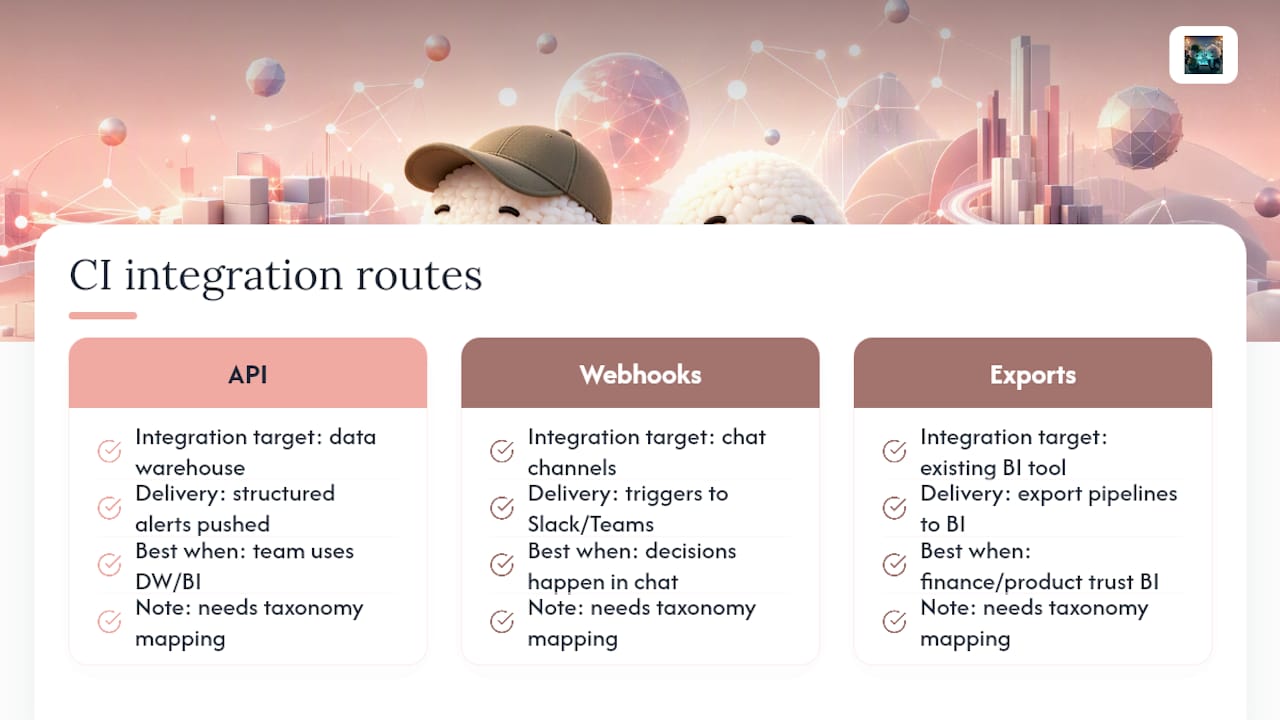
Most integrations happen through one of three routes: direct API connections that push structured alerts into a data warehouse, webhook triggers that fire into Slack or Microsoft Teams channels where decisions actually happen, or export pipelines that land data in the same BI tool your finance and product teams already trust. The choice depends less on technical preference and more on where your team's attention already lives. A signal that requires someone to open a fifth tool gets ignored within a fortnight.
The harder integration challenge is semantic, not technical: aligning competitor signal categories with your internal reporting taxonomy. If your BI dashboard tracks "market share" and your CI feed tracks "competitor pricing moves," someone has to define how the two connect before the data becomes decision-ready rather than just another data source sitting unused.
A workable pattern is to treat automated CI as an upstream feed into existing decision cadences, weekly pricing reviews, monthly product roadmap meetings, rather than creating a new standalone review process. Signals that don't have a home in an existing meeting tend to get lost regardless of how well the underlying pipeline works.
Getting your team to actually use the system
The best automated CI pipeline in the world fails if analysts keep doing manual checks out of habit, or worse, distrust of the new alerts. Adoption problems are rarely technical; they're behavioural.
Start by involving the analysts who'll use the system daily in the threshold-setting phase covered earlier, rather than handing them a finished tool. People trust systems they helped tune far more than ones imposed from above. Run a short training session focused specifically on how to interpret a severity score and what action each alert tier should trigger, not a generic software walkthrough.
Expect a transition period where the team runs both the old manual process and the new automated feed in parallel for two to four weeks. This isn't wasted effort: it builds confidence in the new system's accuracy while giving you a real comparison of what automation catches that manual checks missed, and vice versa.
Nominate a single internal champion, ideally someone respected on the analyst team rather than a manager, to field questions and flag tuning issues during the first month. Adoption tends to stall when troubleshooting funnels through IT tickets instead of a person who understands both the tool and the market context.
Comparing platform types: what you're actually choosing between
Automated competitive intelligence platforms split roughly into three categories, each with real trade-offs rather than a clean winner.
Enterprise-grade market intelligence suites offer the broadest data source coverage and the deepest BI integrations, built for large teams tracking dozens of competitors across multiple regions. The trade-off is cost and complexity: these platforms typically need dedicated administration and a longer onboarding period before value shows up.
Focused monitoring tools specialise in one signal type, pricing, ads, or SEO, and do that one thing with more precision than a generalist platform. They're cheaper and faster to deploy, but you'll likely need two or three of them stitched together to cover the full picture, which reintroduces the integration problem covered above.
AI-native signal platforms lean on multiple AI engines to extract and rank signals across broader categories with less manual configuration upfront, trading some of the deep customisation of enterprise suites for faster time-to-first-signal and lower setup overhead. This is the category Ontherice sits in, and it tends to suit teams that want breadth across markets without a lengthy implementation project.
None of these is universally correct. The right choice depends on how many competitors you're tracking, how much engineering time you can dedicate to integration, and whether speed to first signal matters more than granular customisation.
Practitioner perspective: automate detection, keep humans on interpretation
The rule that actually holds up under pressure: automate the scanning, keep humans on the "so what." A price drop, a hiring surge, a sudden ad spend spike, these are pattern-matching tasks automation handles well. Deciding whether that price drop signals a permanent repositioning or a clearance sale needs someone who understands the competitor's balance sheet and history, not just their webpage.
A workable split is roughly 80/20: automation covers the broad, repetitive detection work; analysts spend their reclaimed time on the 20% of signals that carry genuine strategic weight. Signals involving intent, tone, or ambiguous context (a cryptic executive tweet, a vaguely worded press release) still need a human read. Harvard Business School's research on AI and human judgement backs this framing directly: AI structures and surfaces, people interpret and decide.
— Aidil
Start seeing market signals before your competitors announce them
Such a tool can offer continuous, AI-driven scanning across finance, products, technology, and brand categories, with transparent scoring that users can interrogate instead of a black-box number they have to trust blindly.
Where most tools hand you a dashboard and leave interpretation entirely up to you, Ontherice lets you query the live AI directly about why a signal ranked where it did, closing the gap between detection and understanding that the rest of this guide has been about. That interactive layer is what turns a raw alert feed into something an analyst can actually act on within minutes rather than hours.
If you're weighing a pilot, start with a narrow tier of competitors and a specific signal type you already care about, pricing, product launches, or early market entrants. Explore the AIOpportunities feed to see how premium signals surface ahead of mainstream coverage, or check the AI tools and connectors landing page to understand what's available before you commit budget to a wider rollout.
Sources
- Harvard Business School: Artificial intelligence — human judgement drives innovation
- Gartner: Competitive and Market Intelligence Tools (reviews and market overview)
- Stanford HAI: 2025 AI Index report